

AI has moved from novelty to standard equipment in litigation practice. A majority of surveyed federal judges now use at least one AI tool in their own chambers, all fifty states have taken up AI legislation, and firms that adopted litigation support software early are clearing document-heavy work in a fraction of the time it used to take. The attorneys at a disadvantage are the ones still treating AI as something to avoid rather than something to govern.
The ethical rules for using it are not new. They are the same professional duties you already carry (competence, confidentiality, candor, supervision, and reasonable fees) applied to a tool that did not exist when those duties were written. Compliance comes down to five things: understand how your AI tools work, verify output before it reaches a court or a client, protect confidential data by choosing the right platform, supervise everyone on your team who uses AI, and bill honestly for AI-assisted work. None of that is difficult once you have the right setup.
At DocuLex, we built our platform around these obligations because our founder, Jason Melancon, carries them himself as a civil litigation attorney with over 20 years of trial experience. We hold a Business Associate Agreement with OpenAI, so medical data processed through the platform is not retained after analysis. When your AI is built by someone whose own law license depends on getting compliance right, the security architecture and verification workflows reflect that reality from the ground up.
This guide walks through each obligation with specific examples from litigation practice, including document generation, medical records processing, discovery, and court filings, so you can put AI to work and stay on the right side of every bar association and court rule in the country.
How Do Existing Ethics Rules Apply to AI in Litigation?
The American Bar Association consolidated the profession’s approach to generative AI with Formal Opinion 512, which maps AI usage to six existing Model Rules:
- Rule 1.1 (Competence): Attorneys must understand the capabilities and limitations of the AI tools they use.
- Rule 1.6 (Confidentiality): Client data entered into AI systems must be protected from unauthorized disclosure.
- Rule 1.4 (Communication): Clients must be informed when AI is used in their representation, particularly if the AI platform uses client data for training.
- Rule 3.3 (Candor to the Tribunal): Every citation and factual assertion in a court filing must be verified, regardless of whether AI generated it.
- Rule 5.3 (Supervision): Attorneys are responsible for the AI-assisted work product of associates, paralegals, and staff.
- Rule 1.5 (Fees): AI-driven efficiency gains must be reflected in billing. Attorneys cannot charge clients for work that took two hours as if it took twenty.
The through-line is simple: the attorney signs the filing and owns everything in it. The firms that adopt AI well treat that as the reason to choose tools that make verification easy and keep client data protected, rather than a reason to sit on the sidelines.
What Does the Duty of Competence Require When Using AI?
Rule 1.1 has always required attorneys to stay current with changes relevant to their practice. Since 2012, the ABA’s comments to Rule 1.1 have explicitly included technology competence. In 2026, that means understanding how generative AI models produce output and where they fall short.
Tool Quality Varies, and That Is Why the Right Platform Matters
Not all AI tools are built the same, and the gap shows up most clearly in accuracy. A Stanford and Yale study published in 2025 tested leading general-purpose legal research platforms and found hallucination rates between 17% and 33%, even in tools using Retrieval-Augmented Generation (RAG) architecture.
| Platform Tested | Accuracy Rate | Hallucination Rate |
| Lexis+ AI | 65% | 17% |
| Westlaw AI-Assisted Research | 42% | 33% |
| Ask Practical Law AI | Below 40% | Refused to answer over 60% of open-ended queries |
The trickier failure mode is what researchers call “misgrounded citations.” Rather than inventing a fake case name, which is easy to spot, the tool cites a real case but misstates the holding. The case exists, the citation checks out, but the legal proposition attributed to it is wrong. This is why platform choice and processing method matter. Tools built for legal work that break documents into smaller, verifiable segments and ground answers in your own case files give you far less to catch than a general chatbot working from open-web training data. At DocuLex, structured data processing is the reason we can keep output tied to the source material an attorney actually uploaded.
What Verification Looks Like in Practice
Competence does not mean avoiding AI. It means treating AI output the way you would treat a first draft from a new associate: a useful starting point that gets a careful read before it goes anywhere.
For litigation attorneys, that looks different depending on the task:
- Document generation (demand letters, pleadings, motions): Review every factual assertion against the case file. Confirm every legal citation by reading the cited opinion. Check that procedural requirements (formatting, filing deadlines, local rules) are correct for your jurisdiction.
- Medical records processing: Verify that AI-generated summaries accurately reflect the underlying records. Cross-check diagnoses, treatment dates, and provider names against the original documents. Confirm billing codes match the procedures described.
- Discovery responses: Ensure that AI-pulled answers actually address the interrogatory as written. Verify that no privileged material was inadvertently included. Check completeness against the full case file.
- Deposition summaries: Compare AI-generated summary points against the transcript. Confirm page and line citations. Verify that the summary does not mischaracterize testimony or conflate statements from different witnesses.
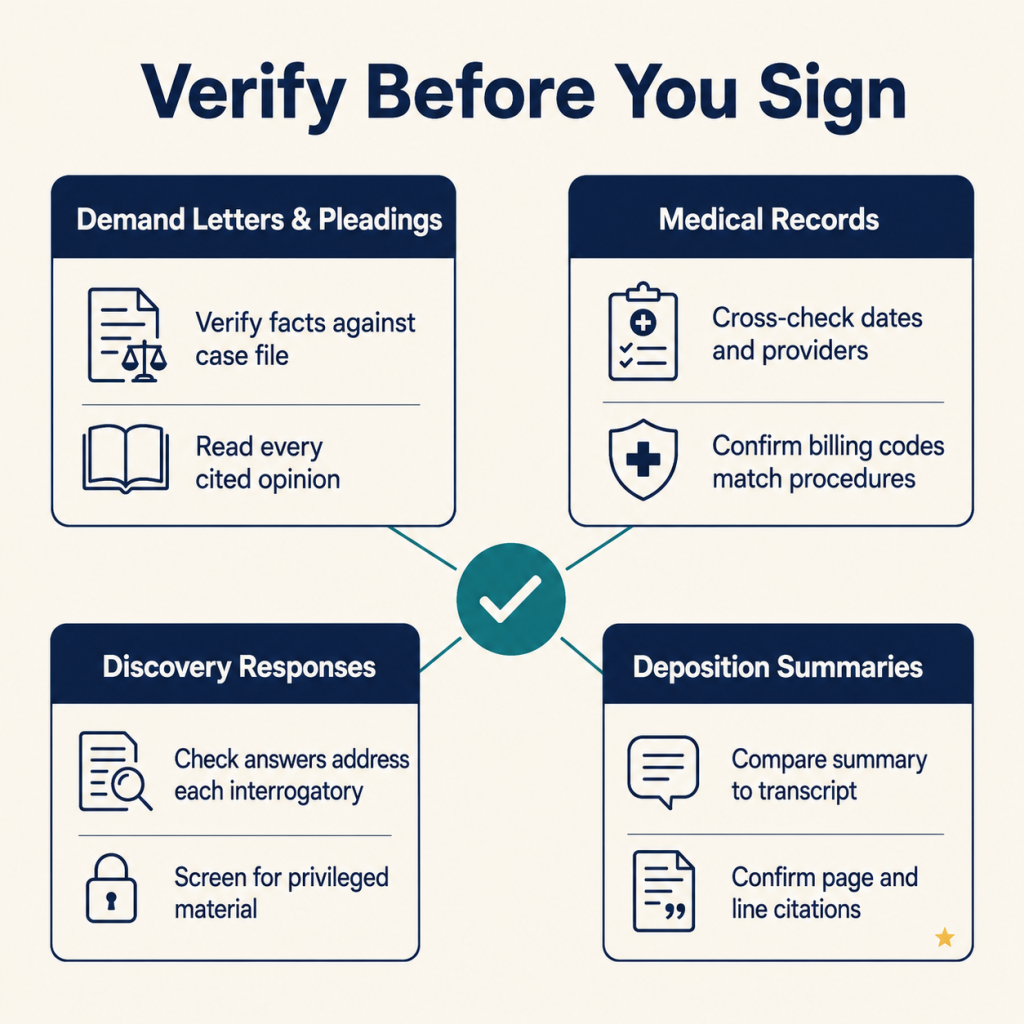
You are not aiming for perfection. You are applying the same level of care you would apply to any work product before signing your name to it. A firm with a clear verification habit gets the speed of AI and keeps the judgment that only an attorney can provide.
How Do Confidentiality Rules Apply to AI Platforms?
Rule 1.6 requires attorneys to make reasonable efforts to prevent unauthorized disclosure of client information. When you enter case data into an AI platform, you are transmitting that data to a third-party system. The confidentiality analysis depends entirely on what happens to that data after you hit “enter,” which makes this one of the easiest obligations to get right once you pick the correct type of tool.
Public AI Tools vs. Enterprise Platforms
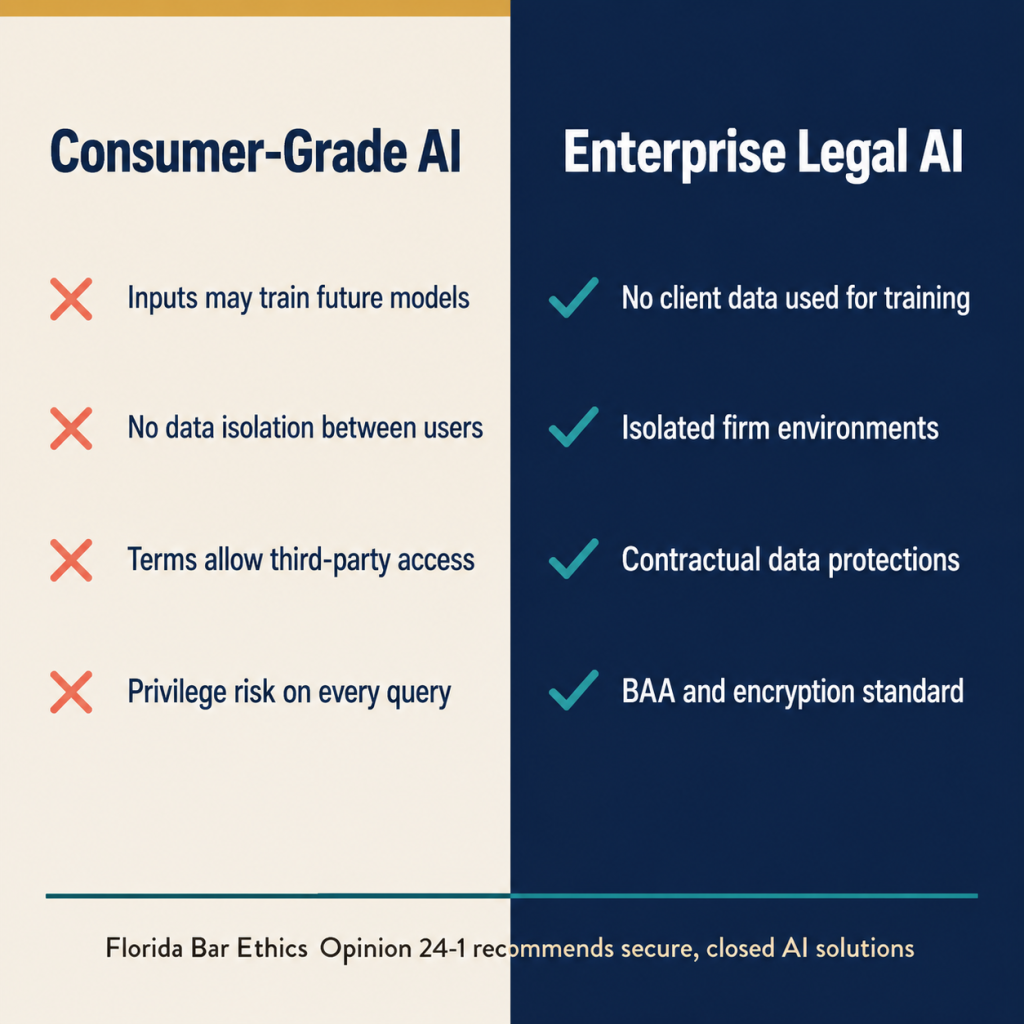
This distinction does most of the work. Public, consumer-grade AI tools (free versions of general-purpose chatbots) typically include terms of service that let the provider collect, store, and use your inputs to train future models. Entering client data, medical records, or case strategy into these tools risks waiving attorney-client privilege by exposing confidential information to a third party.
The Florida Bar addressed this directly in Ethics Opinion 24-1, warning that “self-learning” AI platforms and public cloud tools create privilege risks when attorneys input sensitive data. The Florida Bar recommends using secure, closed AI solutions where data is hosted in controlled environments.
Enterprise-grade platforms designed for legal work operate differently. They process your data within isolated environments, do not use client inputs for model training, and provide contractual data protection guarantees. Choose one of these and the confidentiality question largely takes care of itself.
HIPAA Compliance for Personal Injury Attorneys
For attorneys handling personal injury cases, the right platform also clears a federal bar. Medical records are Protected Health Information (PHI) under HIPAA, and entering PHI into an AI platform that lacks proper safeguards is a federal violation.
Compliant medical records processing requires:
- A Business Associate Agreement (BAA) between your firm and the AI vendor
- No retention of medical data after analysis is complete
- Server-side encryption (such as SSE-KMS) for data at rest and in transit
- Isolated data environments where your firm’s information is separated from other users
- Infrastructure hosted on compliant cloud services (such as AWS)
At DocuLex, we hold a Business Associate Agreement with OpenAI, and medical information processed through our platform is not stored after analysis. Our infrastructure runs on AWS with SSE-KMS encryption, and each firm’s data is isolated within secure, compliant environments. For any AI platform handling litigation files that include medical records, these are baseline requirements, and they are worth confirming before you process a single record.
What Happens When AI-Generated Content Reaches the Court?
Rule 3.3 requires candor toward the tribunal. You cannot submit a filing that contains false statements of fact or law, and “my AI made the mistake” is not a defense. The good news for careful attorneys is that the cases making headlines all share a preventable pattern.
What the Sanctioned Cases Have in Common
The attorneys who have drawn sanctions were almost always doing three things: using a consumer chatbot for legal work, skipping verification, and in several cases trying to hide the AI use after a problem surfaced. Attorneys who ran their work through purpose-built tools and checked it before filing do not show up in these opinions.
By early 2026, more than 600 cases across the United States involved AI-fabricated citations in briefs, according to data cited during California’s SB 574 legislative process. The penalties have escalated, but they track the same behavior. In December 2025, a Cook County Circuit Judge imposed a $59,500 penalty on a legal team in Jordan v. Chicago Housing Authority after their post-trial motions were found to contain fabricated citations and factual misrepresentations generated by ChatGPT, none of which the attorneys had verified before filing.
Prompt Disclosure Keeps You Protected
The pattern across recent decisions is consistent: courts punish concealment far more harshly than the underlying error. When attorneys discover hallucinated content and immediately disclose and correct it, courts have repeatedly declined to impose sanctions. In Green Building Initiative, Inc. v. Peacock, a firm caught two fabricated citations in a brief, acknowledged the problem without being prompted, and took voluntary remedial action. No sanctions were imposed.
| Scenario | Attorney Response | Outcome |
| Jordan v. Chicago Housing Authority | Filed AI-generated citations without verifying them | $59,500 penalty |
| Fletcher v. Experian | Not forthcoming in response to show-cause order | $2,500 sanction |
| Green Building Initiative v. Peacock | Acknowledged error, took voluntary remedial action | No sanctions |
The takeaway is encouraging. A verification protocol that catches problems before filing keeps you out of this situation entirely, and prompt disclosure protects you if something slips through. Firms that build that habit into their workflow get the upside of AI without carrying the downside.
Who Is Responsible When Staff or Associates Use AI?
Rule 5.3 requires attorneys with supervisory authority to ensure that the work of non-lawyers and junior attorneys under their supervision is compatible with their own professional obligations. A partner cannot simply prohibit AI in a firm policy and assume compliance follows.
The Jordan case makes this concrete. The firm had an explicit policy requiring prior approval before using AI tools, and the drafting attorney violated it. The court still held the supervising attorney responsible, because a policy means nothing if you do not enforce it by reviewing the work your team produces.
Effective supervision in an AI-enabled litigation practice includes:
- Requiring disclosure of AI use on all internal work product before it is reviewed for submission
- Establishing verification checklists specific to the type of document (pleading, brief, discovery response, correspondence)
- Reviewing a representative sample of AI-assisted output even when you trust the person who drafted it
- Training staff on the specific tools your firm approves and explaining why unapproved tools create risk
- Documenting your supervision process so you can demonstrate compliance if a question ever arises
The standard is not that you personally verify every word in every document. It is that you have a reasonable system in place and actually follow it. Firms that get this right can hand more work to staff with confidence, which is where a lot of the efficiency gain lives.
How Does AI Change Billing Ethics Under Rule 1.5?
Rule 1.5 requires that all legal fees be reasonable. AI changes the math here in the client’s favor, and the rules are about sharing those gains fairly. When AI reduces a task from twenty hours to two, you bill for the two. This applies whether you bill hourly, by flat fee, or through alternative arrangements.
Billing Rules for AI-Assisted Work
ABA Formal Opinion 512 and state-level guidance (particularly Florida Ethics Opinion 24-1) have established several clear boundaries:
- Bill for actual time spent, including verification. If AI generates a first draft in minutes and you spend two hours reviewing, verifying citations, and editing, you bill for the two hours of attorney time, not the twenty the task would have taken manually.
- Flat fees are still subject to reasonableness. If you set a flat fee based on expected effort and then use AI to complete the work in a fraction of the time, the fee may be deemed unreasonable retroactively if the profit margin is grossly disproportionate to the work performed.
- AI subscriptions are firm overhead, not client costs. General platform subscriptions are treated like office rent or research database fees. They cannot be passed through to clients as line-item charges unless the tool was acquired exclusively for a specific client’s matter and the client consented in writing.
- You cannot bill clients for learning AI tools. Time spent learning a new platform, mastering prompts, or training your team is professional development, not billable work.
Firms adopting AI should rethink their fee structures to reflect the new speed. The efficiency gains are real, and they belong partly to the client. Pre-engagement fee discussions should account transparently for the firm’s anticipated use of AI.
What Are the State-Level AI Compliance Requirements?
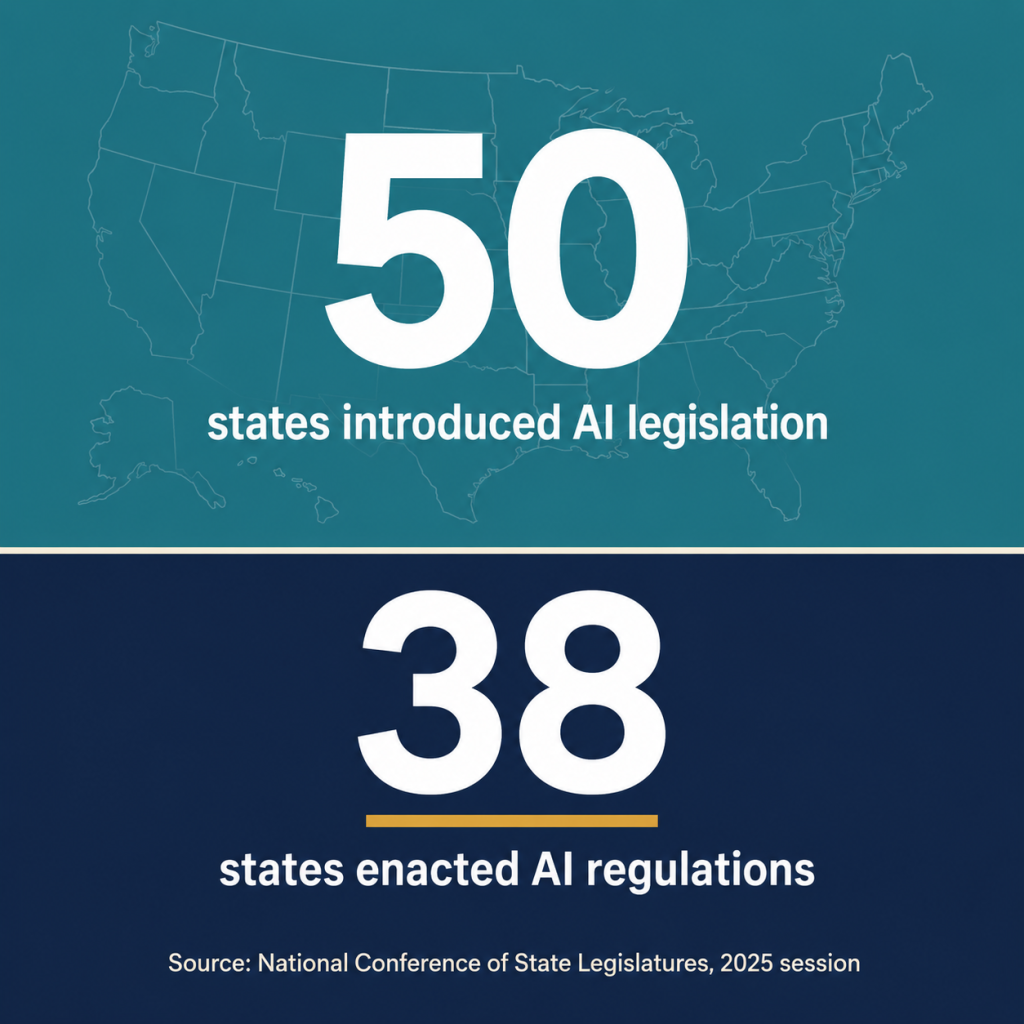
AI is now established enough in legal practice that lawmakers everywhere have built rules around it. By the 2025 legislative session, all fifty states, Puerto Rico, the U.S. Virgin Islands, and Washington, D.C. had introduced legislation addressing artificial intelligence, with 38 states enacting measures designed to regulate AI use.
The Trend Toward Statutory Accountability
The most significant development for attorneys is California’s Senate Bill 574, the first statute in the country that specifically governs how lawyers use AI. SB 574 codifies three requirements:
- Confidentiality protection: Attorneys may not enter confidential or personally identifying client information into public generative AI systems.
- Verification mandate: Attorneys must take reasonable steps to verify the accuracy of all AI-generated material and correct erroneous outputs.
- Personal citation review: No court filing may contain legal citations that the responsible attorney has not personally read and verified.
None of these requirements ask anything that a sound verification habit and a secure platform do not already cover.
Court-Level Disclosure Requirements
Individual courts have added their own requirements. Florida’s Eleventh Judicial Circuit (Miami-Dade County) requires a certification on the face of any court filing indicating whether generative AI was used, along with a sworn statement that all factual assertions and legal authorities were independently verified. Broward County adopted similar requirements. New Jersey has gone further, mandating that law firms develop, adopt, and periodically update written internal AI policies. Beginning in 2027, New Jersey attorneys must also complete mandatory CLE credits on technology, AI, and cybersecurity.
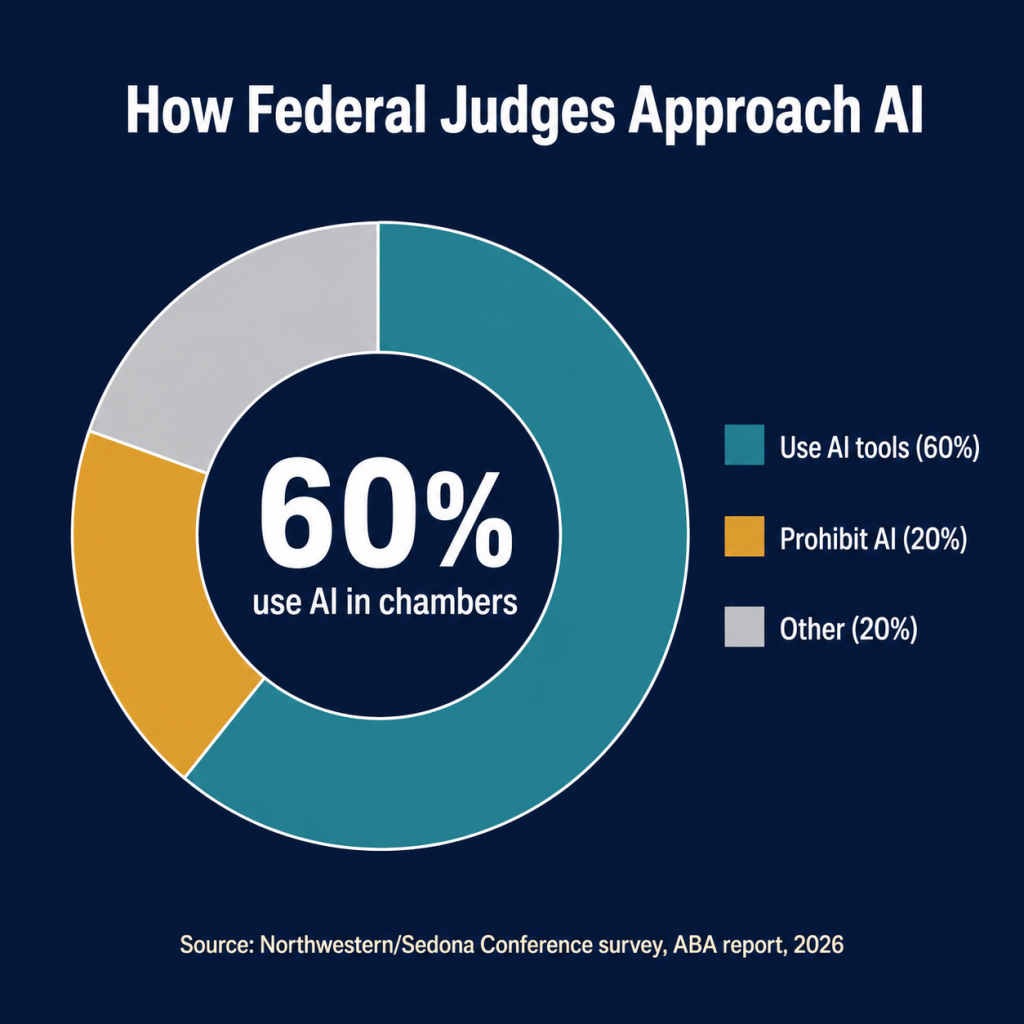
The bench itself signals where this is heading. A 2026 survey of federal judges conducted by Northwestern University and published by the Sedona Conference, reported by the ABA, found that over 60% of responding judges use at least one AI tool in their own chambers, while approximately 20% formally prohibit its use. When the people deciding your cases are already working with these tools, hanging back is its own kind of risk. Before filing in any jurisdiction, check whether the court has a standing order or local rule on AI-assisted filings.
How Should Your Firm Structure an AI Acceptable Use Policy?
Given the sanctions record and state-level requirements, ad hoc decisions about AI tools no longer serve a firm well. Legal risk consultants recommend a tiered classification system, often called a “traffic light” framework, to govern AI use firm-wide.
| Risk Level | Policy | What This Covers |
| Red (High Risk) | Prohibited | Entering confidential client data, privileged strategy, or medical records into public, consumer-grade AI tools. Using AI for autonomous fact-finding without human review. |
| Yellow (Medium Risk) | Permitted with Oversight | Legal research, contract analysis, brief drafting, document generation using enterprise-grade tools. All output requires human verification against primary sources before submission. |
| Green (Low Risk) | Pre-Approved | Administrative scheduling, marketing content, non-sensitive internal communications, summarizing publicly available documents using secure systems. |
For personal injury firms handling medical records, the policy must also address HIPAA compliance. Any AI vendor processing PHI must have a signed BAA, must not retain medical data after processing, and must demonstrate compliant infrastructure (encryption at rest and in transit, isolated data environments, audit trails).
Blanket AI bans tend to backfire. They push staff toward unauthorized tools on personal devices (“shadow AI”), which creates far greater risk than a well-governed adoption program. The goal is to channel AI use through approved, secure platforms with clear verification requirements, so your team can move fast on the work that benefits from it.
Are AI Prompts Discoverable?
A 2026 ruling in Conservation Law Foundation v. Shell Oil Co. established that AI prompts are discoverable under Rule 26 when used by expert witnesses. The court reasoned that when an expert uses AI prompts to filter or analyze documents, those prompts constitute the expert’s methodology, and methodology is a legitimate target for cross-examination.
The protection status of AI prompts depends on who created them and why:
| Who Created the Prompt | Protection Status | Reasoning |
| Attorney (litigation strategy) | Highly protected as opinion work product | Prompts contain the attorney’s mental impressions and investigative focus |
| Expert witness (data analysis) | Fully discoverable | Prompts constitute expert methodology subject to cross-examination |
| Client using consumer AI | No protection (privilege likely waived) | Consumer AI terms typically allow data collection and third-party disclosure |
| Pro se litigant | Protected as work product | AI is a tool, not a person; using it does not constitute third-party disclosure |
Raise AI tool usage during Rule 26(f) conferences. Courts have begun requiring that AI providers used for discovery materials be contractually prohibited from training on user inputs and allow immediate data deletion. In one case (Jeffries v. Harcros Chemicals, Inc.), a court prohibited consumer-grade AI tools on all discovery materials. If your firm processes litigation documents through a dedicated AI platform, you have a clear chain of custody and a documented data-handling protocol. Personal AI accounts scattered across a team are the version of this that surfaces as a discovery problem later.
Frequently Asked Questions
Do I have to disclose AI use in court filings?
It depends on the jurisdiction. A growing number of courts require affirmative certification on filings indicating whether AI was used and confirming independent verification. Florida’s Eleventh and Seventeenth Judicial Circuits mandate this. California’s SB 574 requires verification but approaches disclosure differently. Before filing, check the local rules and any standing orders for the specific court.
Can I use a free AI chatbot for legal research?
You can, but you carry full responsibility for verifying every output, and free consumer tools add avoidable risk: they may use your inputs for model training, they lack the data protection infrastructure required for client materials, and they hallucinate often enough that independent verification is essential on every query. For any work involving client data, an enterprise-grade platform with proper security controls is the easier and safer choice.
What should I look for in a HIPAA-compliant AI platform?
At minimum: a signed Business Associate Agreement with the AI provider, no retention of medical data after processing, server-side encryption (SSE-KMS or equivalent) for data at rest and in transit, isolated data environments per firm, compliant cloud infrastructure (such as AWS), and clear audit trail capabilities. If a vendor cannot demonstrate all of these, do not process medical records through their platform.
Can opposing counsel request my AI prompts in discovery?
If the prompts were created as part of attorney litigation strategy, they are likely protected as opinion work product. If an expert witness used them to filter or analyze data, they are discoverable as methodology. The determining factor is the purpose of the prompt and whether it reflects legal strategy or analytical process. Address AI tool usage proactively during pre-discovery conferences.
How should I adjust my billing when using AI?
Bill for actual attorney time, including review and verification. Do not inflate hours to match what the task would have taken without AI. Treat AI platform subscriptions as firm overhead, not pass-through costs to individual clients. If you use a flat-fee arrangement, keep the fee reasonable relative to the actual effort involved. Discuss AI use transparently in pre-engagement fee conversations.
Take the Next Step
The attorneys getting ahead with AI are the ones who paired it with the right platform and a verification habit. That combination gives you the speed without the exposure. At DocuLex, we built our platform specifically for litigation attorneys who want AI that meets the standard: HIPAA-compliant infrastructure, a Business Associate Agreement with OpenAI ensuring no data retention, structured processing designed to reduce hallucination risk, and enterprise-grade encryption throughout. If you want to see how purpose-built legal AI handles document generation, medical records processing, and case file management while keeping you compliant on every front, join our waitlist to get early access.