

The best AI tools for a medical malpractice practice are the ones that turn thousands of pages of medical records into accurate, source-traceable chronologies and summaries while keeping protected health information secure. Around that core sit a handful of other categories worth evaluating: document and evidence organization, document drafting, deposition and transcript summarization, discovery response support, and AI assistants that answer questions over your own case files. The tool that belongs in your firm is the one that handles accuracy, source-linking, security, and human review well, because in malpractice work those four things determine how much AI actually helps.
AI use in law is no longer a fringe practice. In its December 2025 report on AI and the practice of law, the American Bar Association describes adoption across the profession over the past year as remarkably rapid, with the central question shifting from whether to use generative AI to how to use it responsibly.
At DocuLex, we built our platform for civil litigation and personal injury work, where medical records sit at the center of nearly every file. We process those records visit by visit, generate medical visit and billing summaries organized by provider and date, and run the entire pipeline on HIPAA-compliant AWS infrastructure with a zero medical-data retention policy. Our founder, Jason L. Melancon, is a civil litigation attorney with more than 20 years in personal injury and complex litigation, and he uses the system in his own practice.
This guide walks through the categories of AI tools a medical malpractice firm should evaluate, what each one does, and the questions that separate a reliable tool from a risky one. It does not rank named products, because the right choice depends on how your firm works and which part of the file is eating your hours.
Why medical malpractice is a document problem before anything else
Medical malpractice cases run on records. To prosecute or defend one, you have to show a deviation from the standard of care and then connect that deviation to the patient’s harm through causation. Both of those proofs are built by reading the medical record closely and reconstructing what happened, when, and in what order.
The standard of care is the degree of skill and diligence a reasonably competent provider would have used under similar circumstances, as Cornell’s Legal Information Institute defines it. Proving a breach means showing exactly what was done, what was omitted, and how that compares to accepted practice. Causation usually turns on the “but-for” test: but for the provider’s act or omission, the harm would not have occurred. None of that can be argued from memory. It comes out of the chart.
The vehicle for the whole case is the medical chronology, a timeline that plots every encounter, test result, medication, and procedure in order. A delayed-diagnosis claim, for example, lives or dies on the gap between when a symptom first appears in the record and when the provider acted on it. Medical malpractice also depends heavily on expert witnesses, who will not wade through a disorganized chart. They work from a clean chronology, and a chronology with errors or missing dates compromises their opinion and hands the other side an opening on cross. This is why the AI tools that matter most for med mal are the ones built to read records and produce a reliable timeline.
How to evaluate any AI tool for medical malpractice work
Before comparing categories, set the criteria. Four questions apply to every tool you consider, and the answers matter more in malpractice than in almost any other practice area.
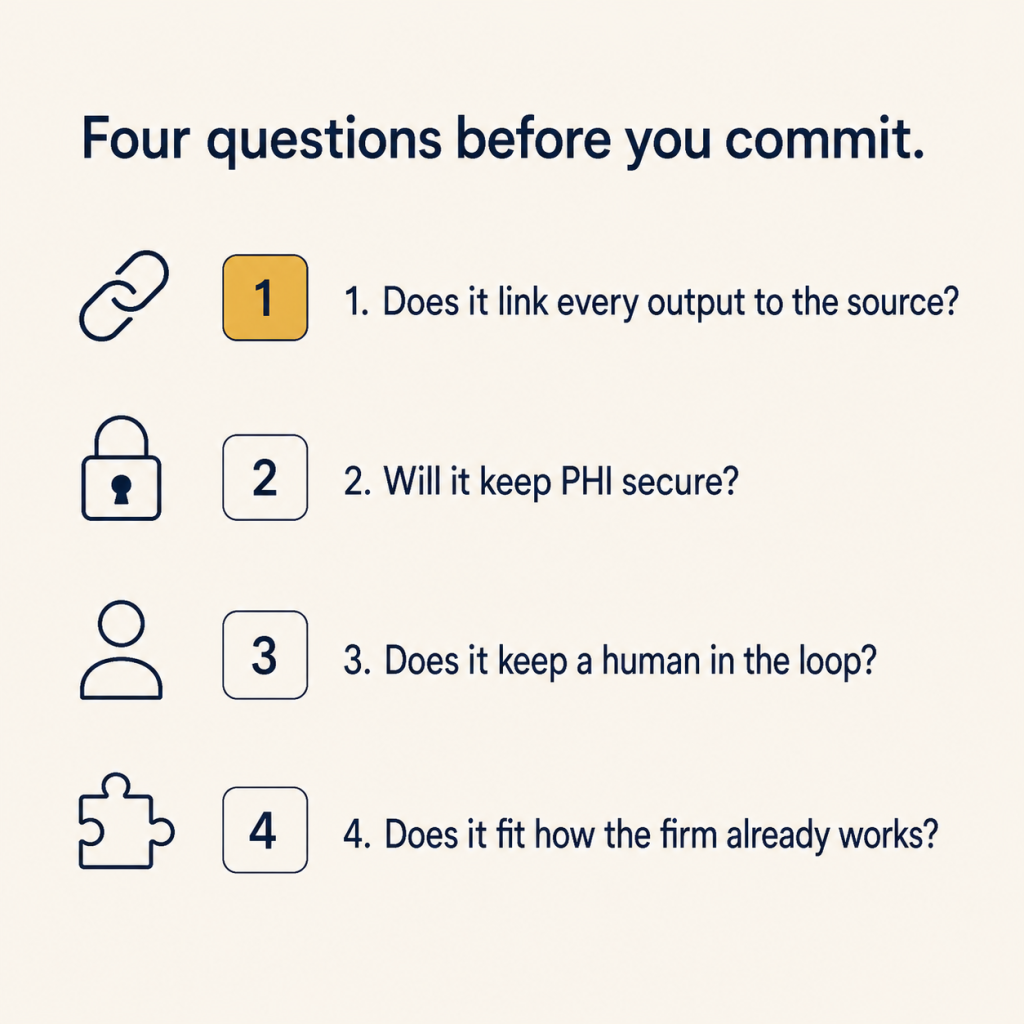
Does it link every output back to the source?
This is the accuracy question, and the answer separates a tool you can trust from one you have to double-check by hand. Large language models generate text by predicting likely words, which means they can state things that were never in the record. A Stanford study found that even purpose-built legal AI research tools produced false or unsupported information 17% to 33% of the time, while general-purpose chatbots hallucinated on 69% to 88% of the legal questions tested.
That is a solvable problem, and source-linking is how the better tools solve it. A tool that links each statement back to the exact page it came from lets you verify in seconds, so the speed gain stays intact. A tool that hands you a fluent paragraph with no citations forces you to re-read the record to trust it, which is the setup to avoid. The consequences of skipping verification are well documented. In Mata v. Avianca, a federal judge fined attorneys $5,000 after they filed a brief full of fabricated cases generated by ChatGPT and then swore the fake cases were real. Source-linking is what makes verification fast enough to actually do.
Will it keep protected health information secure?
Medical records are protected health information, and an AI vendor that processes them on your behalf is a HIPAA business associate. That means you need a signed Business Associate Agreement with the vendor before any record goes into the tool. According to HHS guidance, even a service that never decrypts the data still qualifies as a business associate and still requires a BAA.
There is a subtler point worth checking here. A vendor can hold a BAA with a model provider like OpenAI and still leak PHI, because that agreement only governs what happens inside the model provider’s systems. Raw records also pass through the application’s own logging, prompt construction, and vector storage. Every one of those layers has to be encrypted and covered, or the data is exposed somewhere upstream of the model. Ask any vendor to walk you through where PHI travels and where it is stored. You can see how we answer that question on our data security page.
Does it keep a human in the loop?
The Formal Opinion 512 ethics guidance from the ABA is direct on this point. Lawyers have to understand what an AI tool can and cannot do, must verify any output before it goes to a tribunal, and remain responsible for supervising the work. A good tool makes review easy and never positions itself as the final word. AI shifts your effort from drafting and manual extraction toward fast, careful editing. It does not remove the editing.
Does it fit how your firm already works?
A document and evidence tool should sit alongside the software you already use for calendaring, intake, and billing, not force you to replace it. The strongest setups layer an intelligent document and medical-record system on top of existing case management so the timeline, summaries, and drafts feed back into the file your firm already runs.
The six AI tool categories medical malpractice firms should evaluate
Here is the full set at a glance, with what each category does and the main thing to test before you commit.
| Category | What it does | What to look for |
| Medical record review and chronologies | Reads records and builds an ordered clinical timeline | Source-linking to the exact page, visit-by-visit processing, accuracy |
| Document and evidence organization | Classifies and tags incoming records and exhibits | Classification accuracy, search, encryption and access controls |
| Document drafting and generation | Drafts letters, summaries, and pleadings from case facts | Works from your verified record, easy human review |
| Deposition and transcript summarization | Condenses testimony and groups it by topic | Citations to transcript page and line, faithful summaries |
| Discovery response support | Drafts answers to interrogatories and requests | Confidentiality safeguards, attorney edit and sign-off |
| AI assistant over your case files | Answers questions about your own uploaded documents | Answers grounded in your files only, source links back |
Medical record review and chronology tools
This is the engine of a medical malpractice practice and the category where AI earns its place fastest. These tools use optical character recognition to read scanned charts, natural language processing to understand clinical context, and entity extraction to pull dates, providers, medications, and diagnoses. The strongest systems process records in structured segments, working visit by visit rather than dumping a 4,000-page PDF into a single pass, which keeps the output accurate and traceable.
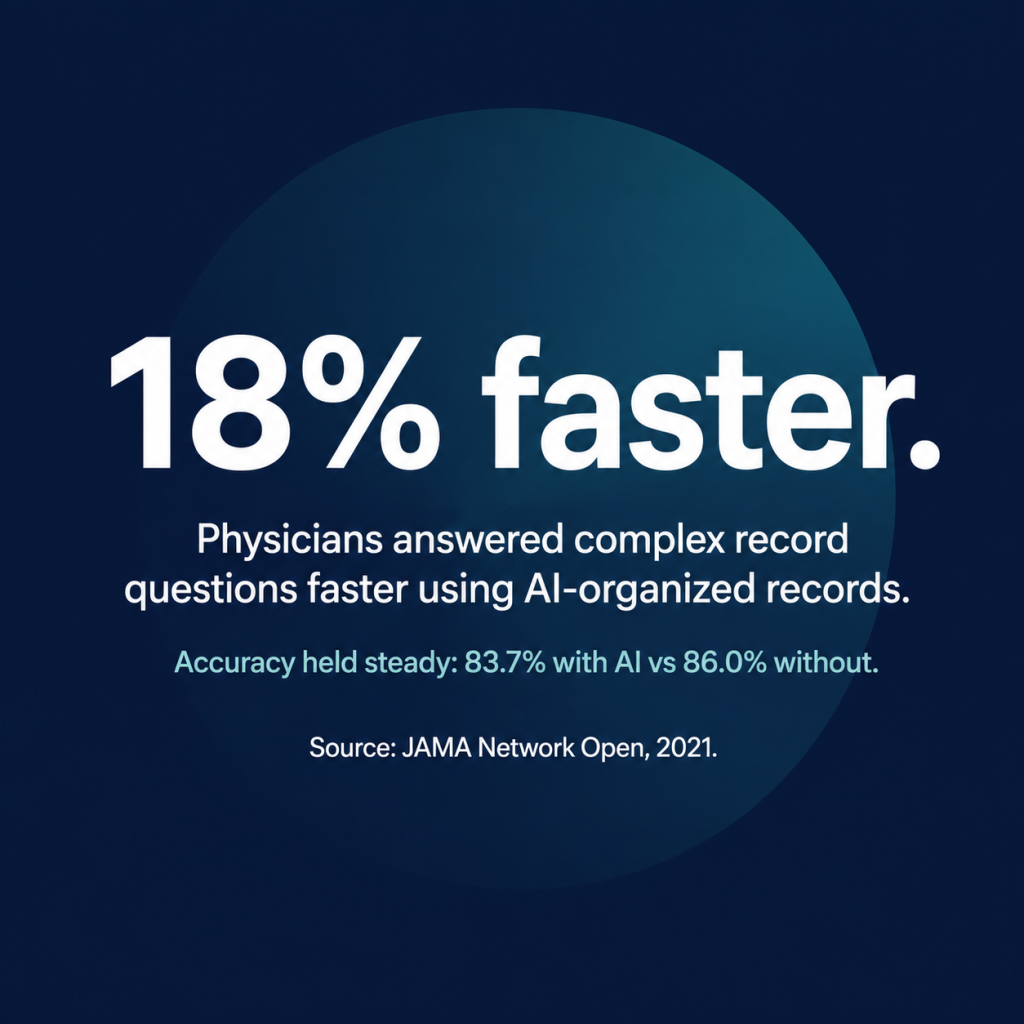
The payoff shows up in the research. A peer-reviewed JAMA Network Open study found that physicians reviewing AI-organized patient records answered complex clinical questions 18% faster, with no meaningful drop in accuracy. The same logic applies to a paralegal building a chronology: a clean, AI-assembled timeline gets the firm to the core facts sooner and lowers the hours your medical expert has to bill reviewing raw charts.
When you evaluate a tool in this category, test whether it links every entry on the timeline back to the source page, how it handles handwriting and poor scans, and whether it processes records in segments or all at once. Our own AI medical records processing is built around visit-by-visit processing, producing medical visit summaries and billing summaries organized by provider and date.
Document and evidence organization
When a hospital network or opposing counsel sends a document dump, someone has to figure out what each file is. Evidence organization AI reads the contents, identifies the document type, and tags it with metadata so the file stays searchable without hundreds of unbillable hours of manual sorting. This category sits alongside your case management software as an intelligent intake layer rather than replacing the system you already use.
Test how accurately a tool classifies common medical document types like surgical reports, nursing notes, and imaging narratives, and confirm that storage is encrypted with proper access controls. Our legal file management software handles this with automated tagging and a searchable database, and we cover the practical side of setting this up in our guide on how to organize litigation case files with AI.
Document drafting and generation
Drafting tools take the facts already in the file and produce a first draft of a written document. For medical malpractice work that often means a settlement demand, correspondence, or a pleading that draws on the chronology and the attorney’s notes. The value depends entirely on whether the tool drafts from your verified record or invents details, which loops back to the source-linking and review criteria above.
Current document generation in DocuLex covers medical visit summaries, medical billing summaries, automated correspondence, automated pleadings, pre-trial orders, and case summaries through our legal document automation software. One-click demand letters, automated federal court pleadings, and automated deposition summaries are in active development rather than shipping today, which is worth knowing as you compare what any vendor markets against what it actually delivers now.
Deposition and transcript summarization
Depositions of treating physicians and medical experts are long, dense, and technical. Summarization tools ingest the transcript and produce a condensed version that groups testimony by topic, such as the expert’s qualifications, methodology, opinions on the standard of care, and any concessions made on cross-examination. Good tools cite back to the page and line so you can confirm a summary against the record before relying on it.
DocuLex processes depositions page by page, the same segmented approach we use for medical records, which keeps the analysis anchored to specific testimony. Automated deposition summaries are a forthcoming capability for us, so treat that as a roadmap item rather than a current feature when you weigh your options.
Discovery response support
Responding to standard interrogatories and requests for production is repetitive, low-margin work. Tools in this category draft initial responses by pulling relevant material from the firm’s own data and the facts of the current case, leaving the attorney to review, edit, and finalize. The two things to check are confidentiality, since these tools touch client data, and whether the workflow keeps the attorney firmly in the editing and sign-off seat.
This is also where AI takes a clear bite out of paralegal workload, freeing staff from rote drafting to focus on substantive case work. We write more about that shift on our AI paralegal page.
AI legal assistants over your case files
This category lets an attorney ask questions in plain language and get answers drawn from the firm’s own documents. Instead of relying on a general model trained on the open internet, the tool builds a secure index of your specific files and answers from that, linking back to the page where the answer lives. Ask “what did the treating physician note about the postoperative infection,” and a good assistant returns the passage and a citation.
One distinction matters: this is a tool that retrieves and answers over your own uploaded case files and medical records, not a legal-research database, and it does not replace Westlaw or Lexis for published case law. Our legal AI chatbot works this way, grounding every answer in the documents you have actually loaded.
Where case management software fits
Case management software handles calendaring, intake, client communication, billing, and trust accounting. It is essential, and the AI document and evidence tools above are not a substitute for it. They sit alongside it. DocuLex is document automation and evidence management software, built to organize records, generate documents, and answer questions over your files. We are not a calendaring or billing system, and we work as the document layer on top of the practice management tools a firm already runs. Our litigation support software is built to fill that role.
What stays in human hands
AI does not replace the medical expert witness. A well-built chronology saves an expert hours and lowers their fees, and the human expert is still the one who testifies to the standard of care and causation. Models organize and surface the record; the clinical judgment stays with the expert.
The same division applies to verification. Because AI produces fluent, confident drafts, the firms that get the most out of it are the ones that treat the output as a strong first draft and run it through the review habits they already apply to any work product. Used that way, AI lowers the workload without adding risk.
Frequently asked questions
Can I use ChatGPT to review medical records in a malpractice case?
Yes, with a tool built for protected health information. Processing PHI requires a Business Associate Agreement and an architecture configured for zero data retention, which the consumer ChatGPT product does not provide, so use a purpose-built tool with a BAA that covers every point where records are stored or processed.
Do AI tools replace medical expert witnesses?
They assist expert witnesses rather than replace them. AI organizes records and builds chronologies that save experts time and reduce their fees, while the expert provides the clinical opinion and testifies to the standard of care and causation. AI prepares the material and the expert renders the judgment.
What is a medical chronology?
A medical chronology is a timeline that plots a patient’s clinical history in order: encounters, diagnoses, test results, medications, and procedures. It is the foundation for proving a deviation from the standard of care and for linking that deviation to the patient’s harm.
Is AI accurate enough for medical malpractice litigation?
It is accurate enough to draft and organize the record, and the workflow is what keeps it reliable. Even specialized legal AI produces errors at meaningful rates, so source-linking and attorney verification of every fact before it reaches a tribunal are what make the output dependable.
Is it ethical for a medical malpractice lawyer to use AI?
Yes, within the duties of competence, confidentiality, and supervision. You have to understand the tool’s limits, protect client data with proper agreements and safeguards, and verify all output before using it. Ethics rules treat AI as a tool you remain responsible for, not a delegate.
Get on the DocuLex waitlist
Medical malpractice work rewards the firm that can read the record fastest and most accurately while keeping client data protected. We built DocuLex to do exactly that for civil litigation and personal injury practices: visit-by-visit medical record processing, document generation, and an assistant that answers over your own files, all on HIPAA-compliant infrastructure with zero medical-data retention. If that fits how your firm handles records, join the DocuLex waitlist to be among the first to use it.