

Reviewing AI output in litigation requires verifying every citation against primary sources, reading the underlying cases in full, confirming quotes and pin cites word for word, and pressure-testing the legal reasoning against the case record. At DocuLex.ai, our platform was built by a civil litigation attorney with more than 20 years of trial experience, and the verification workflow we recommend reflects what holds up under judicial scrutiny. AI accelerates drafting. Attorney judgment finalizes the work product. The lawyer signing the brief carries full ethical responsibility, so the review process matters as much as the tool that produced the draft.
This guide walks through the verification steps, ethical duties, and firm-wide review processes that allow litigation attorneys to use AI confidently and accurately in their practice.
Why Reviewing AI Output Matters in Litigation
AI tools are changing how attorneys draft pleadings, demand letters, discovery responses, and case summaries. Used properly, they cut hours off routine drafting tasks. Used carelessly, they can introduce fabricated citations, misquoted holdings, or invented facts into court filings.
The risk is well documented. According to Stanford research, leading legal AI systems still produce errors in roughly one out of six benchmark queries. Even purpose-built legal research tools have measurable error rates. General-purpose chatbots perform far worse on legal tasks. Treat any AI output as a draft requiring full verification before it reaches a court, a client, or opposing counsel.
| AI System Type | Error/Hallucination Rate | Source |
| Top-tier legal research AI tools | More than 17% of queries | Stanford RegLab (2024) |
| Some legal research AI systems | More than 34% of queries | Stanford RegLab (2024) |
| General-purpose chatbots on legal queries | 58% to 82% of queries | Stanford RegLab |
The numbers reinforce a basic point. AI is a productivity multiplier whose output requires careful attorney review every time.
Ethical Duties That Apply When Using AI in Legal Practice
The duty to review AI output is not optional. It flows directly from the rules of professional conduct that govern every attorney.
What the ABA Says About AI Review
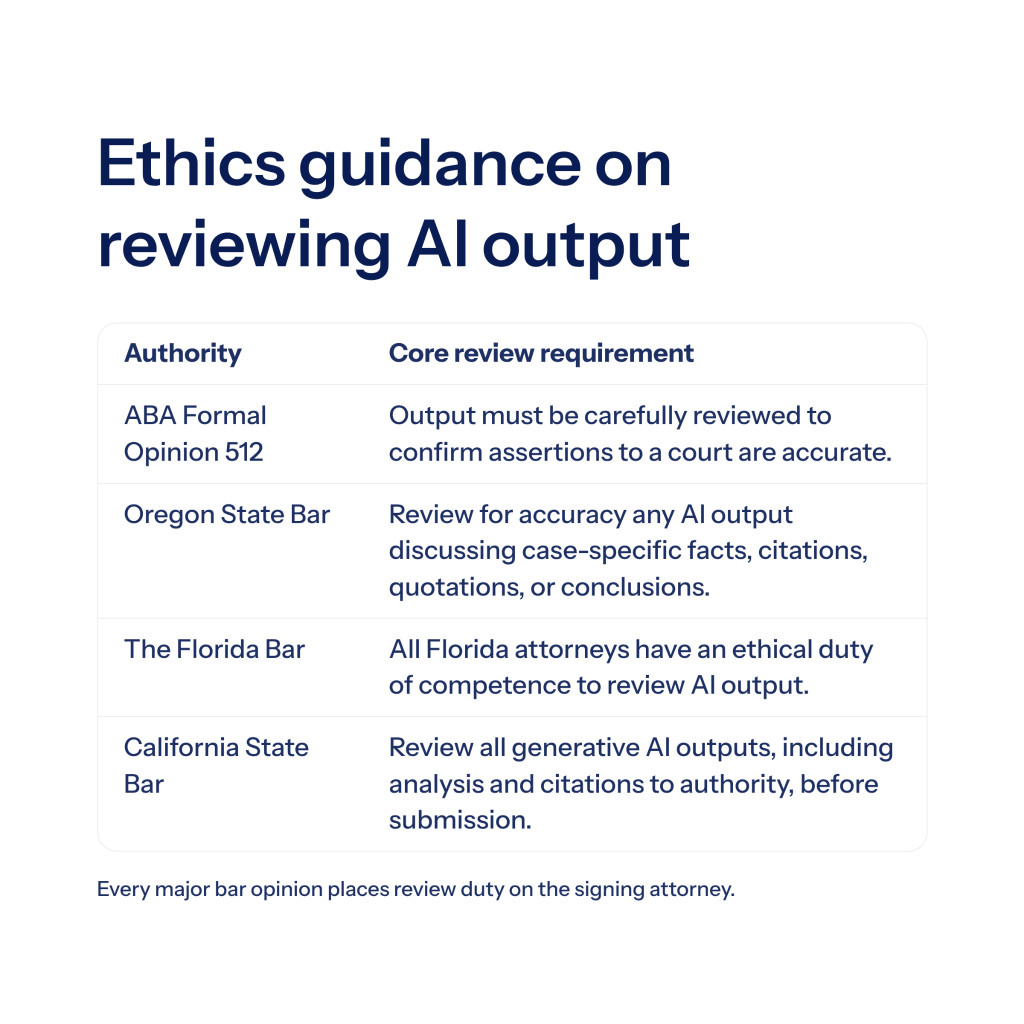
ABA Formal Opinion 512 is the central authority on this issue. It states that output from a generative AI tool must be carefully reviewed to confirm assertions to a court are accurate. The opinion grounds this duty in Model Rule 1.1 (competence), Model Rule 3.3 (candor toward the tribunal), Model Rule 5.1 (responsibilities of supervising lawyers), and Model Rule 5.3 (responsibilities regarding nonlawyer assistance).
State Bar Positions on AI Review
State bars have followed the ABA’s lead with their own guidance. The Oregon State Bar opinion directs attorneys to review for accuracy any AI output discussing case-specific facts or providing case citations, quotations, or conclusions. The Florida Bar guidance makes clear all Florida attorneys have an ethical duty of competence to review AI output. California State Bar guidance similarly requires review of all generative AI outputs, including analysis and citations to authority, before submission to a court.
What Happens When Lawyers Skip the Review
Courts have responded to AI errors with sanctions, fines, and public reprimand. Washington Post reporting cataloged dozens of U.S. cases in which lawyers filed AI-generated briefs containing fake citations. A California appellate court fined an attorney $10,000 for an opening brief in which 21 of 23 case quotes were fabricated by ChatGPT. A Utah appeals court sanctioned an attorney with a $1,000 payment to a legal nonprofit over AI-fabricated citations. The legal precedent set in Mata v. Avianca established that Rule 11 sanctions apply to AI-generated fabrications just as they would to any other unverified filing.
The pattern across these cases is consistent. The court does not care whether the brief was drafted by a paralegal, an associate, or an AI tool. The signing attorney is responsible for accuracy.
Where AI Output Tends to Go Wrong
Knowing where AI is most likely to fail makes review faster and more focused. Common categories of error include:
- Fabricated case citations. AI tools sometimes invent case names, citations, or holdings that do not exist in the legal record.
- Misquoted opinions. Even when a case is real, AI may attribute a quote to the wrong case, paraphrase a holding inaccurately, or pull language from a dissent and present it as the majority view.
- Outdated or overruled law. AI training data has cutoff dates, and tools may cite cases that have been overturned or statutes that have been amended.
- Blended legal standards. AI can combine elements from different jurisdictions or different areas of law into a single rule that does not actually exist.
- Invented facts. When asked about a specific case, AI may insert plausible-sounding facts that are not in the record.
- Incorrect pin cites. Page numbers and paragraph references are particularly prone to errors that look minor but undermine credibility with the court.
Recognizing these failure modes is the first step toward catching them before they reach a filing.
A Step-by-Step Process for Reviewing AI Output
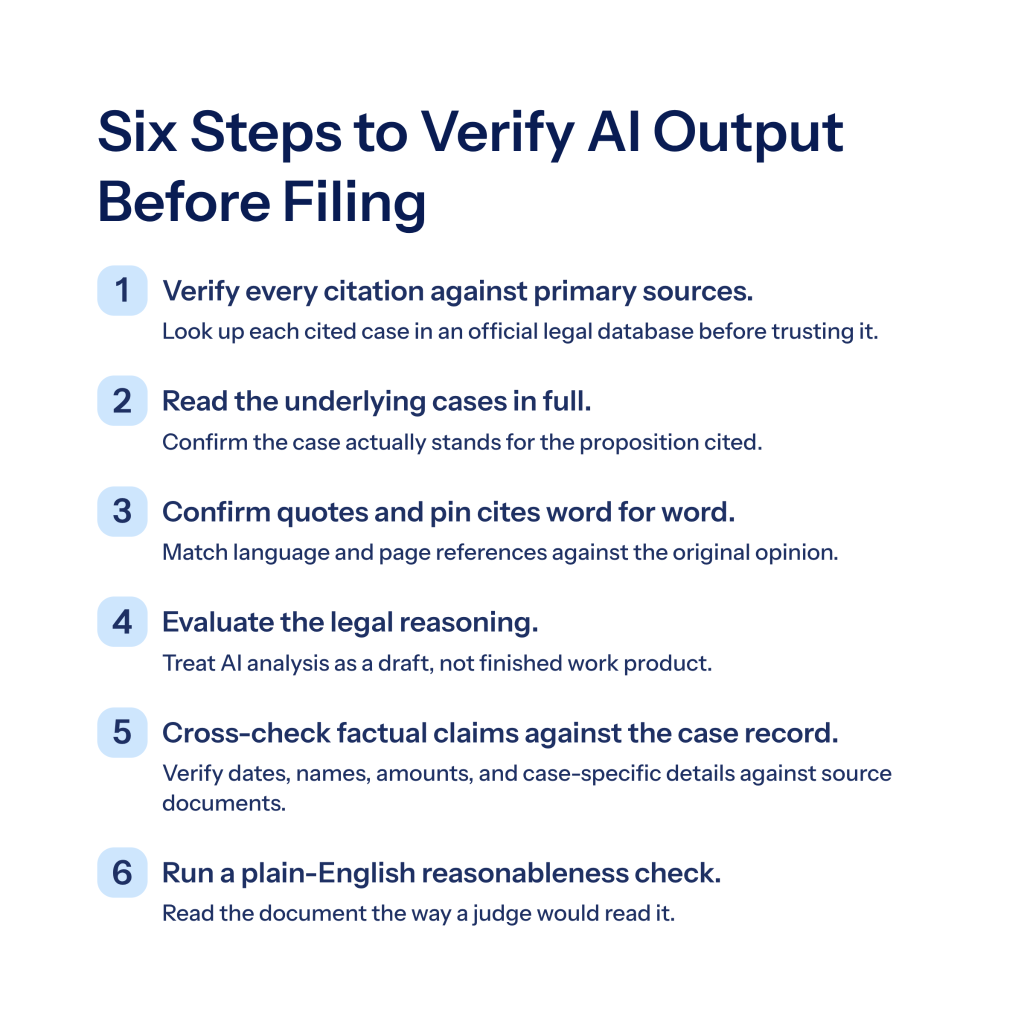
An effective review process moves through each verification step methodically. Here is the workflow we recommend for litigation attorneys reviewing any AI-generated work product, whether it is a discovery response, demand letter, motion, or research memo.
Verify Every Citation Against Primary Sources
For every case cited, look it up in an official legal database. Do not rely on the AI’s representation that the case exists or that the citation is accurate. Confirm the case name, reporter citation, court, year, and pinpoint citation against the primary source.
Read the Underlying Cases in Full
Reading the full opinion is essential. The case may exist while the holding the AI attributed to it does not. Reading the actual opinion confirms whether the case stands for the proposition cited and whether the AI captured the legal reasoning correctly. This is the single most important step in the review process.
Confirm Quotes and Pin Cites Word for Word
When AI provides a direct quote, pull the original opinion and confirm the language matches verbatim. Check that the page citation points to where the quote actually appears. AI tools frequently get pin cites wrong, and an inaccurate pin cite is the kind of small error opposing counsel will use to undermine an entire brief.
Evaluate the Legal Reasoning
Treat AI’s analysis as a draft requiring critical evaluation. Ask whether each legal assertion is supported by controlling authority, whether the reasoning fits the actual case facts, and whether the argument applies the correct standard for the jurisdiction. If something reads as generic or disconnected from the case record, it probably is.
Cross-Check Factual Claims Against the Case Record
For documents that summarize case facts, verify every factual assertion against the underlying record. Confirm dates, names, dollar amounts, medical findings, deposition testimony, and any other case-specific detail against source documents. This is where AI used in personal injury practice particularly benefits from a structured platform that pulls facts from a known case file rather than generating them from general training data.
Run a Plain-English Reasonableness Check
Read the document the way a judge would read it. Does the argument hold together? Are the facts consistent with what you know about the case? If a sentence sounds confident but vague, treat it as a flag worth investigating. High-confidence language with low substance is a common AI tell.
How to Build a Firm-Wide AI Review Workflow
Firms using AI at scale need a workflow that builds verification into the drafting process itself. Individual review remains the foundation, and a firm-wide structure keeps it consistent across matters and attorneys.
A practical approach starts with assigning roles. A junior associate or paralegal can prepare AI-assisted research or first drafts. A senior attorney verifies all citations, factual claims, and legal reasoning before anything leaves the firm. Two sets of eyes catch errors that one person will miss.
Beyond role assignment, firms benefit from:
- A standard AI review checklist. Document the steps every team member must complete before AI-generated content is filed or sent to a client.
- Training on AI limitations. Brief every user on common failure modes so they know what to look for. Treat AI literacy the same way firms treat cybersecurity training.
- A correction protocol. If an AI error is discovered after submission, the firm needs a defined process for promptly notifying the court and opposing counsel and filing the correction.
- Documentation of the review process. Keep notes showing which sources were verified and by whom. This protects the firm if questions arise later.
- Time accounting that reflects reality. Verification time counts toward billable hours. Building review time into matter budgets prevents the temptation to cut corners.
Tools and Methods That Support Human Review
A range of resources can support verification, though none replace the attorney’s judgment.
Independent legal research databases like Westlaw, Lexis, and Bloomberg Law allow attorneys to confirm citations and read full opinions. Citator services flag overruled or negatively treated cases. Bar association ethics opinions and the NCSC guide on AI hallucinations offer ongoing guidance as the technology evolves.
One method to avoid: using a second AI tool to verify the first AI’s output. Courts have rejected AI-to-AI checks as insufficient verification. Cross-checking with primary sources or established research databases is the standard.
How AI Platform Design Affects Review Burden
The amount of verification an attorney has to do depends partly on how the AI tool is designed. Tools that pull from a known case file and generate output grounded in that file create less review burden than open-ended chatbots that can invent facts from training data.
At DocuLex.ai, we built our legal document automation software around case-specific data. The platform processes documents page by page, creates embeddings for fast retrieval, and grounds drafts in materials the firm has uploaded. When a draft references a medical record date or a deposition statement, the source is identifiable inside the case file. Attorneys still verify everything, but the verification is faster because the underlying material is right there.
This design philosophy also shapes how we approach AI medical records processing for personal injury cases. Medical visit summaries, billing summaries, and treatment timelines are generated from the actual records in the file, which means review consists of confirming the platform extracted information accurately rather than confirming it did not invent a treatment that never happened.
The point is broader than any one platform. When evaluating AI tools for litigation work, ask how the tool grounds its output. Tools tied to your actual case materials reduce hallucination risk. Tools that generate from general training data require heavier review.
Frequently Asked Questions
Below are common questions we hear from attorneys evaluating AI tools for litigation work.
How Often Does Legal AI Hallucinate?
Peer-reviewed Stanford research found leading legal AI tools produce errors in roughly one out of six queries. Some tools error more than 34% of the time. General-purpose chatbots perform much worse on complex legal questions. Treat any AI output as a draft requiring full verification.
Can I Use Another AI Tool to Verify AI Output?
No. Courts have rejected AI-to-AI verification as insufficient. Independent verification means confirming citations, quotes, and facts against primary legal sources or established research databases like Westlaw or Lexis, not running output through a second model.
Who Is Responsible When AI Output Contains Errors?
The signing attorney is responsible. Courts have applied Rule 11 sanctions and bar discipline regardless of whether AI produced the underlying error. Supervising attorneys also bear responsibility under Model Rule 5.1 for the AI use of attorneys they supervise.
What Should I Do if I Already Filed Inaccurate AI Output?
Correct it promptly. The duty of candor under Model Rule 3.3 requires notifying the tribunal and opposing counsel of any false statement, regardless of whether AI was the source. Documenting the correction also helps mitigate potential sanctions.
Does Verifying AI Output Defeat the Purpose of Using AI?
No. AI saves time on drafting, structuring, and pulling information together. Verification is faster than starting from scratch, especially when the AI tool is tied to your actual case file rather than generating from general training data. The efficiency gains hold even when full review is included.
Use AI Confidently in Your Litigation Practice
AI tools, paired with disciplined review, allow litigation attorneys to handle higher case volumes without sacrificing accuracy or ethical compliance. The firms getting this right treat AI as an associate-level draft producer and the reviewing attorney as the final authority.
To see how a litigation platform built by a practicing trial attorney approaches grounded, case-specific AI output, join the DocuLex.ai waitlist for early access.