

AI document review uses machine learning and natural language processing to scan, classify, and summarize litigation files in a fraction of the time manual review requires. Properly deployed, it reduces the volume of documents needing attorney eyes by 80 to 90 percent, drops per-document review costs from several dollars to cents, and turns weeks of associate work into days. At DocuLex, our platform was built by a civil litigation attorney with more than 20 years of trial experience to solve this exact problem: turning unstructured case files into organized, searchable, and actionable case data so litigation teams can focus on strategy instead of paging through PDFs.
The rest of this guide covers what AI document review actually does, where it accelerates case prep, what the data shows on time and cost savings, and what to look for when evaluating tools.
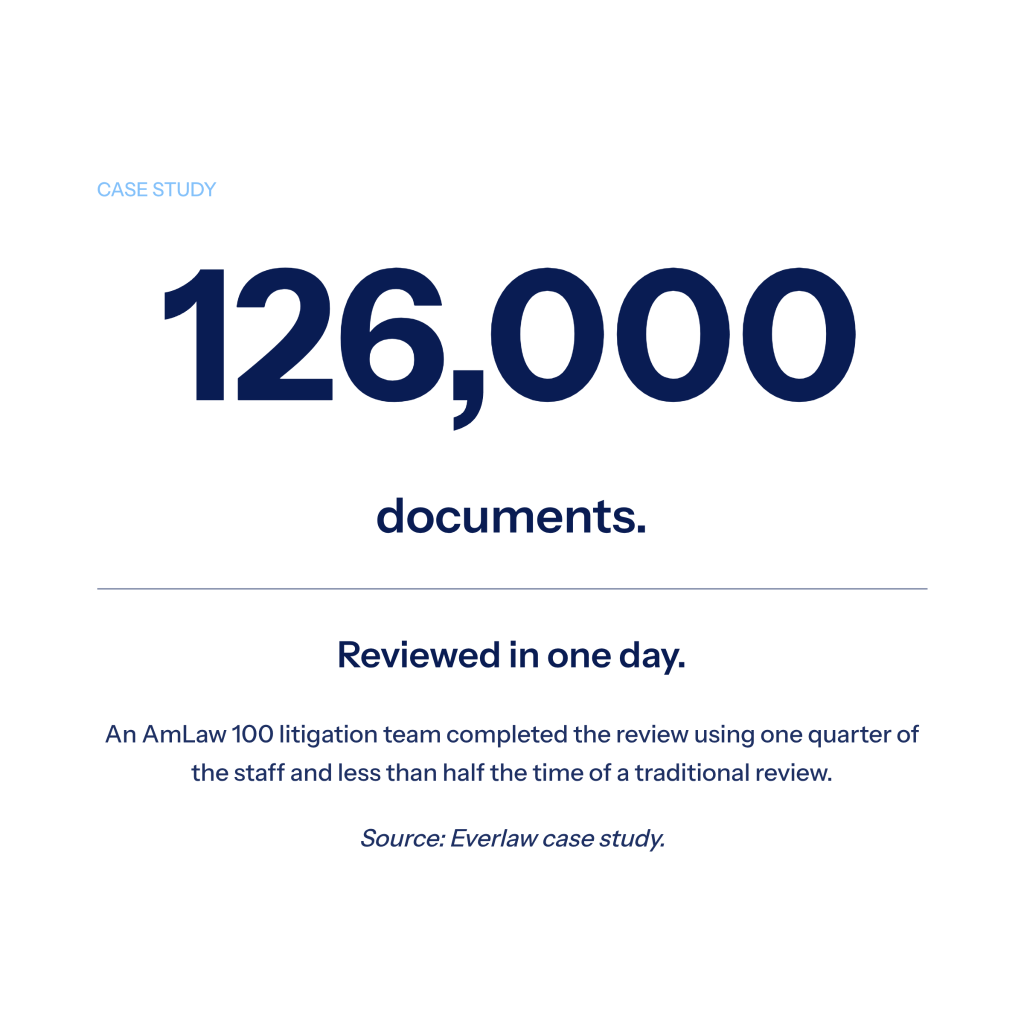
What is AI Document Review in Litigation?
AI document review is a category of software that uses machine learning and natural language processing to read, classify, and extract information from litigation documents at scale. The two main approaches are technology assisted review, often called TAR or predictive coding, and generative AI review, which can summarize documents, draft factual chronologies, and answer questions about case files in plain English.
In practice, the software learns from a small set of attorney-coded examples and ranks the rest of the population by relevance, privilege, or issue. Generative models add a second layer. Instead of just classifying, they read long documents and produce summaries, extract entities, and surface key facts. Both approaches reduce the volume of material a human has to look at and shorten the time spent on each document that does get reviewed.
Federal courts have endorsed the underlying methodology for over a decade. In Da Silva Moore v. Publicis Groupe (2012), Judge Andrew Peck issued the first federal opinion approving predictive coding for document review. Subsequent decisions, including Rio Tinto v. Vale, confirmed that properly validated AI review is an acceptable, and often preferable, method under the Federal Rules of Civil Procedure.
How Much Time Can AI Save on Document Review?
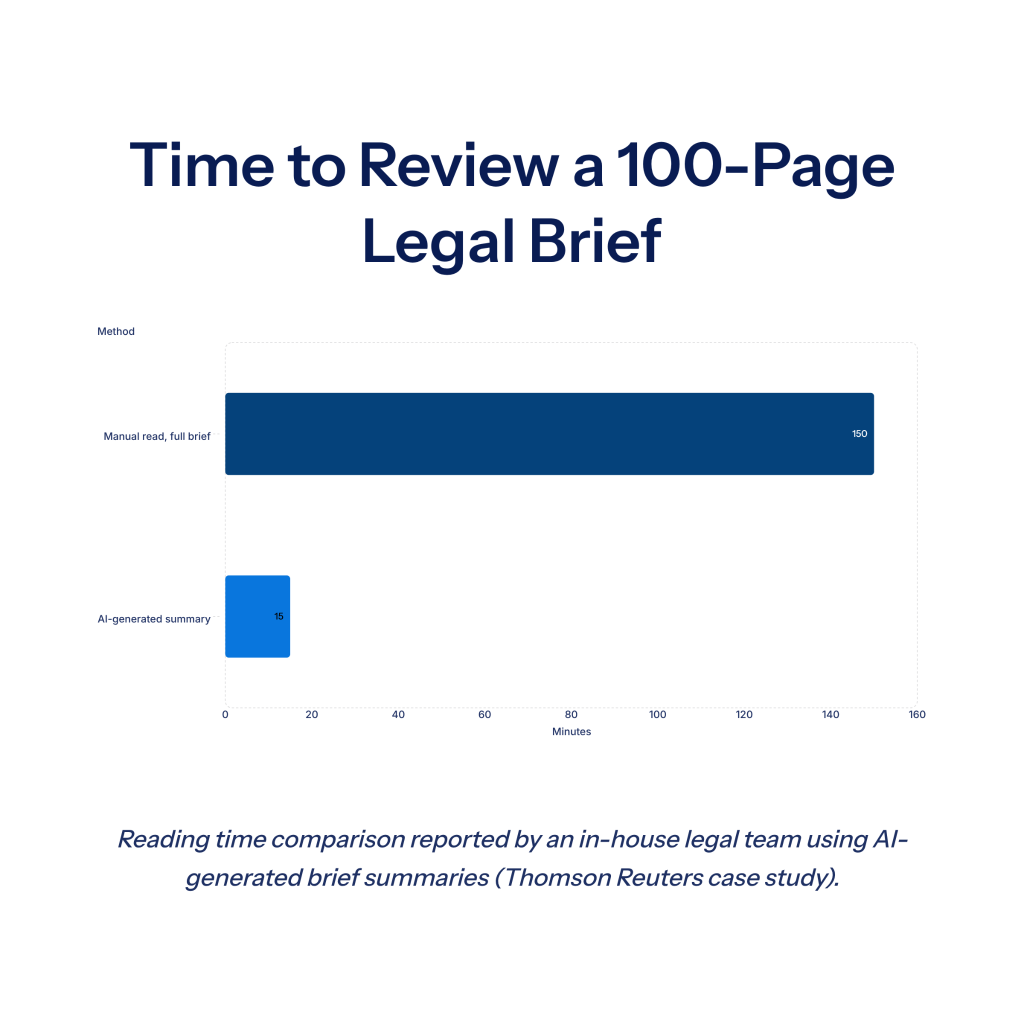
The time savings come from two places: the volume of documents AI removes from the review queue and the time saved on each remaining document.
According to industry analysis from ComplexDiscovery, mature TAR systems commonly filter out 80 to 90 percent of irrelevant documents during first pass review. A 50,000 document collection might leave only 5,000 to 10,000 documents requiring human attention. On the documents that do get reviewed, generative AI summaries shorten the time per document significantly. Attorneys can scan an AI-generated summary first, then drill down only into the sections that matter, rather than reading every page front to back.
| Metric | Manual Review | AI-Assisted Review |
| Documents requiring attorney eyes | 100% of collection | Roughly 10 to 20% |
| Cost per document reviewed | $1.50 to $3.00 | $0.11 to $0.50 |
| Validation against recall targets | Manual sampling, no statistical recall measure | Standard process, with 80% recall a common industry target |
| Staffing required for large reviews | Full review team | Significantly reduced |
The ranges above come from ComplexDiscovery’s industry analysis cited above and EY’s AI document review guidance.
Where AI Speeds Up Litigation Case Prep
Document review is not a single task. It runs across the full case lifecycle, from initial intake through discovery, depositions, and trial prep. AI compresses the timeline at each stage, and the specific gains differ by phase.
First Pass Review and Issue Tagging
This is where the largest volume reduction happens. AI ranks the document population by responsiveness and tags each document with case-relevant issues. Reviewers start with the highest-ranked documents and stop when relevance drops off, rather than reviewing every file. The Sedona Conference and federal courts have repeatedly confirmed that this approach meets discovery obligations when properly validated.
Privilege Review
Privilege review is one of the most expensive parts of any litigation. AI models trained on privilege patterns identify candidate documents for attorney review and flag potential privilege claims, including inadvertent production risks. The result is a smaller, prioritized privilege log queue rather than a flat review of every communication involving counsel.
Medical Records Analysis in Personal Injury Cases
Personal injury cases live or die on medical records, and those records arrive as thousands of pages of provider notes, billing codes, imaging reports, and intake forms. We built our AI medical records processing to handle this specific workflow. The platform processes records visit by visit, organizes them chronologically by provider and date of service, and surfaces complaints, diagnoses, treatments, and billing codes in a structured format. Tasks that used to consume paralegal time for days, like building a treatment timeline or pulling every reference to a specific injury, become near-instant queries.
Deposition Preparation
AI processes deposition transcripts page by page, summarizes key testimony, identifies admissions and inconsistencies, and lets attorneys query specific witness statements through natural language. Instead of re-reading a 300 page transcript before a follow-up deposition, an attorney can ask the system to surface every reference to a specific event or fact.
Demand Letters, Pleadings, and Discovery Responses
Once case materials are organized, generative AI can draft documents directly from the case file. We use legal document automation inside DocuLex to auto-populate demand letters, discovery responses, and pleadings using verified facts from the underlying record. The attorney still reviews and edits, but the blank page problem disappears.
How Much Does AI Document Review Actually Cost?
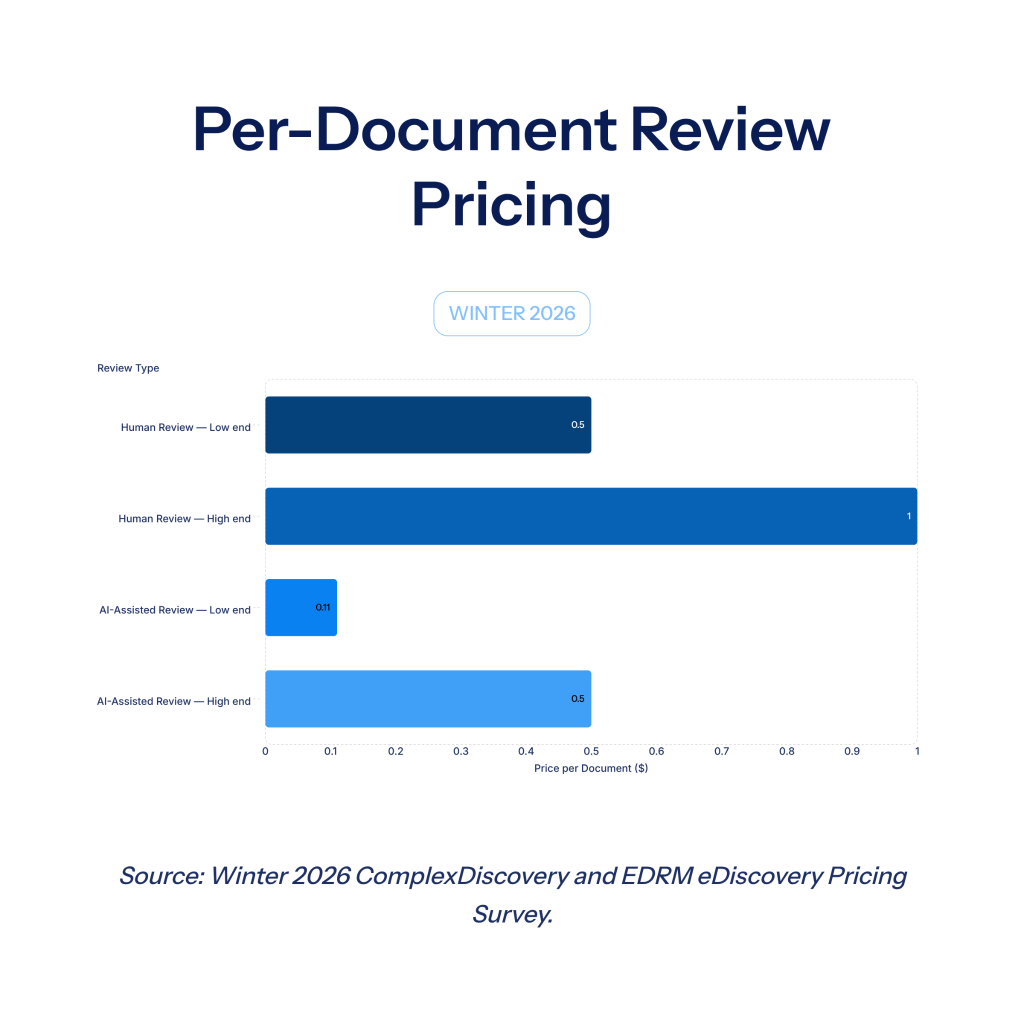
Per-document economics are the clearest argument for AI-assisted review. The Winter 2026 ComplexDiscovery and EDRM eDiscovery Pricing Survey reports current human per-document review rates clustering in the $0.50 to $1.00 range, while AI-assisted review pricing has dropped into the $0.11 to $0.50 zone, down from the $1.50 to $3.00 that human reviewers commanded only a couple of years ago. On a 100,000 document case, the maximum spread between the high end of human review and the low end of AI-assisted review represents roughly $89,000 in potential savings.
Cost savings come from concentrating attorney time on the documents that actually drive case outcomes, with software handling the high-volume processing work in the background. Firms that have implemented AI review at scale have reported six-figure annual savings, primarily through reduced outside counsel and contract attorney spend on first pass review.
Is AI Document Review Accurate Enough for Litigation?
Accuracy is the fair concern. Two issues come up most often: hallucination, where generative models invent facts, and consistency, where AI classifications drift across a large dataset.
Both are solvable with the right architecture. Structured retrieval, where the AI is constrained to information actually present in the case file rather than its general training data, eliminates hallucination on factual questions. This is the design pattern we use across the DocuLex platform. The AI does not draw on outside knowledge when answering questions about a case. It works against vector embeddings of the documents the firm has uploaded, processed page by page so the output reflects the actual record rather than the model’s general training data.
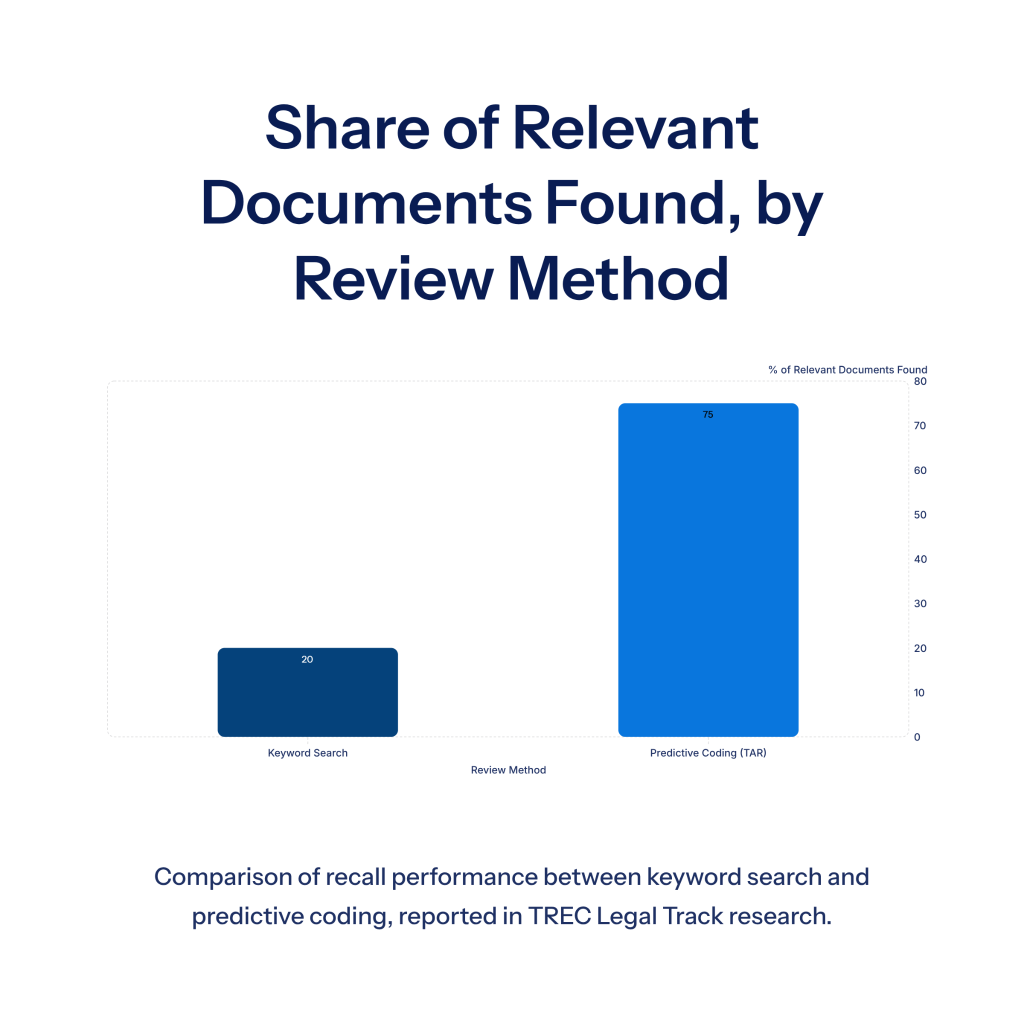
On classification accuracy, validated TAR workflows are measured against statistical recall targets, with 80 percent recall serving as a widely cited industry benchmark and well-tuned implementations achieving higher rates. Independent academic research, including studies from the TREC Legal Track research program, has shown for years that predictive coding finds substantially more responsive documents than keyword search alone.
The other safeguard is human oversight. AI handles volume and surfaces what matters. Attorneys still make the legal judgments. EY’s guidance reinforces this point: AI tools work best when paired with experienced human review.
What to Look For in an AI Document Review Tool
Litigation teams evaluating AI document review software should focus on a short list of criteria.
- HIPAA compliance and data security. Personal injury cases involve protected health information. Any platform processing medical records needs HIPAA compliance, encryption at rest and in transit, and clear data handling terms with any underlying AI providers.
- Citations back to source documents. Generative summaries should link directly to the page they came from. If the tool cannot show its work, the output cannot be trusted in litigation.
- Litigation-specific design. General purpose AI tools were not built for discovery workflows, privilege logs, or medical chronologies. Look for software built around the structures litigators actually use.
- Page-level and visit-level processing. Documents should be broken down into reviewable units, not treated as monolithic files. This is what makes accurate retrieval possible.
- Predictable pricing. Per-seat plus usage models are common. Make sure you understand the cost structure before scaling.
DocuLex was designed around these criteria from the start. Our intelligent litigation platform combines case file management, document generation, and a built-in legal AI chatbot that answers natural-language questions about your case files, all within a HIPAA-compliant environment built on AWS.
Frequently Asked Questions
These are the questions we hear most often from litigation teams evaluating AI document review for their practice.
How Much Faster Is AI Document Review Compared to Manual Review?
AI document review typically reduces review time by 50 to 90 percent depending on the task. First pass review sees the largest gains, often filtering out 80 to 90 percent of the document population before attorney review begins.
Is AI Document Review Admissible in Court?
Yes. Federal courts have approved AI-assisted review since 2012, beginning with Judge Peck’s opinion in Da Silva Moore v. Publicis Groupe. Subsequent decisions have reinforced that properly validated AI review meets discovery obligations under the Federal Rules of Civil Procedure.
Does AI Document Review Replace Attorneys?
No. AI handles volume and surfaces relevant material. Attorneys still make legal judgments about responsiveness, privilege, and case strategy. The combination produces better results than either alone.
How Does AI Handle Privilege Review?
AI models flag candidate privileged documents based on patterns like attorney-client communications and work product indicators. Attorneys review the flagged set, which is significantly smaller than the full document population.
Can AI Document Review Handle Medical Records?
Yes, when the platform is HIPAA compliant. Specialized tools process medical records visit by visit, organize them chronologically, and surface diagnoses, treatments, and billing codes in structured formats.
Building a Faster Case Prep Workflow
AI document review is no longer experimental. Federal courts have approved it, the cost economics favor it, and the time savings are large enough that firms not using it are at a competitive disadvantage on complex matters. AI handles the volume work that has historically consumed associate and paralegal hours, while attorneys focus on the legal judgments that drive case outcomes.
If you want early access to DocuLex when our litigation platform opens to new firms, join the waitlist and we will reach out as seats become available.