

AI document automation is the use of artificial intelligence to generate legal documents directly from case materials: medical records, deposition transcripts, billing statements, and discovery files. Traditional template-based systems fill in blanks on pre-built forms. AI document generation does something different. It reads your actual case data, identifies relevant facts, and produces case-specific work products.
At DocuLex.ai, we built our document automation platform for this second category. Our founder, Jason L. Melancon, spent over 20 years practicing civil litigation before building DocuLex, and the platform reflects a core frustration: template-based tools don’t help with the work that actually consumes litigation teams’ time. Processing a 2,000-page medical file. Synthesizing billing records across a dozen providers. Drafting a demand letter that weaves together liability, treatment history, and damages calculations. That work requires AI that can read and reason through unstructured data.
This guide covers what AI document automation means for litigation practices, where the technology stands in 2026, and what to evaluate before adopting it.
Template Automation vs. AI Document Generation
The term “document automation” gets applied to two fundamentally different technologies. The distinction matters because most litigation bottlenecks fall squarely on one side.
Template automation has been around for over two decades. It maps structured data (fields you fill out in a questionnaire or case management system) to variables in a pre-built document. The software applies conditional logic to adjust pronouns, dates, and boilerplate clauses. It works well for standardized documents: retainer agreements, routine correspondence, form discovery requests.
AI document generation works from the other direction. Instead of requiring a human to structure the data first, AI processes unstructured source materials directly. It reads raw medical charts, handwritten physician notes, deposition transcripts, and billing statements. It extracts relevant information, identifies patterns, and generates drafts that reflect the specific facts of the case.
| Feature | Template Automation | AI Document Generation |
| Data input | Structured fields (questionnaires, forms) | Unstructured documents (medical records, transcripts, case files) |
| Human effort required | Someone must read records and manually enter data into fields | AI reads source materials directly |
| Output type | Pre-built forms with populated fields | Case-specific drafts generated from actual evidence |
| Best suited for | Standardized, repetitive documents (retainers, form letters) | Complex, fact-intensive documents (medical summaries, demand letters, deposition digests) |
| Handles volume and complexity | Limited by how fast a human can enter data | Scales with document volume; processes thousands of pages |
For litigation teams, the distinction is practical. Template automation helps with the 20% of documents that follow a fixed structure. AI document generation targets the 80% that involves reading, synthesizing, and writing from complex source materials.
What AI Document Generation Does in a Litigation Practice
The workflows that consume the most paralegal and associate time in personal injury and civil litigation are the same ones where AI document generation has the most impact.
Medical Record Summarization
Organizing medical records is the connective tissue of personal injury case preparation. A single case can involve thousands of pages spanning multiple providers, years of treatment, and dozens of visit types. The traditional process requires a paralegal to read every page, index the records, extract treatments and diagnoses, note gaps, identify pre-existing conditions, and build a chronological narrative. The American Bar Association has noted that paralegals must arrange and synthesize voluminous records that often span decades across multiple providers.
AI document generation changes this workflow. When medical files are uploaded into a platform with AI medical records processing capabilities, the system standardizes formatting, runs optical character recognition on handwritten notes, and extracts specific data points: dates of service, provider names, diagnostic codes, medications, subjective complaints, and treatment plans. The output is a structured, chronological medical summary.
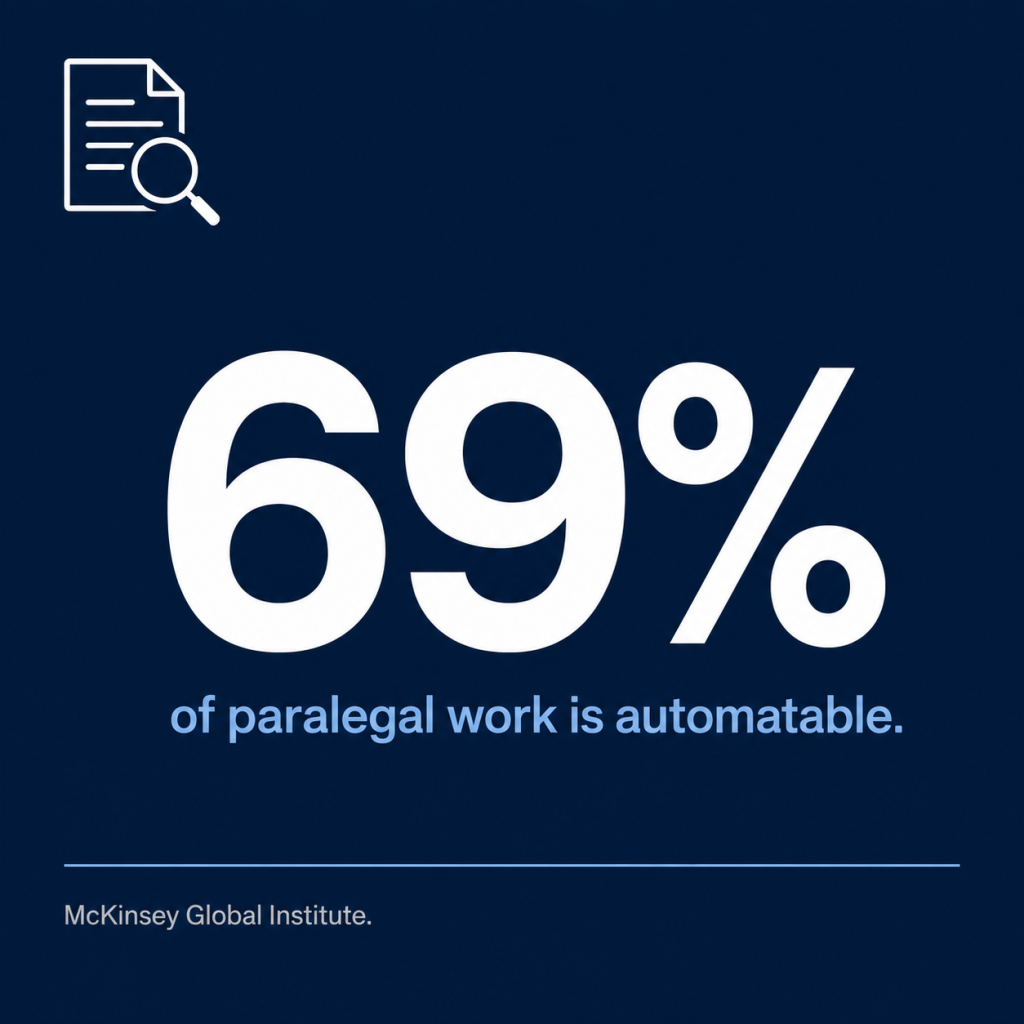
The paralegal’s role shifts from data entry to analysis. Instead of typing out a timeline, they review the AI’s output, cross-reference it against the legal strategy, and identify missing records or weaknesses in causation. A McKinsey Global Institute study found that 69% of paralegal work activities are susceptible to automation, with data collection and processing being the most automatable categories. That is exactly the type of work AI document generation automates.
Settlement Demand Letters
A demand letter pulls together everything from the pre-litigation phase: liability narrative, treatment chronology, special damages calculations, and general damages. Drafting one from scratch means pulling from police reports, medical summaries, billing records, and case notes, then constructing a persuasive document from all of it.
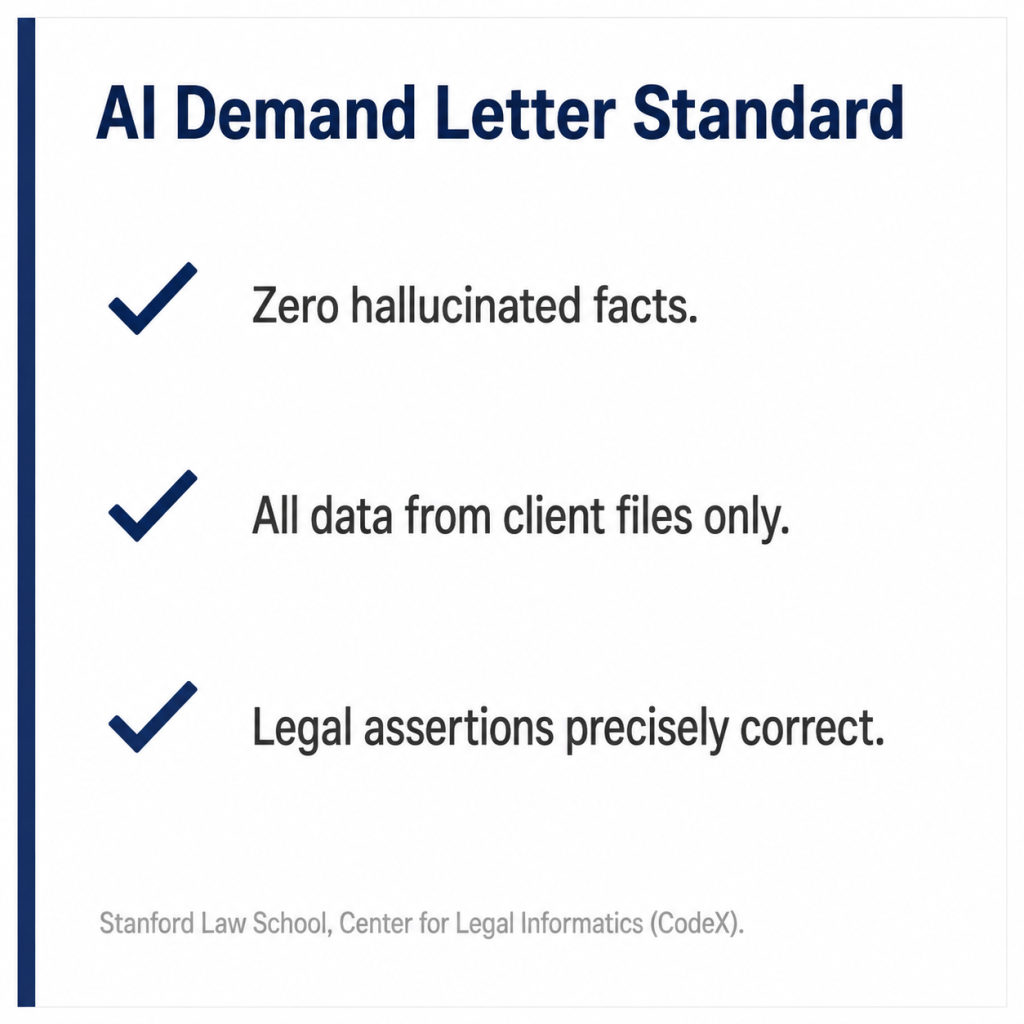
AI document generation handles the assembly. The system draws from medical chronologies, billing summaries, and case files already processed on the platform to produce a structured draft. Stanford Law School’s Center for Legal Informatics (CodeX) has developed an evaluation framework for AI-generated demand letters, requiring that drafts contain zero hallucinated facts, that all information trace strictly to client-provided data, and that legal assertions be precisely correct.
The attorney’s job becomes editorial: applying experienced judgment to ensure the narrative carries the right tone, emphasizes the strongest facts, and meets jurisdictional requirements. The hours previously spent assembling the document shift toward refining it.
Deposition Transcript Analysis
During discovery, attorneys face thousands of pages of deposition transcripts. Extracting contradictory statements, party admissions, or testimony from specific experts is labor-intensive. AI tools with litigation document management capabilities can process transcript collections and let attorneys query them using natural language. Summarize a witness’s testimony on a specific event. Identify inconsistencies between deponents. Pull every reference to a particular piece of evidence.
That gives every litigator the kind of instant recall and cross-referencing that would otherwise require a team of associates reading transcripts for days.
Discovery Responses
AI document generation also applies to discovery compliance. When discovery requests arrive, an AI system can scan stored case materials, identify responsive information, and draft initial responses. The attorney reviews and refines, but the foundation is already built from actual case data rather than starting from a blank page.
Where the Legal Industry Stands on Adoption
AI adoption in legal practice is no longer an early-adopter story. According to Thomson Reuters Institute’s 2026 AI report, organization-wide AI adoption in professional services reached 40% in 2026, nearly doubling from 22% just a few years earlier. Fifteen percent of elite firms have moved beyond basic chatbot use into “Agentic AI,” deploying autonomous agents that execute multi-step workflows with minimal human supervision.
An analysis of the 2025 Clio Legal Trends Report found that 79% of legal professionals now use AI in some capacity. The data also reveals a direct correlation between AI adoption and firm growth:
- Firms with 20%+ revenue growth over four years use AI-driven automation at twice the rate of stable firms and nearly three times the rate of shrinking firms
- Large firms lead at 87% adoption, but solo practitioners report 71%, using AI to compensate for limited staff
- 65% of AI users report improved work quality; 62% say it reduces tedious work; 48% report better work-life balance
The adoption gap is becoming a competitive gap. Firms that automate document-heavy workflows are handling more cases with the same team size. Firms that don’t are absorbing the full cost of manual processing.
HIPAA Compliance and Data Security
For litigation attorneys handling personal injury, medical malpractice, or workers’ compensation cases, AI document automation raises an immediate question: what happens to the medical records you upload?
The answer depends entirely on the platform. And getting it wrong carries serious consequences.
The Business Associate Agreement Requirement
When a law firm uses a cloud-based AI platform to process medical records, the vendor functions as a business associate under HIPAA. Federal law requires a BAA (Business Associate Agreement) before any protected health information is transmitted. The BAA legally binds the vendor to implement the same safeguards required of the firm itself.
Using consumer-grade AI tools (the free versions of general-purpose chatbots) to process medical records without a BAA in place is a breach of both federal privacy law and legal ethics. A peer-reviewed study published through the National Institutes of Health documented the liability risks of healthcare providers and legal professionals inputting patient data into publicly available AI tools that may retain and use that data for model training.
What a Secure Platform Looks Like
The baseline requirements for any AI platform processing litigation files with medical data:
- A valid Business Associate Agreement with the AI provider, ensuring protected health information is handled according to HIPAA requirements
- Zero data retention policies where medical records are processed but not stored for model training or any secondary purpose
- End-to-end encryption for data at rest and in transit
- Isolated firm data preventing cross-client or cross-firm visibility
- Enterprise-grade infrastructure (AWS or equivalent) with regular security audits
At DocuLex, we maintain HIPAA-compliant infrastructure on AWS with SSE-KMS encryption and hold a Business Associate Agreement with OpenAI. Medical data processed through our platform is not retained after analysis. These are not optional features. For any firm handling medical records, they are prerequisites.
The federal government is also updating the HIPAA Security Rule to strengthen cybersecurity requirements around business associate relationships, so compliance is an ongoing obligation.
Ethics Rules and the Impact on Billing
The ABA’s Formal Opinion 512 (issued July 2024) is the most significant ethical guidance on AI use in legal practice. Every litigation attorney using or considering AI document automation should understand its implications.
What the ABA Requires
- Competence (Rule 1.1): Attorneys must understand both the capabilities and limitations of any AI tool they use. This duty is ongoing as the technology evolves.
- Confidentiality (Rule 1.6): Client data cannot be input into AI systems without informed consent. The ABA specifies that standard boilerplate language in engagement letters is not sufficient.
- Supervision (Rules 5.1, 5.3): Supervising attorneys must establish firm-wide AI policies and ensure all staff, including paralegals and associates, are trained on them.
- Verification: Every AI-generated output must be reviewed by a human for accuracy. Multiple federal courts now require AI certification in filings, where the drafting attorney certifies under penalty of Rule 11 sanctions that all citations and facts were verified against actual sources.
The Billing Question
Formal Opinion 512 directly addresses fees. Attorneys who bill hourly may only charge for actual time spent on a task. If AI reduces a 10-hour medical summary to 20 minutes of generation plus review, the client is billed for the actual time worked. Attorneys cannot charge the historical time equivalent or add a technology surcharge.
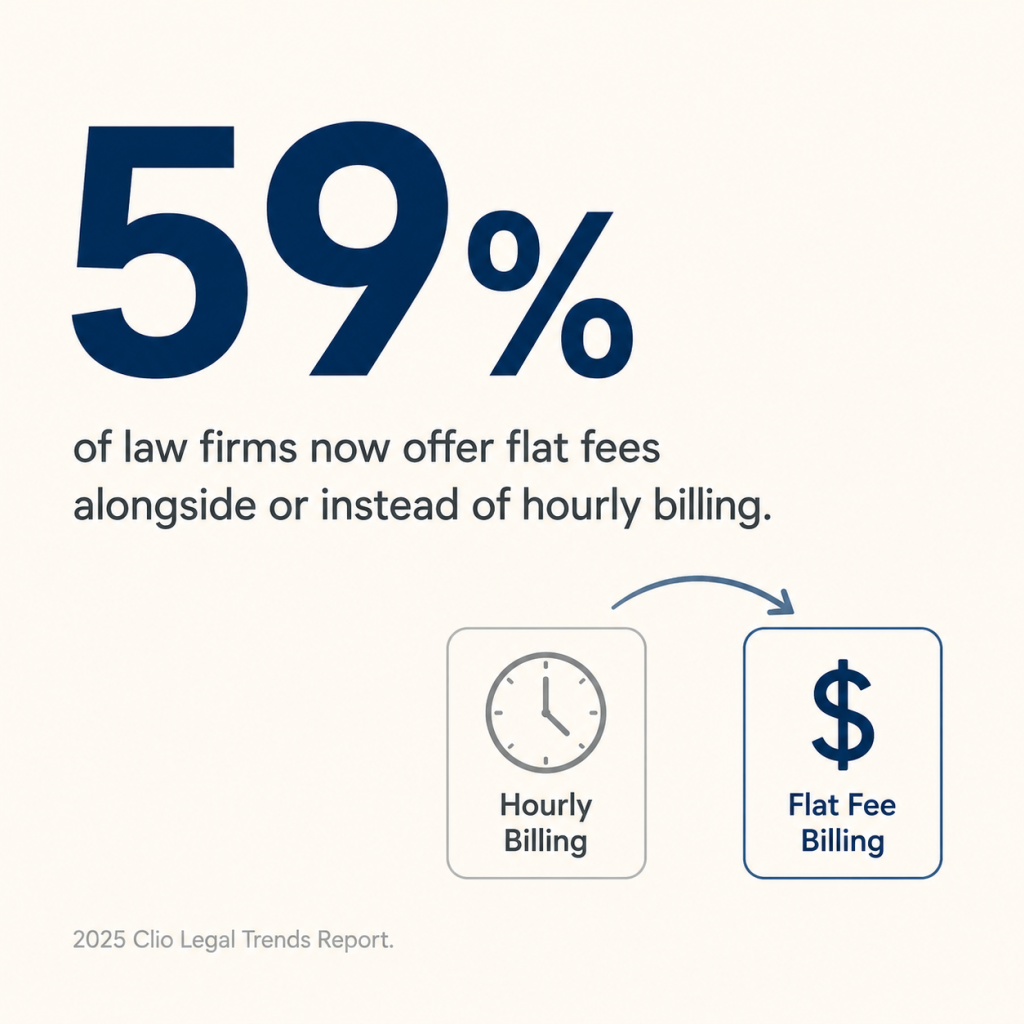
This creates a real tension with hourly billing. As the Clio Legal Trends data shows, 59% of firms now offer flat fees either exclusively or alongside hourly rates, a trend directly correlated with AI-driven efficiency. Firms that shift to flat-fee or value-based billing capture the economic benefit of AI without ethical conflicts. Firms that cling to hourly billing will see revenue decline as the same work takes less time.
The Florida Bar has echoed this position, explicitly ruling that attorneys cannot charge hourly fees for time that would have been spent without AI assistance.
The Hallucination Risk and How to Manage It
AI hallucinations (fabricated facts, fictitious case citations, non-existent statutes) remain a real risk. Attorneys have faced sanctions and reprimands for submitting filings that contained AI-generated fabrications they failed to verify.
The risk is highest with open-domain AI tools that generate responses from general training data. Platform-specific AI that uses Retrieval-Augmented Generation (RAG), where the model only draws from documents you’ve uploaded to your case file, significantly reduces this risk. The AI is constrained to the evidentiary record rather than pulling from internet-scraped data.
No AI system eliminates the need for human review. The practical framework:
- Use AI platforms that ground outputs in your uploaded case materials, not general knowledge
- Verify every factual claim, citation, and date against the source documents
- Treat AI output as a first draft, not a final product
- Establish firm-wide review protocols before any AI-generated content is filed or sent
The California State Bar’s guidance puts it plainly: overreliance on AI tools is inconsistent with the practice of law and the application of trained human judgment.
What to Look for When Evaluating AI Document Automation
Not every tool that calls itself “AI document automation” does the same thing. When evaluating platforms, these questions separate useful tools from marketing claims:
- Does it process unstructured data? If the tool requires you to fill out forms or structured fields before generating documents, it is template automation. AI document generation should read your raw case files directly.
- Does it work from your case materials? The AI should generate documents from the medical records, transcripts, and files you have uploaded, not from general training data. This is what Retrieval-Augmented Generation enables.
- Is it HIPAA-compliant with a BAA? For any firm handling medical records, a valid Business Associate Agreement is non-negotiable. Ask about data retention policies and encryption standards.
- What document types does it generate? Look for specific litigation outputs: medical chronologies, billing summaries, demand letters, deposition digests, discovery responses. Generic “document drafting” claims don’t tell you much.
- How does it handle accuracy? Ask about hallucination mitigation. Does the platform cite source documents in its output? Can you trace generated text back to specific pages in your case file?
- Was it built for litigation? An AI paralegal tool designed for litigation workflows will handle the document types, filing structures, and compliance requirements that general-purpose AI tools miss.
Frequently Asked Questions
Is AI document automation the same as document assembly?
No. Document assembly (template automation) uses structured fields and conditional logic to fill in pre-built forms. AI document automation reads unstructured case materials (medical records, transcripts, billing records) and generates case-specific documents from that data. Both fall under the “document automation” label, but they solve different problems.
Can AI replace paralegals in a litigation practice?
AI does not replace paralegals. It changes what they spend their time on. Instead of manually building medical chronologies page by page, paralegals review and refine AI-generated summaries, cross-reference against case strategy, and focus on analysis rather than data entry.
What are the HIPAA requirements for using AI on medical records?
Any AI platform processing protected health information must have a valid Business Associate Agreement with your firm. The platform should use end-to-end encryption, maintain a zero-data-retention policy for medical records, and operate on isolated infrastructure that prevents cross-firm data access.
How does ABA Formal Opinion 512 affect billing for AI-assisted work?
Attorneys billing hourly may only charge for actual time spent. If AI reduces a task from 10 hours to 30 minutes, you bill for 30 minutes. You cannot charge the historical time equivalent or add a technology surcharge. This is pushing many firms toward flat-fee or value-based billing models.
How do I know if an AI tool is generating accurate documents?
Look for platforms that use Retrieval-Augmented Generation, meaning the AI draws only from documents in your case file rather than general knowledge. Verify every output against source materials. Treat AI-generated documents as first drafts that require attorney review before use.
Start With the Work That Takes the Most Time
The cases already on your desk have medical files that need summarizing, billing records that need organizing, and demand letters that need drafting. AI document automation handles the synthesis so your team can focus on strategy, client communication, and trial preparation.
DocuLex.ai was built for exactly this workflow. Our platform generates medical visit summaries, billing summaries, pre-trial orders, discovery responses, and more directly from the case materials you upload. Built by a practicing civil litigation attorney, backed by HIPAA-compliant infrastructure, and designed around how litigation teams actually work.
Join the waitlist to see how it works with your caseload.