

For federal court filings in 2026, the AI tool worth using is the one that lets you trace every output to a real source and confirm it before you sign. That single test now outweighs feature count, price, and brand reputation, because federal courts have spent the year sanctioning attorneys personally for filing AI-fabricated citations, and “the AI did it” has not survived as a defense in a single reported case. By early April 2026, one academic tracker had logged 811 U.S. court filings containing AI hallucinations, and U.S. courts imposed $145,000 in direct sanctions for fake citations in the first quarter alone.
We built DocuLex as a practicing litigator’s answer to that risk. Our founder, a civil litigation attorney with more than 20 years in personal injury and complex litigation, uses the platform in his own practice, and we designed it around one principle: the AI works only from your firm’s own case files, processes them in small structured pieces to limit fabrication, and leaves a licensed attorney to confirm every output before it goes near a filing. The sections below cover what “best” has to mean for federal work, the categories of tools you will touch in a federal matter, and what to demand from each.
Why federal courts are sanctioning attorneys for AI in 2026
The risk for 2026 is not theoretical. Federal courts have moved from one-off warnings to published doctrine, and the rulings share a common holding: responsibility attaches at the moment you sign and file, no matter who or what produced the text.
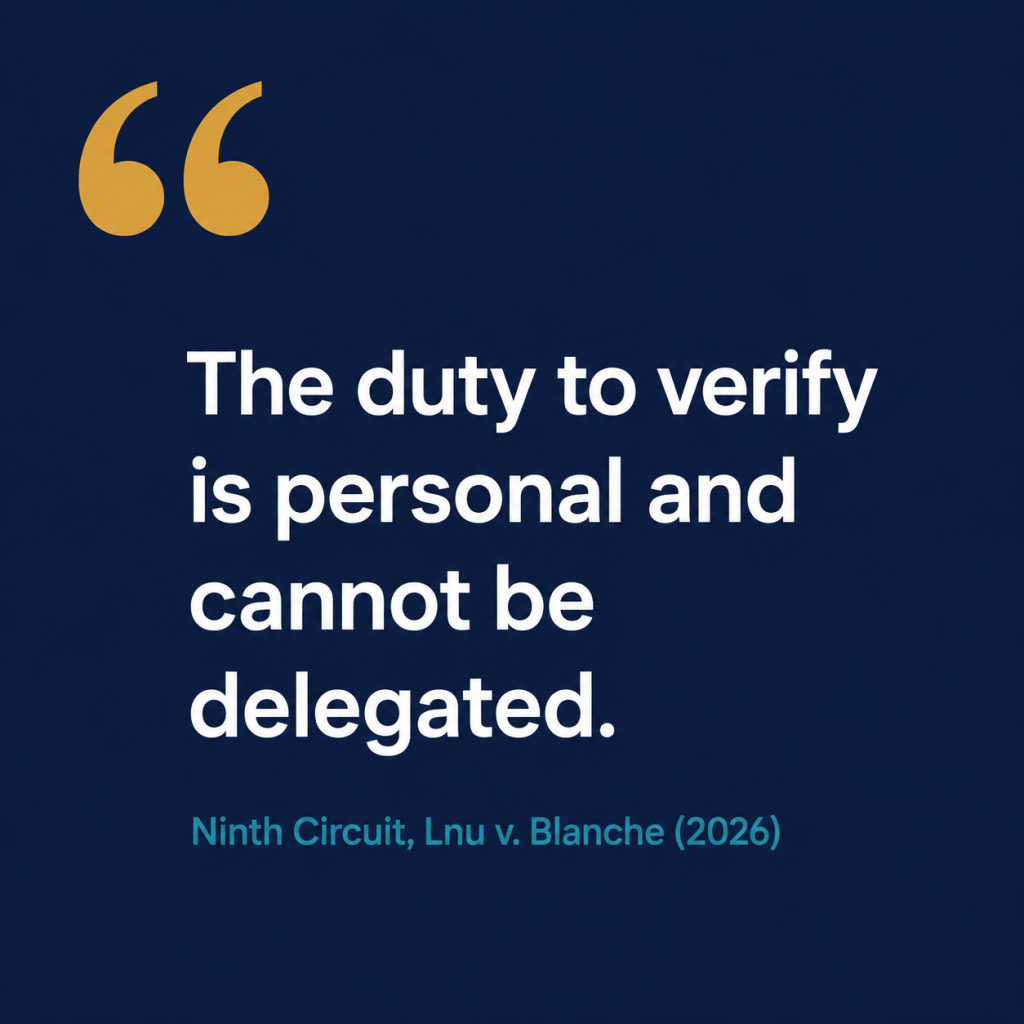
In June 2026, the Ninth Circuit suspended two attorneys from practice before the court for six months and fined them $2,500 each after their opening brief cited cases that did not exist. The attorneys blamed an unlicensed law graduate who had used generative AI without authorization, then tried to recast the fabricated cases as typographical errors. The court rejected both defenses. It held that the duty to verify is personal and cannot be delegated, and that passing off an AI fabrication as a typo was a separate failure of candor that lengthened the suspension. The Ninth Circuit’s published order lays out the full reasoning.
A common and expensive assumption is that paying for an enterprise legal AI platform removes the danger. It does not. In a separate 2026 ruling, the Sixth Circuit disciplined an attorney who relied on a premium, purpose-built legal research platform to draft appellate briefs. The platform misquoted and misrepresented the holdings of two real cases, and the attorney filed without independently confirming them. The court disqualified the attorney, denied all fees for the appeal, and referred the matter for discipline, holding that a vendor’s accuracy claims buy no safe harbor and that the duty to supervise AI matches the duty to supervise staff. The Sixth Circuit’s ruling is worth reading before you trust any platform’s marketing.
The penalties across 2026 share a pattern: personal fines, fee-shifting, and practice restrictions that follow the attorney for months.
| 2026 ruling | Court | What triggered it | Penalty |
| Lnu v. Blanche | 9th Cir. | Fake citations, then called typos | $2,500 per attorney, six-month suspension |
| Whiting v. City of Athens | 6th Cir. | More than two dozen fake citations | $30,000 in fines, opposing fees, double costs |
| United States v. Farris | 6th Cir. | Premium platform misquoted real cases | Disqualified, denied all fees, discipline referral |
| McCormick v. Texakoma | E.D. Tex. | Fake case, blamed departed staff | $5,000, one year of sworn verification certificates |
| Couvrette v. Wisnovsky | D. Or. | 15 fake cases, 8 fabricated quotes | $15,500, case dismissed with prejudice |
The last row is the one every litigator should sit with. In the Oregon case, the sanction did not stop at the attorney. The court dismissed the client’s claims with prejudice, ending the lawsuit entirely over citations the attorney never verified.
What “best” actually means for federal court filings
Once you accept that verification is personal, the features that sell most AI tools stop being the ones that matter. Four criteria separate a tool that is safe for federal work from one that becomes a liability the moment you rely on it.
| Criterion | Safe for federal filings | Risky for federal filings |
| Citation verifiability | Every output links to the exact source you can open and read | Produces fluent text with no traceable source |
| Processing method | Works on small, defined tasks inside your own documents | Writes whole briefs or answers open legal questions on its own |
| Confidentiality | Enterprise terms, no training on your inputs, data purged after use | Public account that may store and train on your prompts |
| Attorney review | Shows its evidence so you can confirm or reject each output | Hides its reasoning and hands you a finished draft to trust |
Citation verifiability and traceability
General AI tools fail in legal work because they generate plausible text rather than retrieve verified facts. A tool fit for federal filings forces the model to pull exact language from a closed set of documents you control, such as your own case file, and attaches a citation you can open and confirm in seconds. That is how you satisfy a court’s standing order or a state verification rule without re-researching everything the tool produced.
Segmented, small-piece processing
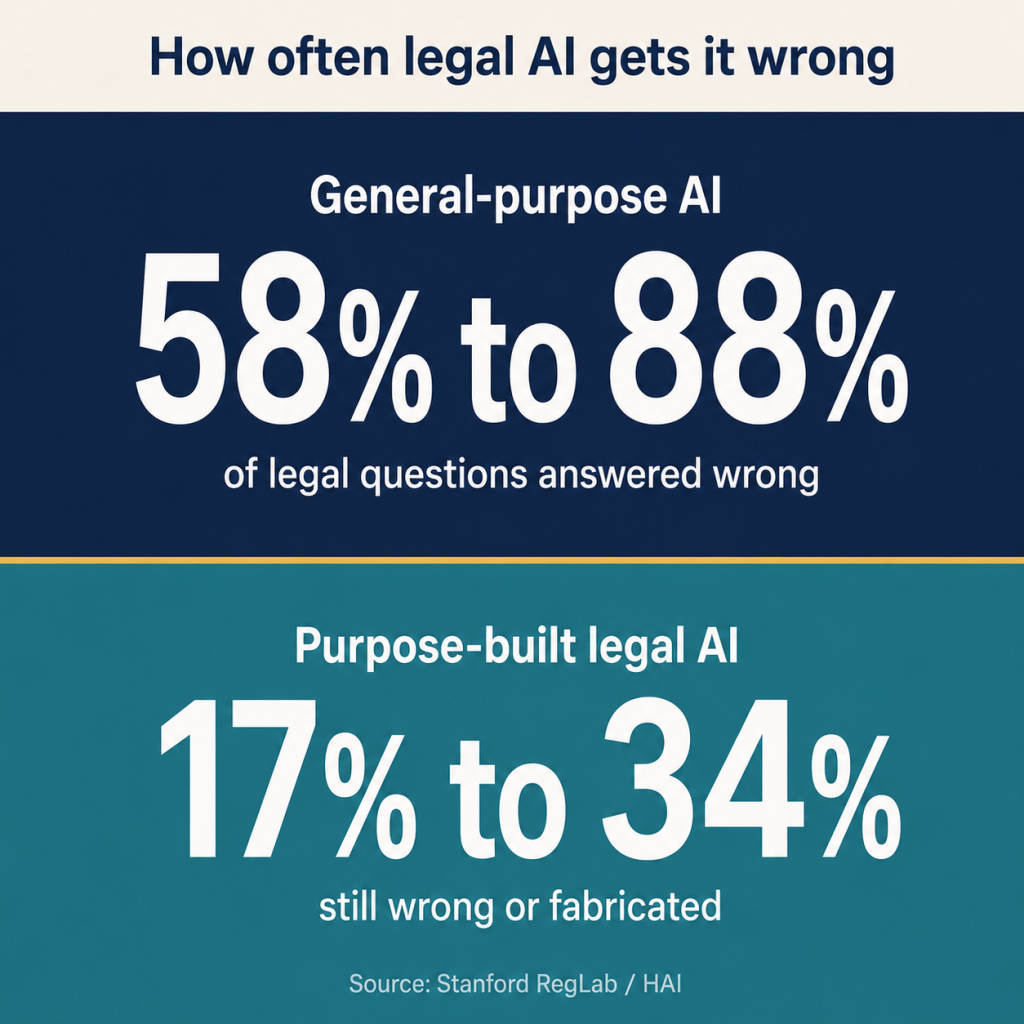
Stanford researchers found that general-purpose models hallucinated on 58% to 88% of legal questions, and a follow-up study showed that purpose-built legal tools using retrieval still produced wrong or fabricated answers 17% to 34% of the time. The pattern behind those numbers is consistent: the more open-ended the task, the higher the failure rate. A tool asked to write an entire motion invites the most fabrication. A tool handling narrow, defined tasks inside documents you uploaded (“find the date of the surgery in this record,” “compare the timeline in these two depositions”) gives the model far less room to invent.
Confidentiality and a zero-retention posture
Public AI accounts create a second danger that has nothing to do with hallucination. In early 2026, a federal court in New York held that materials a litigant prepared with a public, consumer AI tool were not protected by attorney-client privilege or work product, because the platform’s terms allowed it to collect and reuse the inputs. Months later, a Delaware court used a party’s recovered chatbot history as direct evidence of bad faith in a contract dispute. For confidentiality, a tool for legal work needs enterprise terms that prohibit training on your inputs. For personal injury work, it also needs full HIPAA compliance with a Business Associate Agreement and data that is purged after processing.
Attorney-in-the-loop verification
The 2026 judicial consensus is that the attorney is the final gatekeeper, and that role cannot be delegated to software. A tool that hides its reasoning or makes its outputs hard to audit works against you. The better design presents each finding next to the exact evidence it came from, so you review, confirm, or reject before anything reaches a draft.
The categories of AI tools in a federal filing workflow
A federal matter touches several kinds of AI, and each carries a different risk. Treat them separately rather than judging “AI” as one thing.
General-purpose AI chatbots
Consumer chatbots are the riskiest place to do legal work. They are not grounded in any verified database, their answers carry no traceable citations, and free or personal tiers may train on whatever you type. They are also the source of most sanctioned filings. If you use one at all, keep it to non-confidential, non-citational tasks, and never paste client facts, medical records, or case strategy into a public account.
Legal research and citation tools
For finding and confirming authority, demand inline citations that link to primary law you can open and read, not summaries you have to trust. The same enterprise lesson from 2026 applies. Even a respected legal platform can misstate a real case, so the value sits in how fast the tool lets you confirm a quote against the source, not in the brand on the invoice.
Document and pleading drafting tools
For drafting, the safest tools build from facts already in your file rather than from the open internet. A drafting assistant that pulls names, dates, and figures from your own verified records keeps the output traceable to your record. This is where DocuLex’s legal document automation generates letters, correspondence, and case summaries from your stored case data, so the facts in a draft come from documents you control. Auto-built federal pleadings, such as Rule 26(f) reports and exhibit lists, are on our roadmap rather than a current feature, so treat any tool that claims one-click federal filings with the skepticism it deserves.
Medical-record and case-file analysis
Personal injury federal filings ride on medical records, which makes this category both important and sensitive. The tool you use to read and summarize records should work only inside the file you uploaded, return summaries traced to specific pages, and handle protected health information under HIPAA with no retention after processing. Our AI medical records processing handles exactly this. It summarizes records and billing from the documents in a given matter, cites back to the source pages, and runs on infrastructure that does not retain medical data after analysis.
Case-file organization and retrieval
You cannot verify what you cannot find. A federal matter can run to thousands of pages, and a tool that organizes and retrieves that material lets you confirm a fact against the record in seconds instead of hours. Look for searchable, tagged storage that points to the exact document. We cover the workflow in our guide to organizing litigation case files with AI, and it is the backbone of DocuLex’s legal file management.
Where DocuLex fits
We do not position DocuLex as a tool that files your federal pleadings for you, and in 2026 you should be wary of any tool that claims it can. We built it around the failure mode that is getting attorneys sanctioned, with four design choices that map to the criteria above:
- It works from your own case file. The AI retrieves and drafts from the documents you upload, not from the open web, so the facts in an output trace back to your record.
- It processes in small, structured pieces. Rather than reasoning across an entire matter at once, the platform breaks work into narrow tasks, which limits the room for fabrication.
- It keeps medical data confidential. DocuLex runs on AWS with SSE-KMS encryption, is HIPAA compliant, operates under a Business Associate Agreement, and does not retain medical data after analysis. The specifics are on our data security page.
- It keeps you in the loop. The AI assistant retrieves answers from your case file and shows where they came from, so you confirm against the source rather than trust a black box. That is the thinking behind our legal AI chatbot.
The credibility here is practical. DocuLex is built by a civil litigation attorney who signs federal filings himself, which is why reliability and verification shaped the platform from the start. The platform is in active development, and we keep our claims to what it does today.
The verification step no AI tool removes
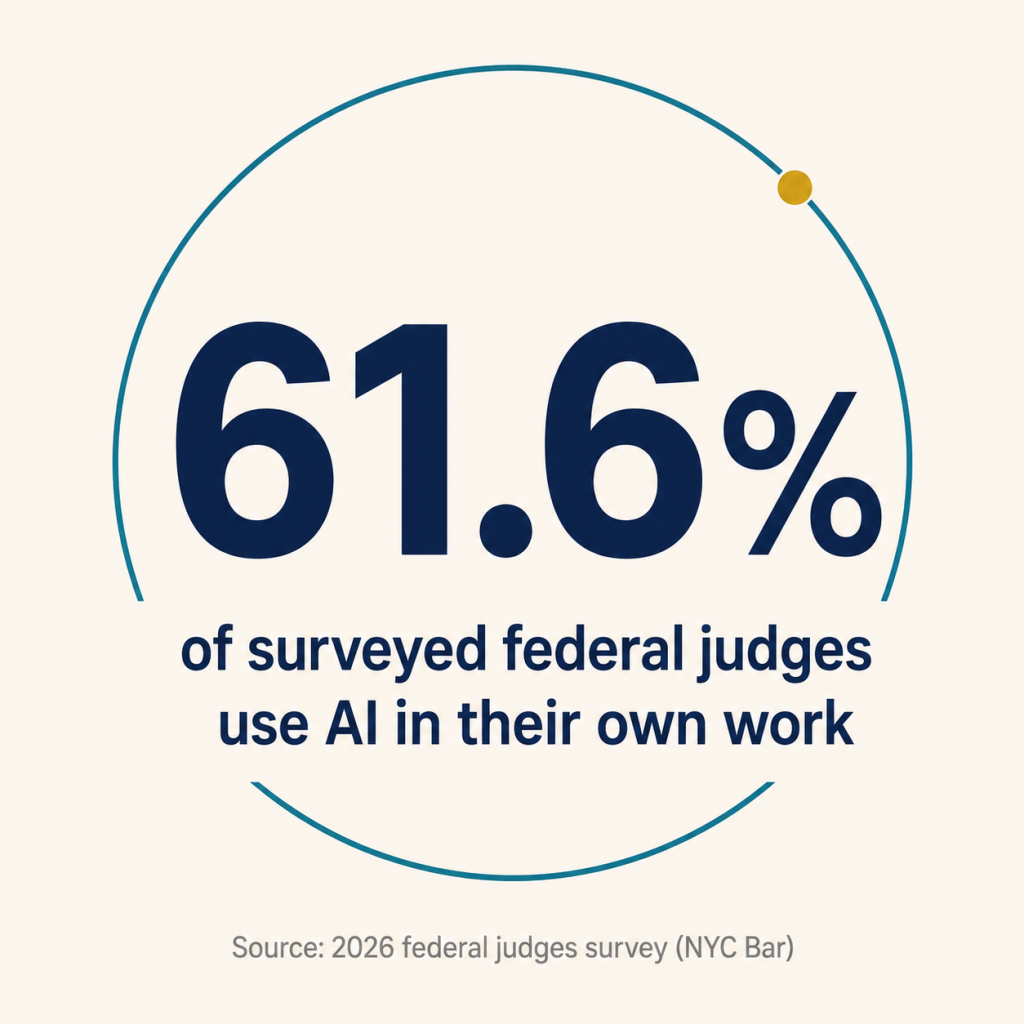
No tool, ours included, removes the attorney’s duty to verify, and the regulatory direction makes that permanent. More than 30 federal district courts now have standing orders requiring attorneys to disclose AI use and certify that a human checked every AI-assisted output. Florida went further: effective June 15, 2026, every attorney signing a filing must certify that the cited authorities exist and are quoted accurately, whether or not AI was involved. California guidance now states plainly that lawyers cannot hand legal judgment to an AI system. And a 2026 survey found that 61.6% of the federal judges surveyed use AI in their own work, which means the bench knows how these tools fail and how to catch the errors.
The practical takeaway is short. Choose tools that make verification fast, because the verification itself is not optional and never will be. The best AI tool for a federal filing is the one that hands you the evidence to check its work in seconds.
Frequently asked questions
Can you get sanctioned for using AI in a court filing?
You can be sanctioned for filing AI output you did not verify. Using AI itself is permitted, and federal courts in 2026 have said so directly. What they require is that the signing attorney personally confirm every citation and quote before filing.
Is it safe to use a public AI chatbot for federal filings?
No. Public chatbots are not grounded in verified law, produce citations you cannot trace, and may store or train on your inputs, which can waive privilege. For confidential or citational work, use a tool with enterprise terms, source-linked outputs, and no training on your data.
Do federal courts require you to disclose AI use?
It varies by court. More than 30 federal district courts have standing orders requiring disclosure or a verification certification, while others rely on existing competence and candor rules. Check the standing orders for your specific court and judge before filing.
What makes an AI tool safer for personal injury filings?
Personal injury filings depend on medical records, so the tool should work only inside your own files, trace summaries to specific pages, and handle protected health information under HIPAA with a Business Associate Agreement and no data retention after processing.
Get early access to DocuLex
We built DocuLex so the work it produces traces back to your own verified case file, the way federal practice in 2026 now demands. If you want litigation document tools designed around verification from the ground up, join our waitlist and we will reach out as we open access.