

Early discovery in federal court refers to any formal discovery activity conducted before the parties hold their Rule 26(f) planning conference. Under Federal Rule of Civil Procedure 26(d)(1), parties generally cannot serve interrogatories, take depositions, or seek other discovery until that conference takes place. Limited exceptions allow Rule 34 document requests delivered more than 21 days after service, pre-action depositions under Rule 27, discovery by mutual stipulation, and court-ordered expedited discovery on a showing of good cause.
At DocuLex.ai, our platform was built by civil litigation attorneys with more than 20 years of experience handling federal cases. We see firsthand how the early phases of a lawsuit shape everything that follows. The teams that organize and analyze case materials quickly tend to enter formal discovery with stronger positions, sharper requests, and faster response times.
This guide explains what early discovery means under the Federal Rules of Civil Procedure, when it’s permitted, and how litigators successfully request it.
Understanding the Federal Discovery Moratorium
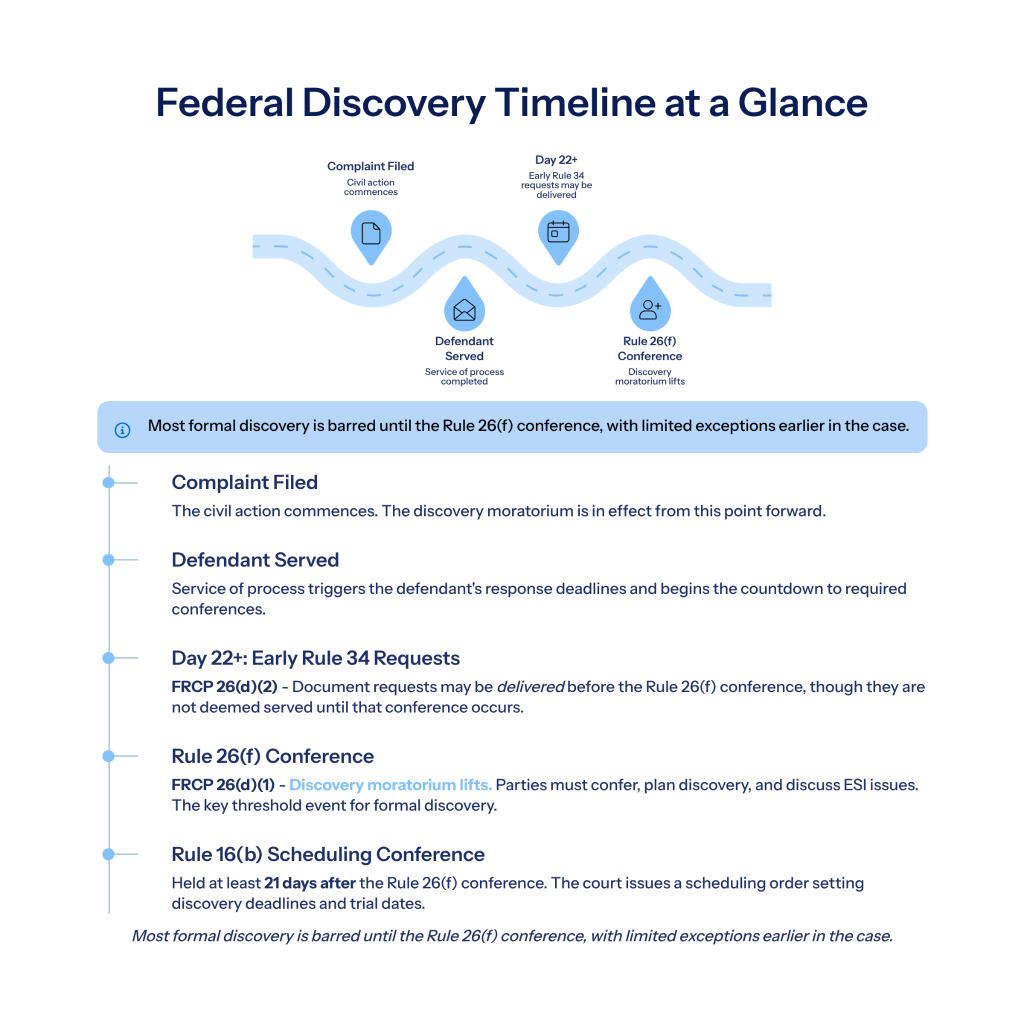
The starting point for any discussion of early discovery is the moratorium imposed by Rule 26(d)(1). The rule provides that a party may not seek discovery from any source before the parties have conferred as required by Rule 26(f), with narrow exceptions for situations authorized by other rules, by stipulation, or by court order.
This moratorium serves a practical purpose. The Rule 26(f) conference exists so parties can build a coordinated discovery plan before formal requests start flying. Holding discovery until that conference forces lawyers to talk first, identify the issues that actually matter, and avoid the kind of duplicative or overbroad requests that bog down litigation.
The moratorium typically lifts after the parties confer under Rule 26(f), which the rule itself requires to take place at least 21 days before the initial scheduling conference under Rule 16(b). Once that meeting happens, parties can serve interrogatories, requests for admission, depositions, and document requests under the timing rules of each individual discovery device.
Exceptions That Allow Early Discovery Under the FRCP
Several rules carve out exceptions to the moratorium, allowing parties to begin certain discovery activities before the Rule 26(f) conference. These exceptions exist because the drafters recognized that strict timing rules sometimes interfere with legitimate case preparation.
Early Rule 34 Document Requests After 21 Days
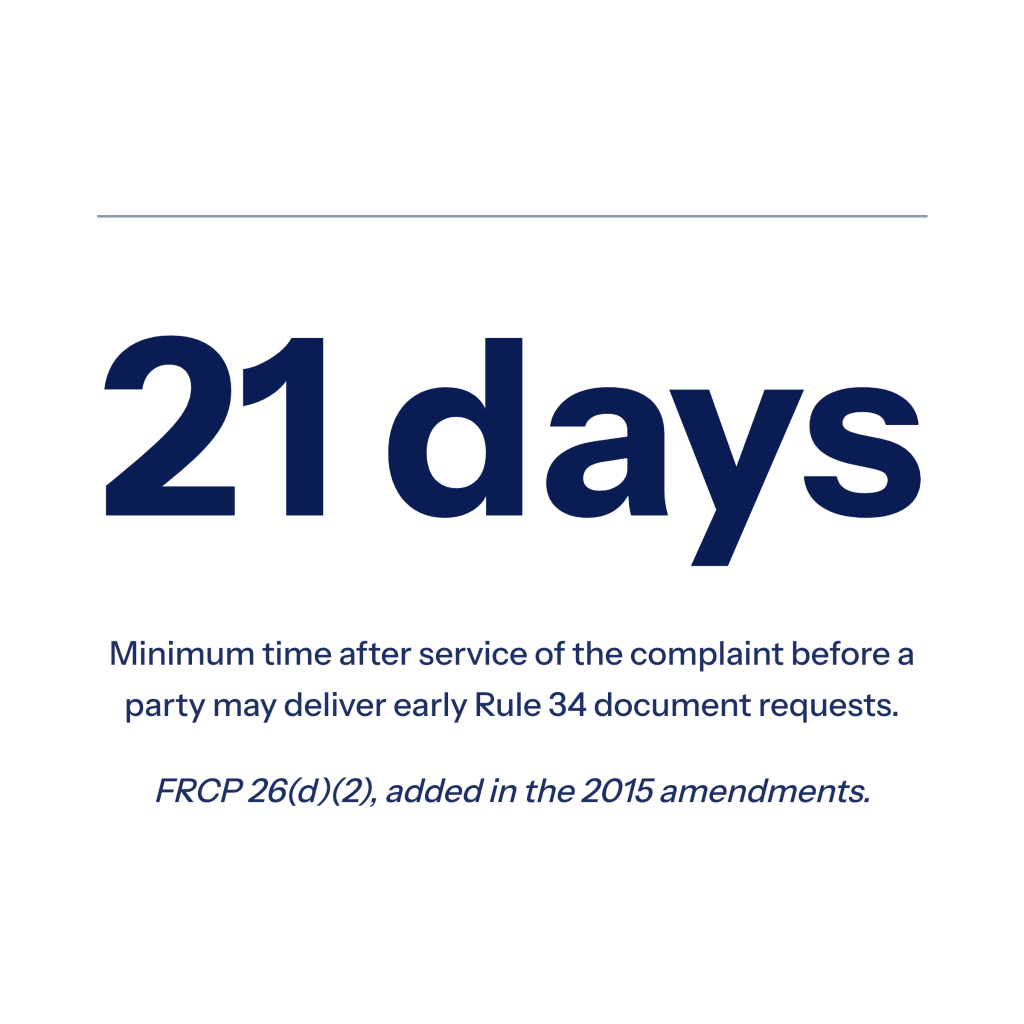
The 2015 amendments to the FRCP added Rule 26(d)(2), which lets parties deliver Rule 34 document requests more than 21 days after a defendant has been served, even before the Rule 26(f) conference. The requests are not technically “served” until the conference occurs, and the responding party’s clock does not start running until then. As an ABA analysis of the amendments explains, the change was meant to give parties advance notice of likely document requests so the Rule 26(f) conference itself could focus on real disputes rather than abstract debates about scope.
In practice, this means a plaintiff can put together a comprehensive set of document requests early in the case and deliver them within weeks of service. The defense team gains time to review those requests, identify burden issues, and prepare to negotiate scope at the planning conference.
Stipulations Between Parties
Rule 26(d)(1) explicitly allows discovery by stipulation. If both sides agree, they can begin any form of discovery before the Rule 26(f) conference. Stipulated early discovery commonly appears in cases with looming hearings, perishable evidence, or witnesses with limited availability.
A written stipulation signed by counsel for all parties is generally enough. Many courts prefer that stipulations be filed on the docket so the court has a record of the agreement.
Pre-Action Depositions Under Rule 27
Rule 27 of the FRCP allows a party to take a deposition before any lawsuit is filed, but only to perpetuate testimony that might otherwise be lost. The petitioner must show the testimony is needed for an anticipated action, that the petitioner cannot bring the action yet, and that the deposition is necessary to prevent a failure of justice.
Courts apply Rule 27 narrowly. It is not a tool for general fact investigation or for identifying potential defendants. The classic use case involves an elderly or seriously ill witness whose testimony might not survive until a complaint is filed.
How to Get Court-Ordered Expedited Discovery
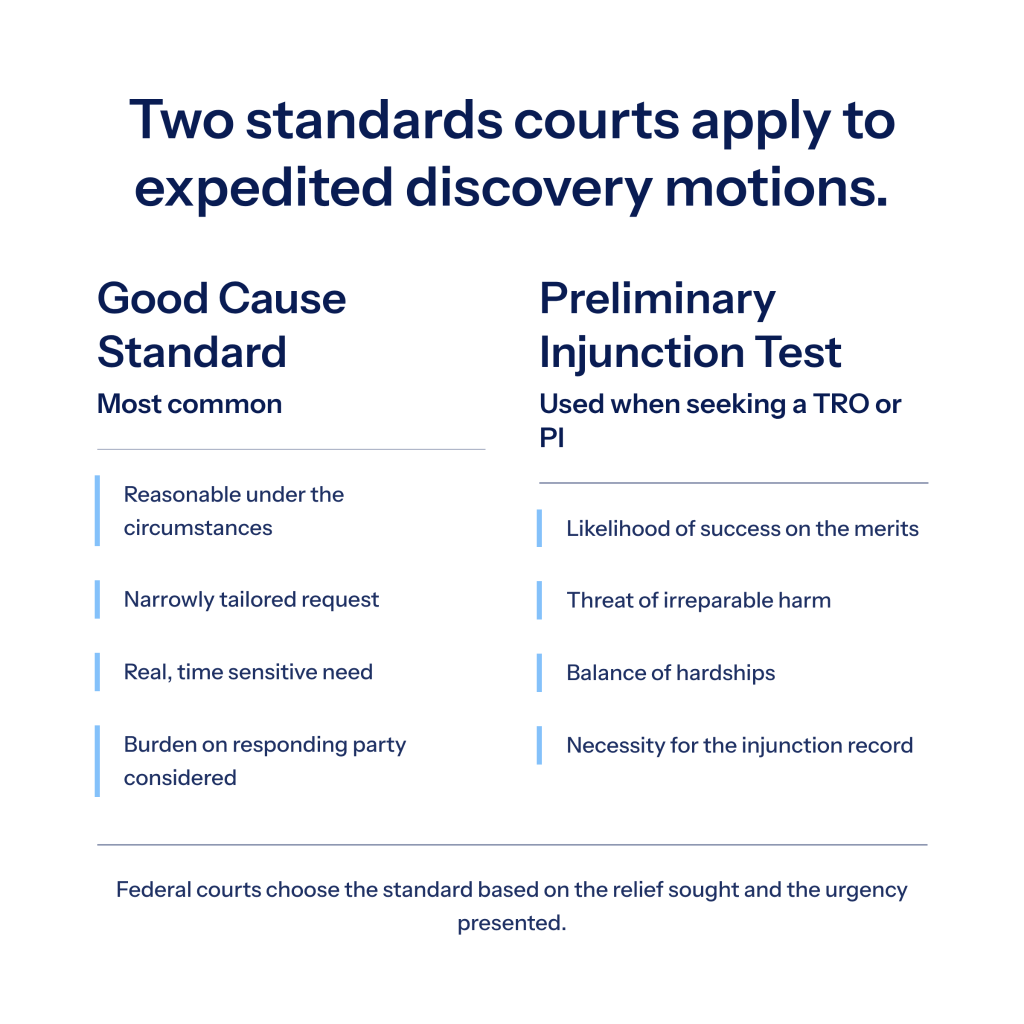
When the moratorium would otherwise apply but a party needs evidence quickly, the standard route is a motion for expedited discovery. Federal courts grant these motions on a case-by-case basis, applying their own discretionary standards because the rules themselves do not specify a uniform test.
The Good Cause Standard
The most common test is the “good cause” standard. Courts consider whether the requested discovery is reasonable under the circumstances, whether it is narrowly tailored, and whether the moving party has identified a real need that cannot wait until the regular discovery period.
Factors courts often weigh include the timing of the request, the breadth of the proposed discovery, the burden on the responding party, and the prejudice to the moving party if the request is denied. Narrow, focused requests tied to a specific upcoming event tend to fare better than broad, exploratory ones.
The Preliminary Injunction Test
Some courts apply a stricter test when the moving party seeks early discovery in support of a temporary restraining order or preliminary injunction. Under this approach, courts consider the likelihood of success on the merits, the threat of irreparable harm, the balance of hardships, and whether early discovery is necessary to develop the record for the injunction hearing.
This test is more demanding because it borrows from the substantive standards for preliminary relief. Lawyers moving for a TRO or PI typically pair their motion with a request for narrowly targeted expedited discovery, often limited to a handful of depositions and specific document categories tied to the issues in the injunction.
Common Scenarios Where Courts Grant Early Discovery
Across federal districts, certain patterns appear in granted motions for expedited discovery:
- Trade secrets and unfair competition cases where evidence of misappropriation may be destroyed
- Identification of unknown defendants, including subpoenas to internet service providers in copyright and harassment matters
- Preservation of testimony from witnesses about to leave the country or facing serious illness
- Asset tracing in fraud cases where funds may move quickly across jurisdictions
- Election and time-sensitive matters where the relief sought becomes moot after a specific date
The American Bar Association’s litigation section has noted that motions paired with TROs or PIs are far more likely to succeed when they explain exactly how the requested discovery connects to the injunction relief.
Federal Early Discovery Rules at a Glance
The table below summarizes how the timing rules apply to each common discovery method.
| Discovery Method | When Available | Governing Rule |
| Document requests (Rule 34) | More than 21 days after service, technically served at Rule 26(f) conference | FRCP 26(d)(2) |
| Interrogatories (Rule 33) | Only after Rule 26(f) conference, unless stipulated or ordered | FRCP 33(a)(2) |
| Requests for admission (Rule 36) | Only after Rule 26(f) conference, unless stipulated or ordered | FRCP 36(a) |
| Depositions (Rule 30) | Only after Rule 26(f) conference, unless leave granted or witness leaving the country | FRCP 30(a)(2) |
| Pre-action depositions (Rule 27) | Before any lawsuit is filed, with court permission, to preserve testimony | FRCP 27(a) |
| Stipulated discovery | Any time the parties agree in writing | FRCP 26(d)(1) |
| Expedited discovery | Any time, on motion, for good cause | FRCP 26(d)(1) |
The rules layer on top of each other, so litigators planning early discovery need to consider both the general moratorium under 26(d)(1) and the specific timing rule for the discovery device they want to use.
Strategic Considerations for Federal Litigators
Even when early discovery is technically available, deciding whether to pursue it is a strategic question. The cost of preparing a motion for expedited discovery, the risk of putting the court on notice of weaknesses in your case, and the burden you create for your own team all factor into the calculus.
A few patterns we’ve observed across federal litigation:
- Use early Rule 34 requests deliberately. Delivering document requests under Rule 26(d)(2) signals seriousness to the other side and shapes the Rule 26(f) conference. It works best when the requests are precise, tied to clear legal theories, and reasonable in scope.
- Match early discovery to the relief you’re seeking. Courts grant expedited discovery when the moving party can show a tight nexus between the requested information and a specific need. Vague references to general case preparation rarely succeed.
- Plan your response capacity before you make requests. Document requests delivered early can come back during a busy phase of pleading practice and motion drafting. A request for production may produce thousands of pages that need review and analysis on a tight timeline.
This last point is where modern technology has changed the practical math of early discovery. The bottleneck in federal litigation is often not the request itself but the team’s ability to process, summarize, and analyze the materials that come back. Tools that ingest documents, build case timelines, and surface relevant facts at scale change what a small team can accomplish in the early phases of a case. Our legal document automation software was designed with these workflows in mind, helping litigators turn raw productions into organized case intelligence quickly.
Frequently Asked Questions
The questions below address the most common timing issues federal litigators face when planning their early discovery strategy.
Can You Take Depositions Before the Rule 26(f) Conference?
In most cases, no. Rule 30(a)(2)(A) requires leave of court to take a deposition before the time set by Rule 26(d), unless the parties stipulate or the witness is about to leave the United States. The narrow exception for departing witnesses recognizes that some testimony cannot wait, but courts apply it carefully.
How Soon Can You Serve Interrogatories in Federal Court?
Interrogatories generally cannot be served before the Rule 26(f) conference. Rule 33(a)(2) explicitly defers them to the timing set by Rule 26(d). Parties can serve interrogatories before the conference only by written stipulation or court order.
What Happens If You Serve Discovery Too Early?
If a party serves formal discovery before the moratorium lifts, the responding party can object on timing grounds and is generally not required to respond. Some courts will treat the request as void, while others may allow it to be re-served at the proper time. Premature discovery can also draw a motion for protective order and, in egregious cases, sanctions for failure to comply with the rules.
Do State Courts Follow the Same Early Discovery Rules?
No. Each state has its own rules of civil procedure, and many states allow discovery to begin earlier than the federal system. Some state courts permit discovery as soon as the complaint is served, while others have their own version of a planning conference. Federal practice rules apply only in federal court.
Moving Forward With Federal Discovery Confidently
Early discovery in federal court is a narrow but important pathway for litigators handling time-sensitive cases, perishable evidence, or matters tied to preliminary relief. Understanding the moratorium, the rule-based exceptions, and the standards for expedited discovery is the first step to using these tools effectively.
If you’re building a federal litigation practice and want to see how our platform helps teams organize case materials, automate routine document drafting, and respond to discovery faster, schedule a demo with DocuLex to learn more.