

Most guides covering AI drafting tools for law firms were written by people evaluating tools for contract review, due diligence, and transactional work. If you’re a civil litigator evaluating these tools, that framing is almost useless. The documents you draft every day (pleadings, demand letters, discovery responses, deposition summaries, medical record chronologies) have almost nothing in common with a contract redline.
At DocuLex, we built our platform specifically for civil litigation attorneys, including for active use in our own practice. Our founder, Jason Melancon, spent more than 20 years as a civil litigation attorney handling complex litigation, personal injury, and commercial cases before designing a tool around what litigators actually need. The evaluation criteria below come from that firsthand experience, not from a product roadmap driven by enterprise contract deals.
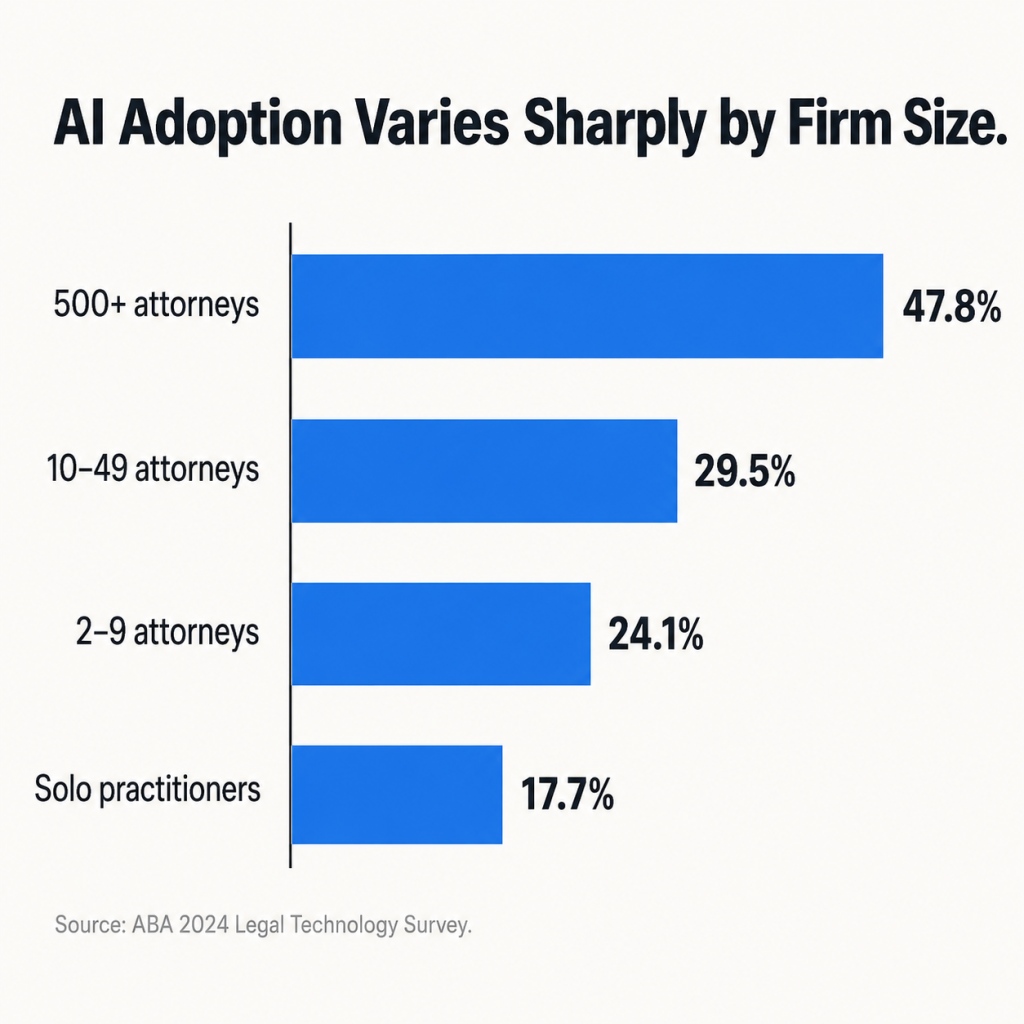
AI adoption in law firms has grown to the point where the question is no longer “should attorneys use AI drafting tools?” The ABA’s 2024 Legal Technology Survey found that 30% of attorneys were using AI-based technology tools in their offices. The more useful question now is whether the tool you’re evaluating was actually built for your type of practice.
Why Most AI Drafting Tool Comparisons Don’t Apply to Litigators
Search for “best AI drafting tool for law firms” and nearly every result centers on contract drafting: clause libraries, redlining, playbooks, standard terms. Those are legitimate products solving a real problem in transactional practice. They are not the same problem you’re solving.
The evaluation criteria genuinely differ:
| Criterion | Transactional Focus | Litigation Focus |
| Primary document types | Contracts, NDAs, term sheets | Pleadings, demand letters, discovery responses, deposition summaries |
| Source material | Standard templates, clause libraries | Case-specific facts, medical records, deposition transcripts |
| Medical record handling | Rarely relevant | Often central to the case |
| HIPAA compliance | Sometimes needed | Essential for PI and medical malpractice matters |
| How drafts are grounded | Template-based or general legal knowledge | Must pull from the actual case file |
| Verification standard | Legal accuracy and clause consistency | Record facts, court formatting requirements |
A tool that performs well for contract automation may be completely inadequate for generating a demand letter grounded in a client’s treatment history. Evaluating tools on the wrong criteria leads to an expensive mistake.
The Criteria That Actually Matter for Litigation Drafting
The five criteria below are the ones we’d want answered before putting any AI drafting tool into active litigation use. They’re ordered roughly by how quickly each one eliminates a bad fit.
Does It Draft the Documents Litigators Actually Use?
Start here. Many AI drafting tools market themselves as “legal AI” without specifying what they actually draft. Look at demo materials closely and you’ll usually find contract-centric use cases.
For litigation work, the documents that consume the most attorney and paralegal time include:
- Demand letters that synthesize liability, causation, and damages from the case record
- Discovery responses and interrogatory answers drawn from case files
- Deposition summaries and key witness reports
- Medical record chronologies organized by provider and date of visit
- Pleadings, pre-trial orders, and court filings
- Internal case summaries
Ask any vendor to demonstrate against these use cases specifically. DocuLex’s legal document automation software was built around these document types from the ground up: medical billing summaries, automated pleadings, discovery responses, and deposition reviews.
Red flag: A vendor who defaults to contract drafting demos but can’t walk you through a demand letter generated from an uploaded medical record and accident report.
Is It Grounded in Your Case File?
This is the most important technical question for any litigator to ask. There are two fundamentally different architectures behind AI drafting tools:
- Prompt-based drafting. You describe the document you want, and the AI drafts it using general legal knowledge. The output often looks polished but has no connection to your actual case.
- Case-file-grounded drafting. The tool ingests your case materials (medical records, depositions, correspondence, prior filings) and generates documents using the facts in your matter.
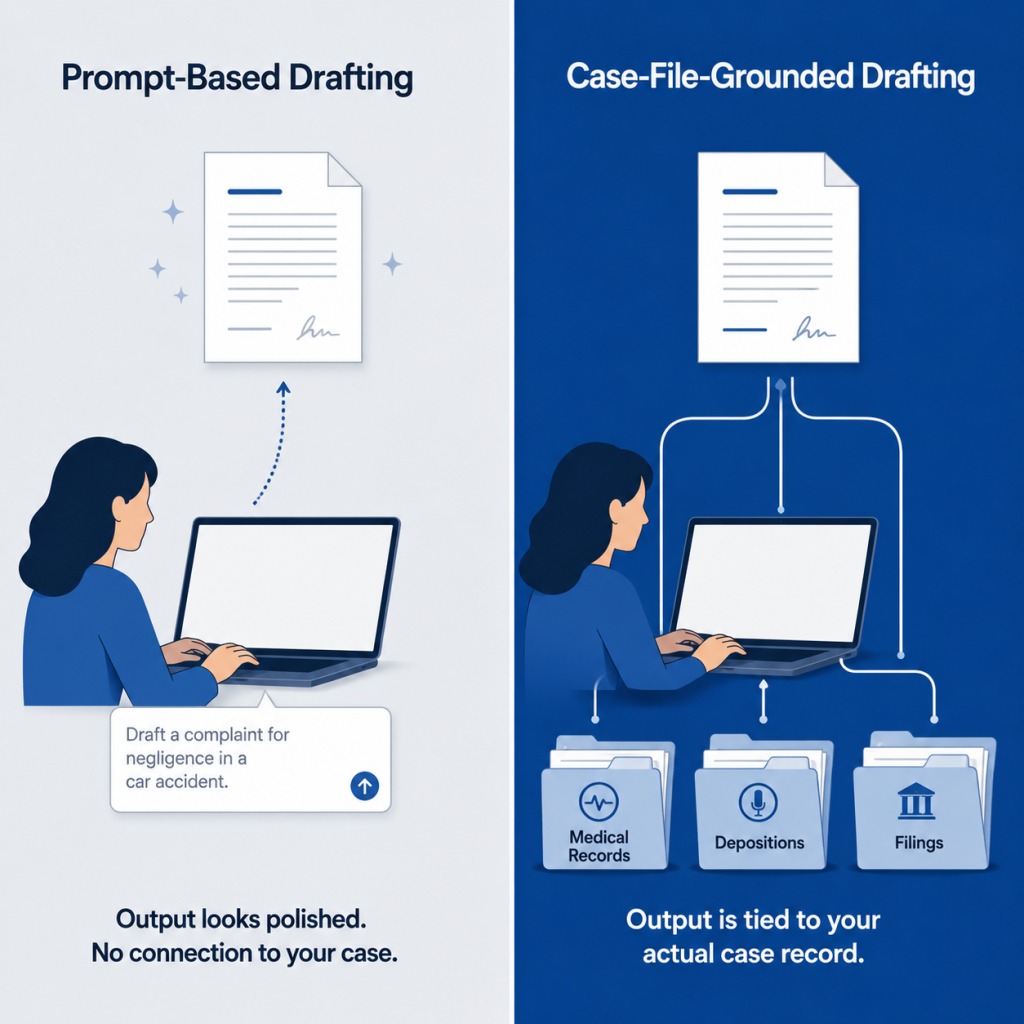
For litigation, only the second approach produces work product you can verify and rely on. The ABA’s guidance on LLM use in litigation workflows explains that retrieval-augmented generation (RAG) is the mechanism that grounds AI output in specific source documents rather than in the model’s general training data. The same guidance notes that chunking strategy, embeddings, and retrieval quality “critically influence” legal usefulness, and that long context windows are not a cure-all because models often miss material buried in the middle of large inputs.
The practical test: ask vendors to generate a deposition summary from a transcript you upload, then check whether the summary cites specific page and line references from that transcript or whether it’s a plausible-sounding reconstruction. That difference is the difference between a tool you can supervise and one that creates professional liability.
Red flag: A vendor who can’t explain how their system segments, retrieves, and cites source documents. “It analyzes your files” is not an answer.
How Does It Handle Medical Records?
For personal injury attorneys, medical record review is one of the most time-consuming tasks in the practice. Records arrive from multiple providers in inconsistent formats, often running thousands of pages, and contain the key facts around treatment, causation, gaps in care, and billing. The ABA has noted for PI lawyers that medical records are “the most important element of damages” and that meaningful AI applications in this space include chronology building, identifying treatment gaps, causation analysis, prior trauma identification, and billing extraction.
Generic AI tools treat medical records as text to summarize. That produces one undifferentiated block of output that’s difficult to use for case strategy. Litigation-specific tools process records visit by visit and provider by provider, preserving the structure that makes medical timelines actionable.
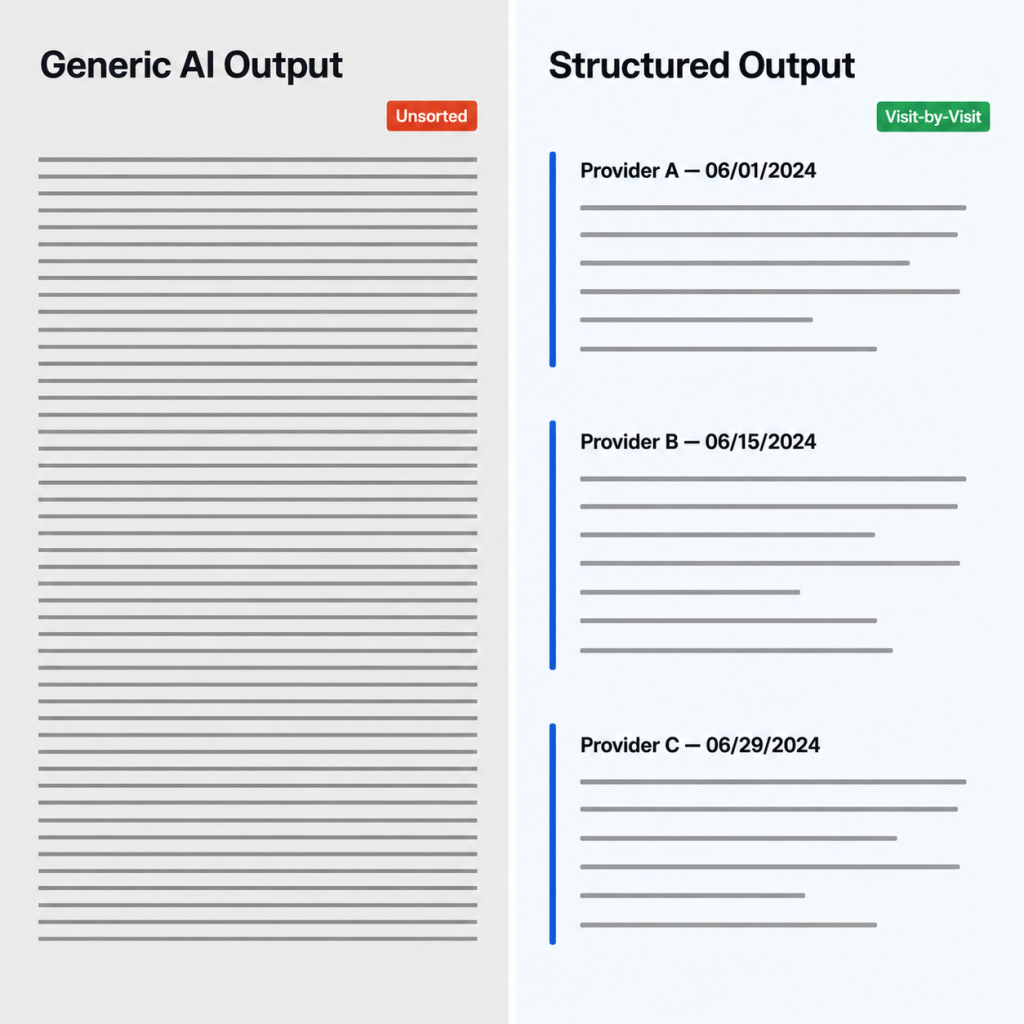
The question to ask: does the system produce organized summaries by provider, date, diagnosis, and billing code, or does it generate one general narrative about the whole file?
DocuLex’s AI medical records processing processes records visit by visit, organizing output by healthcare provider and date, with complaints, evaluations, diagnoses, treatments, and billing codes captured in structured format.
Red flag: A vendor who demonstrates medical record handling with a short, clean sample record. Ask to see how their system handles 2,000 pages from multiple providers across a multi-year treatment history.
Is HIPAA Compliance Actually Built In?
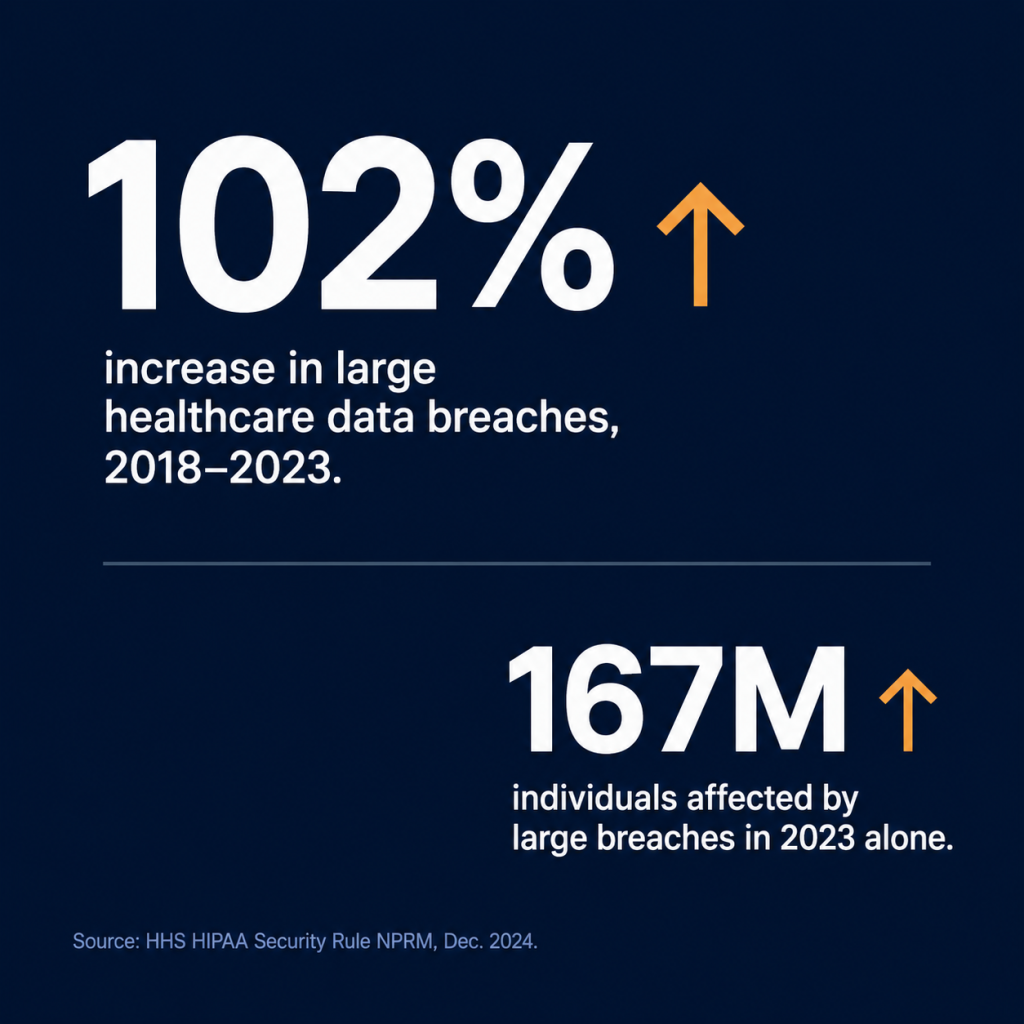
Law firms handling medical records in personal injury cases are subject to HIPAA obligations. If your AI drafting tool ingests protected health information, the vendor is functioning as a business associate under HIPAA, which requires a signed Business Associate Agreement (BAA). HHS guidance on HIPAA and cloud computing is explicit: if a cloud provider creates, receives, maintains, or transmits ePHI on a covered entity’s behalf, a BAA is required, and the customer firm must be able to conduct its own risk analysis.
Beyond the BAA, the substantive questions matter:
- Is medical data retained after processing, or deleted immediately?
- Are your inputs used to train or fine-tune the AI model?
- Are subcontractors (including the underlying model provider) bound by equivalent data protection terms?
- What happens to your data at contract termination?
DocuLex’s data security framework is built on AWS infrastructure with SSE-KMS encryption and includes a Business Associate Agreement with OpenAI covering zero retention of medical data after analysis. Firm data is isolated within our secure AWS environment.
Red flag: A vendor who says they’re “HIPAA-compliant” but can’t produce a BAA, explain their data retention policy, or confirm that subprocessors are covered by equivalent protections.
Can You Verify What It Produces Before It Goes Out?
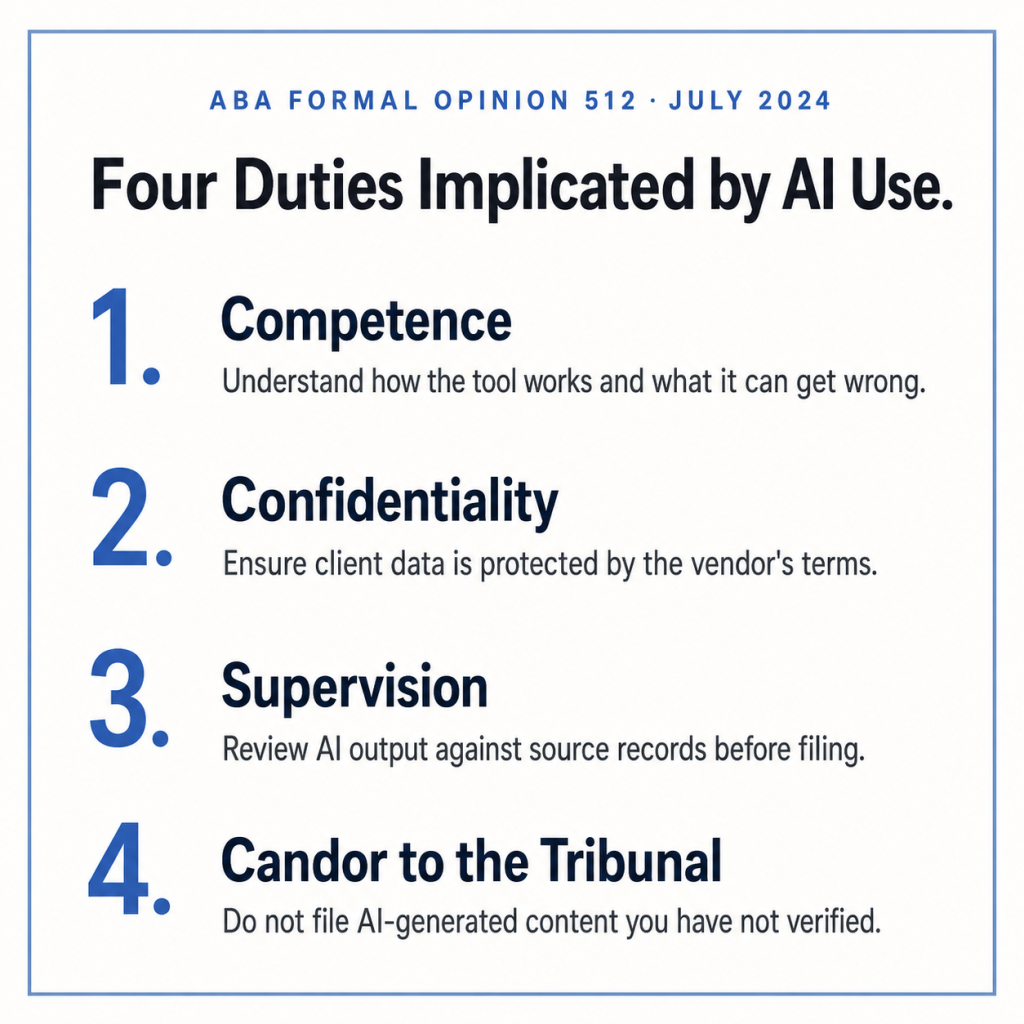
Attorney supervision of AI output is an ethics obligation, not a preference. ABA Formal Opinion 512, issued July 29, 2024, addressed a lawyer’s use of AI tools and specifically identified the duties of competence, confidentiality, supervision, and candor to the tribunal as directly implicated by AI use. Filing an AI-generated document without reviewing it against the source record does not discharge that duty, regardless of how sophisticated the tool is.
The hallucination problem remains active. In February 2025, Morgan & Morgan lawyers were sanctioned after AI-generated fake citations appeared in filed documents. Additional sanctions were imposed in California and Alabama courts later that year. These cases share a common failure: AI output that looked correct but was never verified against the actual record.
For litigators, the verification standard is straightforward: can you trace every specific fact in an AI-generated document back to a source record in your case file? A tool designed for litigation should make that verification fast, not an obstacle. Questions to ask:
- Does the system show citations to source documents alongside generated output?
- Is there a review workflow that makes it easy to catch facts the system got wrong?
- Can a supervising attorney quickly confirm which record supports which paragraph of a demand letter?
Red flag: Output that reads cleanly but offers no traceable connection to the source records in your case file.
Pricing: What to Clarify Before You Commit
Legal AI pricing varies widely, and the base subscription rarely reflects the complete cost. Before committing to any tool, clarify:
- Is pricing per seat, per matter, per document, or compute-based (tokens, storage)?
- Does medical record ingestion and processing cost extra?
- Are training, onboarding, and implementation fees included?
- What are the contract commitment terms, and what happens to your data at termination?
DocuLex is priced at $99 per month per attorney seat, which includes unlimited matters, 250 GB of storage, and one free staff seat. AI usage is billed separately on a transparent per-million-token basis for input processing, output generation, and document embeddings. There are no hidden onboarding fees or per-matter charges.
How to Apply This Framework
The market for AI drafting tools in law firms has matured enough that tool selection matters. But most of that market was built around transactional practice, and the evaluation criteria developed for contract work don’t transfer to litigation.
The five criteria above are designed specifically for the documents, workflows, and professional obligations of civil litigation. A tool that holds up against all five will be grounded in your actual case materials, capable of drafting the documents litigators use most, genuinely HIPAA-compliant with proper subprocessor coverage, and built to make attorney verification fast rather than perfunctory.
Frequently Asked Questions
Do I Need a Business Associate Agreement with My AI Drafting Tool?
If your AI drafting tool processes medical records or other protected health information on your behalf, yes. Under HIPAA, a vendor that creates, receives, maintains, or transmits ePHI on behalf of a covered entity is functioning as a business associate and is required to sign a BAA. You should also confirm that any subprocessors the vendor uses, including the underlying AI model provider, are covered by equivalent protections.
What Is the Difference Between AI Legal Research Tools and AI Drafting Tools?
AI legal research tools are designed to find and analyze case law, statutes, and secondary sources. AI drafting tools generate document text, typically using templates, prompts, or case file materials as inputs. Some platforms combine both functions. For litigators, the more important distinction is whether a drafting tool is grounded in your specific case file or operates independently of your matter records.
Why Do Most AI Drafting Tool Comparisons Focus on Contract Work?
Enterprise demand for AI in legal practice initially concentrated in corporate transactional work, where contract volume is high and use cases like redlining and clause standardization were relatively easy to automate. That shaped which tools received early investment and where most public benchmarking has been done. Litigation drafting (particularly medical record analysis, demand letters, and discovery responses) involves more variable, unstructured source material, which makes it harder to build for and has been slower to appear in mainstream product comparisons.
If you’d like to see how DocuLex handles any of the criteria in this guide, including a demonstration using your actual case types or documentation on our HIPAA compliance and data handling practices, contact us.