

Legal research in 2026 looks very different from five years ago. AI tools now handle case law lookup, internal case file analysis, medical record review, deposition summarization, and document drafting. The right tool for any law firm depends on what kind of research drives daily work. For litigators, particularly personal injury and civil litigation attorneys, case-specific research within their own files matters as much as external case law lookup. At DocuLex.ai, we built our AI legal assistant around that need: it searches a firm’s case materials, depositions, and medical records the way Westlaw searches case law. Below, we cover the top AI legal research tools across categories, starting with the platforms litigators reach for first.
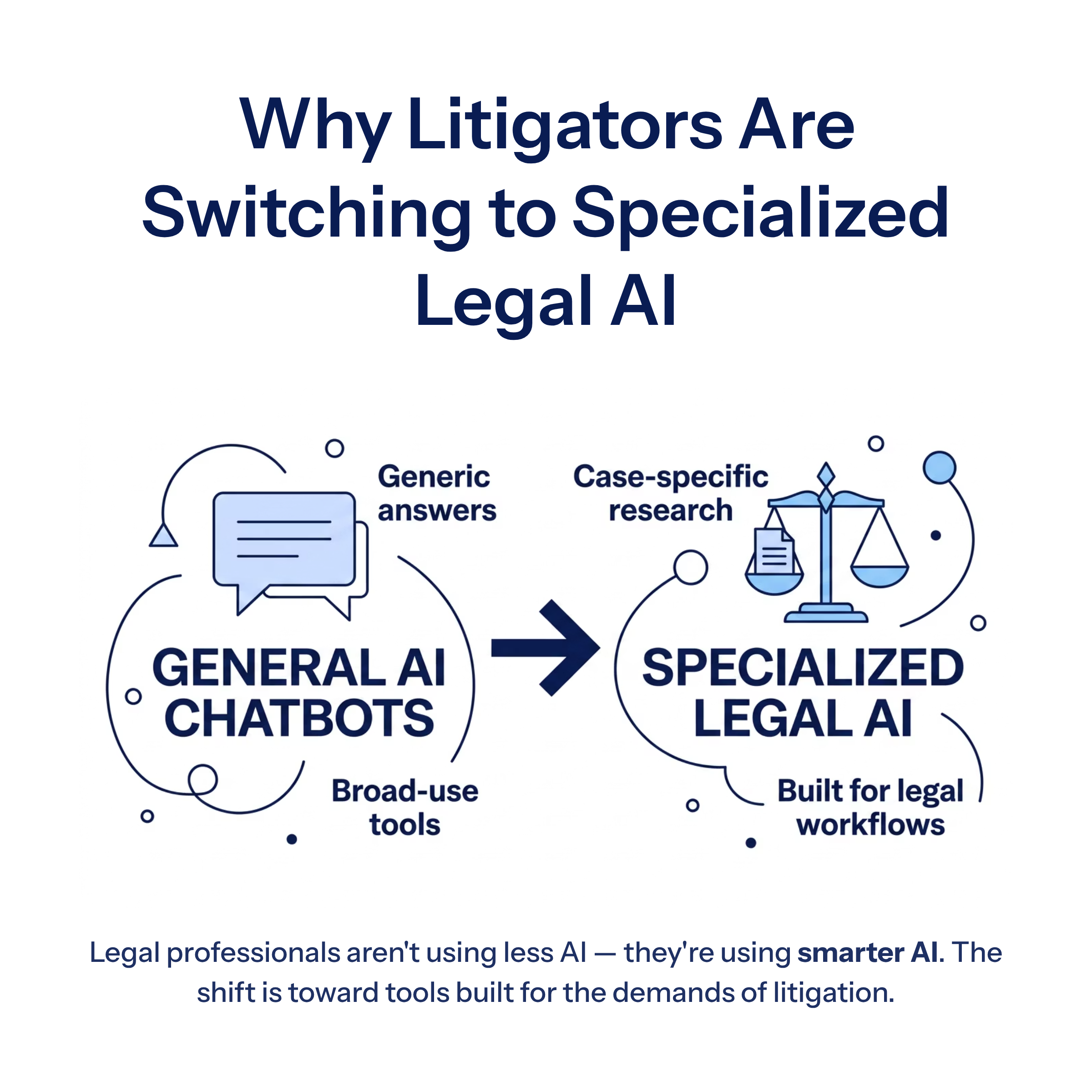
The shift toward AI in legal work has been steep. A 2024 Stanford study found that leading legal AI tools hallucinated in 17% to 34% of benchmarking queries, despite vendor claims of high accuracy. That gap between marketing and benchmark accuracy is one of the biggest reasons litigators have started looking beyond general AI chatbots for serious research work.
What Counts as Legal Research in 2026
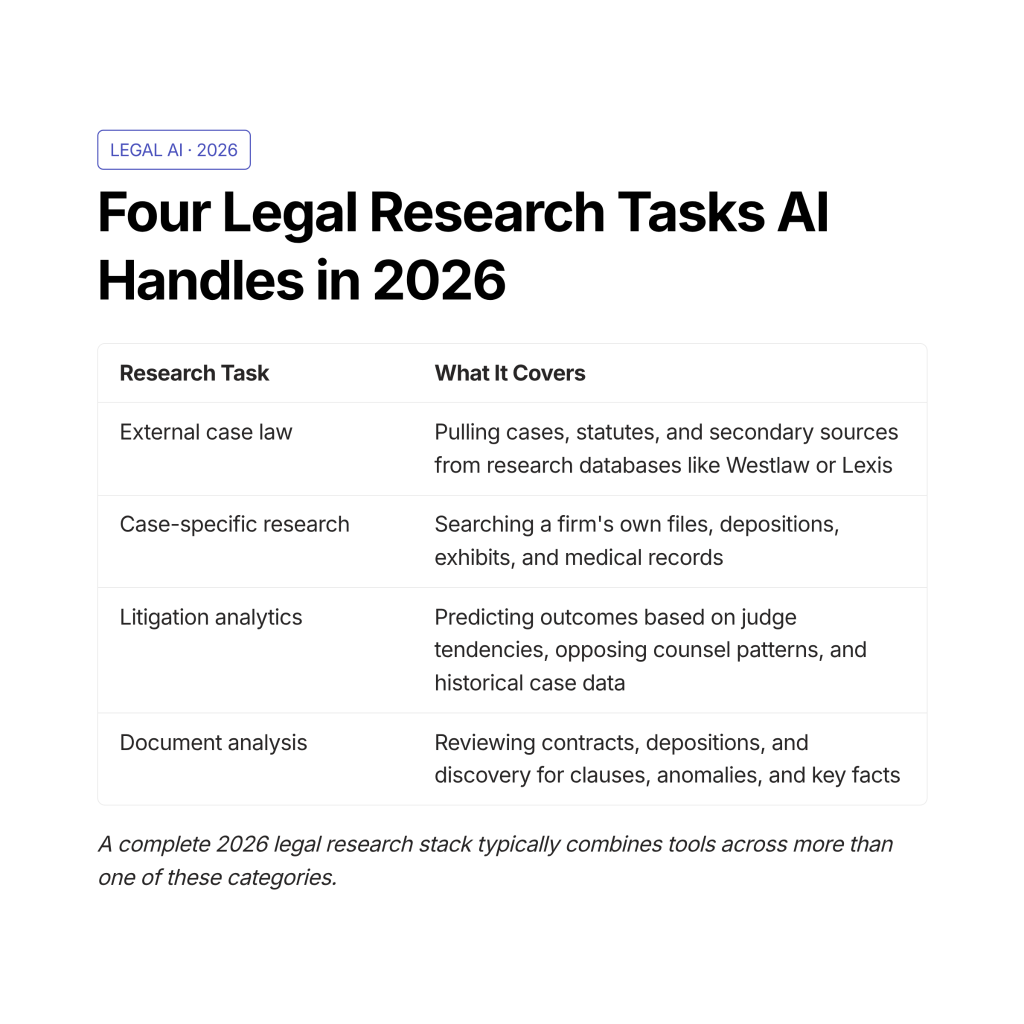
Traditional legal research meant pulling case law, statutes, and secondary sources from databases like Westlaw or Lexis. That part of the workflow still exists, but it now sits alongside three other research tasks that AI handles well:
-
- Case-specific research: Searching your own case files, depositions, exhibits, and medical records for facts, dates, and statements relevant to a specific matter.
-
- Litigation analytics: Predicting outcomes based on judge tendencies, opposing counsel patterns, and historical case data.
-
- Document analysis: Reviewing contracts, depositions, and discovery for clauses, anomalies, and key facts.
A complete legal research stack in 2026 usually includes tools from more than one of these categories. The list below is organized that way.
Comparison Table: Top AI Legal Research Tools in 2026
| Tool | Best For | Primary Category |
| DocuLex.ai | Litigation case files, medical records, document drafting | Case-specific research |
| Westlaw Precision AI | Federal and appellate case law | External case law |
| Lexis+ AI | Multi-jurisdictional case law and Shepard’s | External case law |
| Bloomberg Law AI | Combined legal and business research | External research |
| VitalLaw Expert AI | Editor-vetted Q&A and summarization | External research |
| Harvey AI | Enterprise multi-step research and drafting | AI assistant |
| Lex Machina | Judge and court analytics | Litigation analytics |
| vLex | International and comparative law | External case law |
| Casetext CoCounsel | Solo and small firm research | AI assistant |
| Microsoft Copilot for Legal | Drafting inside Word and Outlook | Drafting and analysis |
1. DocuLex.ai: Best for Litigation Case Files and Medical Records
DocuLex.ai is built for civil litigation attorneys, with particular depth in personal injury work. Where most AI legal research tools focus on external case law, DocuLex focuses on the materials that already sit inside your firm: depositions, medical records, discovery responses, accident reports, and pleadings. Our AI legal assistant lets attorneys ask natural-language questions across all uploaded case materials and get answers grounded in those specific files.
Three features make DocuLex stand out for litigators:
-
- Medical records processing. Our automated medical records system processes records visit by visit, generating patient visit summaries, medical billing summaries, and chronological treatment histories. Tasks that paralegals previously spent days on are completed in seconds.
-
- Case-specific AI search. The AI chatbot retrieves information from any uploaded case material. Questions like “what did the treating orthopedist say about the L4-L5 injury at the second visit?” return precise, sourced answers.
-
- Document automation. Beyond research, the platform drafts demand letters, discovery responses, pleadings, and correspondence using facts pulled directly from the case file.
DocuLex addresses two of the biggest concerns with legal AI: hallucinations and data security. Our structured data processing approach segments case materials into smaller, manageable pieces before analysis, which reduces the AI’s tendency to fabricate facts. On the security side, we are HIPAA compliant with a Business Associate Agreement covering medical data, and the platform runs on AWS infrastructure with SSE-KMS encryption. No medical data is retained after analysis.
Pricing starts at $99 per attorney seat per month, which includes 250 GB of storage, unlimited matters, and one free staff seat. AI usage is billed separately at $3.75 per million input tokens and $15 per million output tokens.
DocuLex is best suited for personal injury firms, civil litigation practices, and litigation departments that handle document-heavy cases. It is not a substitute for a case law database. Most firms run DocuLex alongside Westlaw or Lexis.
2. Westlaw Precision AI: Best for Federal and Appellate Case Law
Westlaw Precision AI is Thomson Reuters’ AI-enhanced version of Westlaw. It supports natural-language queries, KeyCite citation validation, the Quick Check brief analyzer, and Litigation Analytics. The platform is widely adopted in large firms and remains a standard for federal and appellate research.
The tradeoff: Stanford’s benchmark study found that Westlaw AI-Assisted Research hallucinated in over 34% of queries, the highest rate among the specialized legal AI tools tested. That makes verification of outputs essential, particularly for citations.
3. Lexis+ AI: Best for Multi-Jurisdictional Research
Lexis+ AI is LexisNexis’ conversational AI overlay on its research database. It supports natural-language Q&A, integrates with Shepard’s citations for citation validation, and offers strong multi-jurisdictional content coverage. The same Stanford study measured Lexis+ AI’s hallucination rate at around 17%, lower than Westlaw’s but still high enough to require careful verification.
Lexis+ AI is a good fit for firms that need broad case law coverage across federal, state, and international content, and that already use Shepard’s as part of their citation-checking workflow.
4. Bloomberg Law AI: Best for Combined Legal and Business Research
Bloomberg Law’s AI features include Bloomberg Law Answers (chat-based Q&A) and Bloomberg Law AI Assistant (document Q&A and summarization). The platform pulls from Bloomberg’s combined legal and business databases, which makes it useful for transactional work, regulatory research, and matters where business context matters as much as case law.
The AI features are included with a Bloomberg Law subscription at no extra charge, which makes adoption easier for firms already on the platform.
5. VitalLaw Expert AI: Best for Editor-Vetted Answers
Wolters Kluwer’s VitalLaw Expert AI takes a different approach to hallucination risk. The platform uses an “editor-in-the-loop” model, where AI-generated answers are vetted against Wolters Kluwer’s editorial content. It also offers interactive summarization features, including checklists and key-point extraction, with source transparency through footnotes and a visible reasoning mode.
VitalLaw is positioned for firms and legal departments that prioritize source-vetted answers over raw speed. The trade-off is that the editor-in-the-loop approach can feel slower than fully generative tools.
6. Harvey AI: Best for Enterprise Multi-Step Research
Harvey AI is a lawyer-specific platform used by many AmLaw100 and Magic Circle firms. It supports multi-step reasoning across multiple jurisdictions and can be trained on a firm’s own documents and style guides. Harvey integrates with internal knowledge systems and processes private documents securely.
By the end of 2025, Harvey reported around $190 million in annual recurring revenue with more than 1,000 customers across 60 countries, reflecting fast adoption among large enterprise firms. Pricing is custom and not publicly disclosed. Enterprise contracts typically require seat minimums that push annual costs into the six figures, putting Harvey out of reach for most small and mid-sized firms.
7. Lex Machina: Best for Litigation Analytics
Lex Machina, owned by LexisNexis, focuses on litigation analytics rather than text-based research. It aggregates court data to show judge tendencies, attorney win rates, motion trends, and case timelines. Litigators use it to predict how a particular judge has ruled on similar motions, how long similar cases have taken, and what strategies opposing counsel has used in past matters.
Lex Machina is often sold as an add-on rather than a primary research tool. Pricing is not publicly disclosed and is set through custom enterprise quotes.
8. vLex: Best for International and Comparative Law
vLex aggregates international case law and statutes with AI-powered search and machine translation. For firms with international clients or matters that involve foreign law, vLex provides coverage that domestic platforms do not.
The platform is particularly useful for cross-border litigation, international arbitration, and comparative legal research.
9. Casetext CoCounsel: Best for Solo and Small Firms
Casetext’s CoCounsel offers AI-assisted case law search, automated contract review, and citation checking. Pricing has historically been more accessible than enterprise tools, starting around $225 per month for the Pro tier, which makes it a viable entry point for solo and small firms. Casetext was acquired by Thomson Reuters in 2023 and has been progressively integrated with Westlaw.
10. Microsoft Copilot for Legal: Best for Drafting Inside Microsoft 365
Microsoft Copilot for Legal works inside Word, Outlook, and Teams. It supports clause extraction, document summarization, and drafting within familiar Microsoft 365 applications. For firms that have standardized on Microsoft, it provides AI assistance without requiring a separate platform.
Copilot is not a case law research tool. It works best as a drafting and document analysis layer alongside a dedicated research platform.
How to Choose the Right AI Legal Research Tool
The biggest mistake firms make is treating “AI legal research” as one category and trying to pick a single tool. The tools above serve different research tasks. Most firms end up using two or three.
When evaluating any AI tool for legal research, four factors matter most:
-
- Hallucination rate. Independent benchmarks, not vendor claims, are the only reliable measure. Always verify citations against original sources.
-
- Data security. For any tool that touches medical records or other protected information, HIPAA compliance and a Business Associate Agreement are non-negotiable. Confirm whether client data is used to train the underlying model.
-
- Integration with existing files. A tool that searches case law but cannot read your firm’s case files leaves a gap. A tool that reads case files but cannot pull in case law leaves a different one. Map the gap before you buy.
-
- Cost structure. Some tools charge flat per-seat pricing. Others charge by token usage or query volume. The right model depends on whether your AI usage is predictable or variable.
According to the 2026 Legal Industry Report from 8am, nearly seven in 10 legal professionals now use generative AI for work, more than double the prior year’s figure. That growth is also producing court sanctions: more than 1,200 cases worldwide have arisen from lawyers citing AI-fabricated case law. Verification remains the attorney’s responsibility regardless of which tool produced the citation.
Frequently Asked Questions
What is the most accurate AI tool for legal research?
No AI legal research tool is fully accurate. Stanford’s 2024 benchmark study found Lexis+ AI hallucinated in around 17% of queries and Westlaw AI-Assisted Research in over 34%. Tools that ground answers in vetted source material, like VitalLaw Expert AI or DocuLex.ai for case-specific research, tend to perform better than tools that rely on open-ended generation.
Can AI replace traditional legal research databases?
No. AI tools layer on top of databases like Westlaw and Lexis rather than replacing them. The underlying case law content still comes from those publishers. AI changes how attorneys query and synthesize that content.
Is AI legal research HIPAA compliant?
It depends on the tool. Most general-purpose AI tools, including consumer ChatGPT, are not HIPAA compliant. Litigation-specific tools that handle medical records, including DocuLex, are built with HIPAA compliance and Business Associate Agreements covering medical data. Always confirm compliance status before uploading any protected health information.
How much do AI legal research tools cost in 2026?
Pricing ranges widely. Solo and small firm tools start around $99 to $225 per user per month. Enterprise platforms like Harvey AI require seat minimums and typically push annual costs into the six figures. Usage-based pricing for AI tokens is common on top of base subscription fees.
The Bottom Line for Litigators
For civil litigation attorneys, particularly those handling personal injury cases, the most valuable AI research happens inside your own case files. Medical records, depositions, and discovery materials hold the facts that win cases. A tool that surfaces those facts in seconds, drafts the demand letter from them, and keeps everything HIPAA compliant is worth more than a faster way to find a circuit split.
If your firm handles document-heavy litigation and you want to see how AI can streamline case file research, medical records processing, and legal document automation in one platform, join the DocuLex.ai waitlist to schedule a demo.