
Yes, AI can write a demand letter. For a growing number of PI firms, it already does, in draft form. The gap is between what AI can produce and what an attorney can ethically sign.
DocuLex.ai was built specifically for this problem. A moderately complex PI case involves 2,000 to 5,000 pages of medical records, and most AI tools were not designed to handle that volume in a HIPAA-compliant way.
The ABA issued its first formal ethics guidance on generative AI in July 2024 (Formal Opinion 512), and federal courts have documented over 1,300 cases involving AI-hallucinated content in legal filings as of April 2026. Stanford researchers have found that even purpose-built legal AI tools hallucinate 17 to 34 percent of queries. At the same time, 37 percent of PI practitioners now personally use generative AI (AffiniPay 2025 Legal Industry Report), ahead of the 31 percent profession-wide average.
What a PI Demand Letter Actually Requires
A demand letter, as Cornell’s Legal Information Institute defines it, is a document “outlining the dispute between the two opposing parties and demanding that the recipient take or cease a certain action… drafted to influence the recipient’s understanding of the dispute’s risks and rewards in a way that favors the client’s interests.”
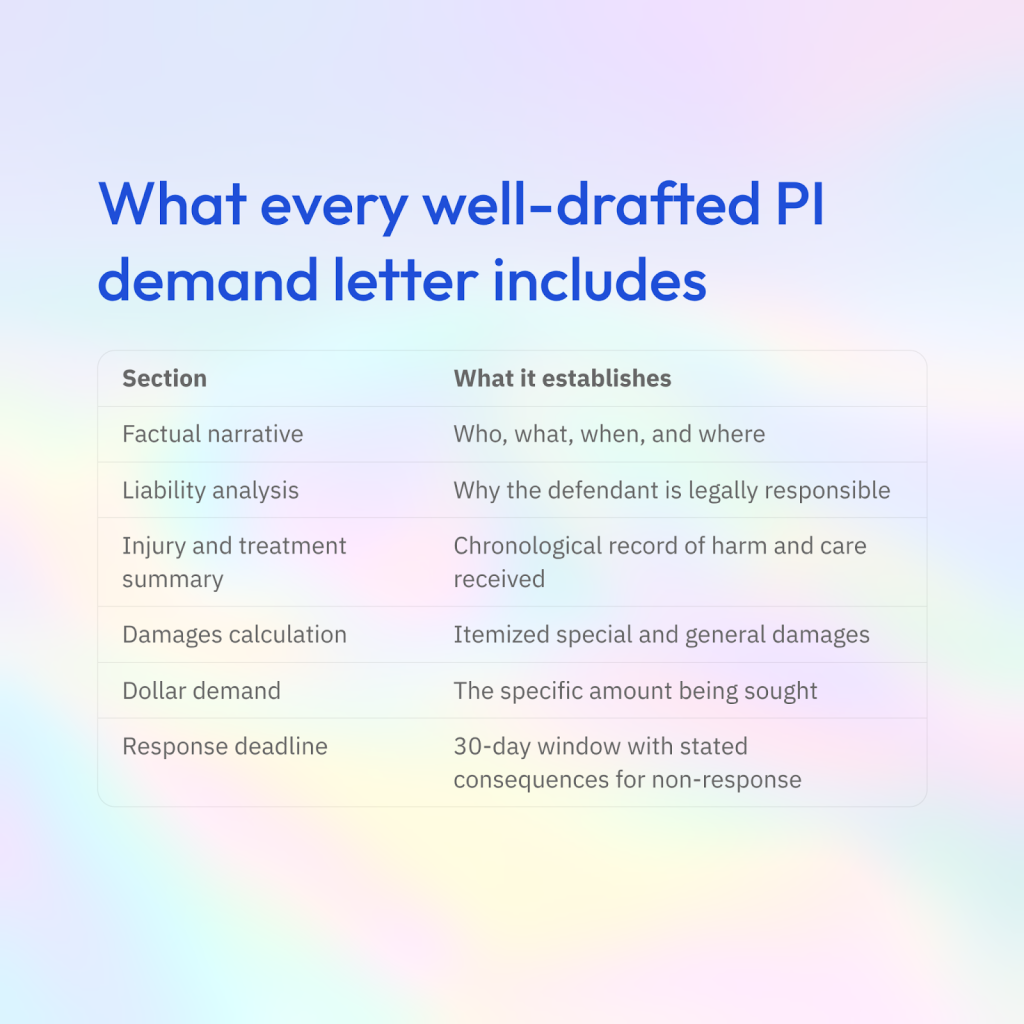
Roughly 95 percent of personal injury cases settle before trial, which means the demand letter is, in most cases, the firm’s primary work product. Every well-drafted PI demand includes:
- A factual narrative covering who, what, when, and where
- A liability analysis explaining why the defendant is legally responsible
- A chronological injury and treatment summary
- An itemized damages calculation covering both special and general damages
- A specific dollar demand
- A response deadline, typically 30 days, with stated consequences
The challenge for any AI system is that the injury and treatment summary draws on medical records that can run into the thousands of pages for a moderately complex PI case. Catastrophic injury and medical malpractice files can exceed 10,000 pages. That volume is exactly where AI saves the most time, and where errors are hardest to spot.
The Real Cost of Manual Drafting
In a contingency-fee practice, drafting time is pure overhead. Every hour spent on a demand letter is an unpaid hour, carried on the firm’s balance sheet until settlement arrives. Personal injury is overwhelmingly contingency-based, typically at 33 to 40 percent of the recovery, so non-billable drafting time compounds directly against firm profitability.
Thomson Reuters’ 2024 Future of Professionals Report projects that AI will save legal professionals up to 12 hours weekly by 2029, which they characterize as “the equivalent of adding an additional colleague for every 10 team members.” Their 2025 update raised that projection to 240 hours of savings per legal professional annually.
How AI Actually Drafts a Demand Letter
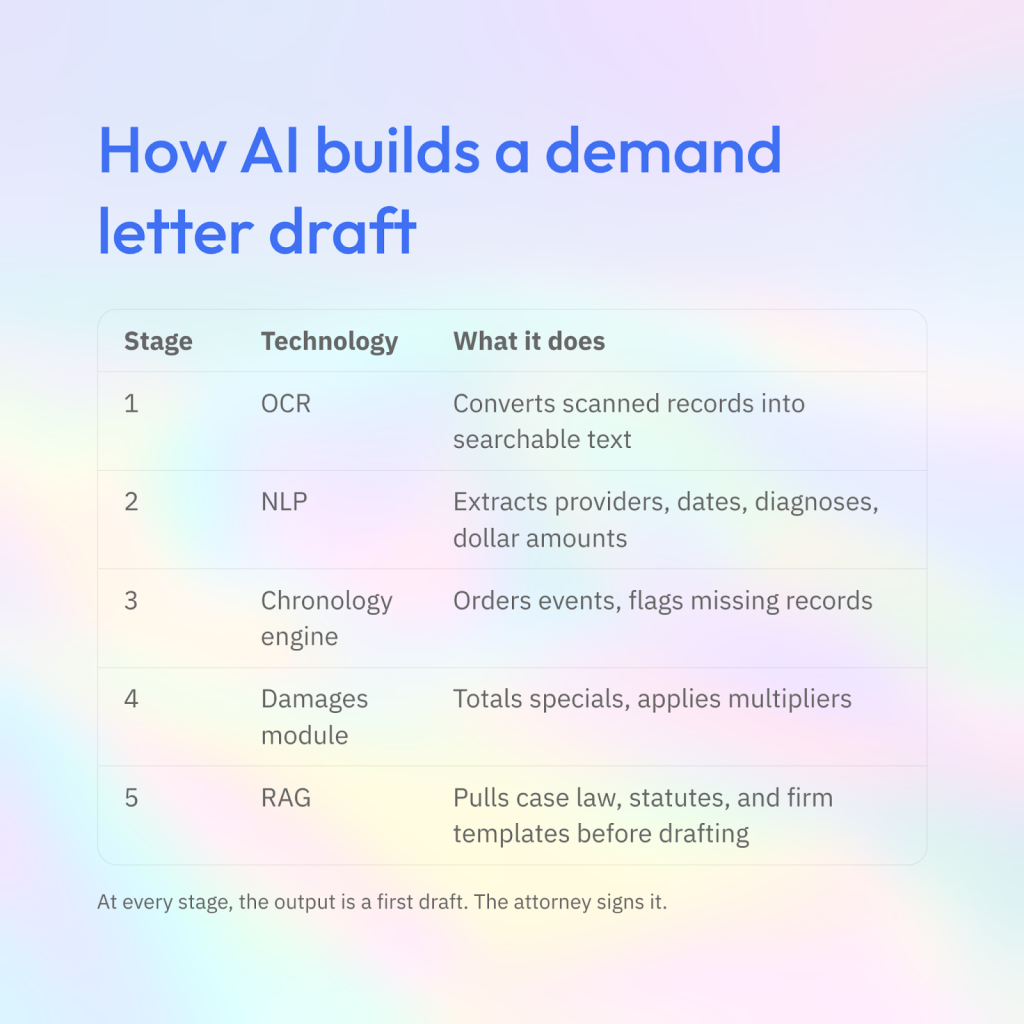
At every tier of AI involvement, the rule is the same: the output is a first draft. The attorney signs it.
Modern AI demand-letter tools layer multiple technologies to move from raw case files to a structured draft:
- Optical character recognition (OCR) converts scanned records and handwritten notes into searchable text
- Natural language processing (NLP) extracts entities such as provider names, dates, diagnoses, and dollar amounts
- A chronology engine orders events into a timeline and flags missing records
- A damages module totals special damages and applies configurable multipliers
- Retrieval-augmented generation (RAG) pulls statutes, case law, and firm-template language from a vector database before the language model produces the draft
RAG has become the standard architecture for legal AI because it grounds responses in verified external sources, including case law, statutes, and firm templates, rather than the model’s training data alone. The ABA noted in July 2024 that “AI tools using RAG might still produce errors, but these errors are more akin to human mistakes than AI hallucinations.”
Three levels of AI involvement have emerged in PI practice:
- Summarization only: AI condenses records and depositions so a human can draft
- Assisted drafting: AI generates paragraph-level text for specific sections that the attorney edits
- Full draft: AI produces an end-to-end letter from structured inputs
The output is a first draft. The attorney signs it.
The Hallucination Problem Has Not Been Solved
Most vendor marketing skips this entirely. Buying a “legal-specific” AI tool does not eliminate hallucinations. The Stanford HAI/RegLab study by Magesh et al. (Journal of Empirical Legal Studies, 2025) benchmarked purpose-built legal AI tools against more than 200 open-ended queries:
| Tool | Hallucination Rate |
| Lexis+ AI (LexisNexis) | ~17% |
| Westlaw AI-Assisted Research (Thomson Reuters) | ~33-34% |
| GPT-4 (general-purpose) | ~58-82% |
The study also tested Thomson Reuters’ Ask Practical Law AI and found it hallucinated at rates consistent with the 17-33% range reported for the platform’s other tools. The authors specifically rebuked vendor claims of “hallucination-free” output. Stanford’s earlier Dahl et al. paper concluded that legal mistakes with large language models “are pervasive.”
The sanctions record confirms the stakes are real. Researcher Damien Charlotin’s open database of AI hallucination cases in court filings has grown from 87 in May 2025 to over 1,300 by April 2026, roughly a 15-fold increase in under a year.
This is not a big-firm problem. About 90 percent of implicated firms are solo or small practices, and roughly 56 percent of sanctions cases involve plaintiffs’ counsel.
The most cited case is Mata v. Avianca (S.D.N.Y. 2023), where two attorneys submitted a brief with six fabricated opinions generated by ChatGPT. Judge Castel imposed a $5,000 sanction under Rule 11, finding subjective bad faith: the attorneys continued defending the citations after opposing counsel flagged them as nonexistent. In Wadsworth v. Walmart Inc. (D. Wyo. 2025), a motions team was sanctioned after their in-house AI tool generated eight case citations, none of which existed.
What ABA Formal Opinion 512 Actually Requires
On July 29, 2024, the ABA’s Standing Committee on Ethics issued Formal Opinion 512, the first nationwide AI ethics framework for lawyers. It applies six Model Rules to generative AI practice.
Competence (Rule 1.1): Lawyers do not need to become AI experts, but they must have a reasonable understanding of any tool’s capabilities and limitations. They “may not abdicate their responsibilities by relying solely on a GAI tool to perform tasks that call for the exercise of professional judgment.”
Confidentiality (Rule 1.6): Before inputting client information into any AI tool, lawyers must evaluate the risk of disclosure. For self-learning tools, informed client consent is required, and general boilerplate in an engagement letter is not sufficient.
Fees (Rule 1.5): Opinion 512 closes the door on double-billing. A lawyer may charge for the actual time spent prompting and reviewing, but may not charge for the time the AI saved. Efficiency gains belong to the client.
Candor (Rule 3.3): Unverified AI output submitted to a tribunal can produce false statements. The opinion cites Mata v. Avianca directly.
Supervision (Rules 5.1/5.3): Managerial lawyers must establish clear AI use policies and supervise both their lawyers and third-party vendors.
State bars have moved quickly but unevenly. Florida locked AI competence requirements into its court rules effective October 2024. Texas issued Professional Ethics Opinion 705 in February 2025. The California State Bar requires lawyers to “critically review, validate, and correct both the input and the output.” D.C. Bar Ethics Opinion 388 described generative AI as “chatting with an omniscient, eager-to-please intern who sometimes lies to you.”
According to the ABA’s 2024 Legal Technology Survey, 30 percent of firms are now using AI tools, up from 11 percent in 2023. The compliance landscape is keeping pace with adoption. Firms that have not updated their engagement letters and AI supervision policies are already exposed.
HIPAA Is the PI-Specific Problem
For PI attorneys, the AI ethics question is also a HIPAA question. HHS guidance is clear: when a PI firm feeds protected health information (PHI) into an AI vendor, that vendor becomes a subcontractor processing PHI, and a signed Business Associate Agreement (BAA) is legally required under 45 CFR sections 164.502(e) and 164.504(e).
Many consumer-grade tools, including the free version of ChatGPT, will not sign a BAA. Using those tools with medical records is not a gray area.
HHS Office for Civil Rights completed 22 HIPAA enforcement actions in 2024, collecting over $9.9 million in settlements and civil money penalties, and reports a 264 percent increase in large ransomware breaches in healthcare since 2018.
A BAA is the floor, not the ceiling. The full compliance checklist for any AI tool handling PI medical records includes:
- A signed HIPAA BAA covering the AI vendor and any sub-processors
- An explicit no-training clause prohibiting the vendor from using firm or client data to refine models
- Zero data retention with verifiable deletion after analysis
- AES-256 encryption at rest and TLS 1.2 or higher in transit
- 60-day breach notification
- U.S.-only data residency
- Role-based access controls and immutable audit logs
SOC 2 Type II certification is worth requesting in vendor diligence. It is not a substitute for a BAA, but it demonstrates that the vendor’s security controls have been independently audited.
Our AI medical records processing system is built on AWS infrastructure with SSE-KMS encryption, and we hold a Business Associate Agreement with OpenAI covering our use of their models. The LLM provider does not retain medical information after analysis.
What Responsible AI Use Looks Like in Practice
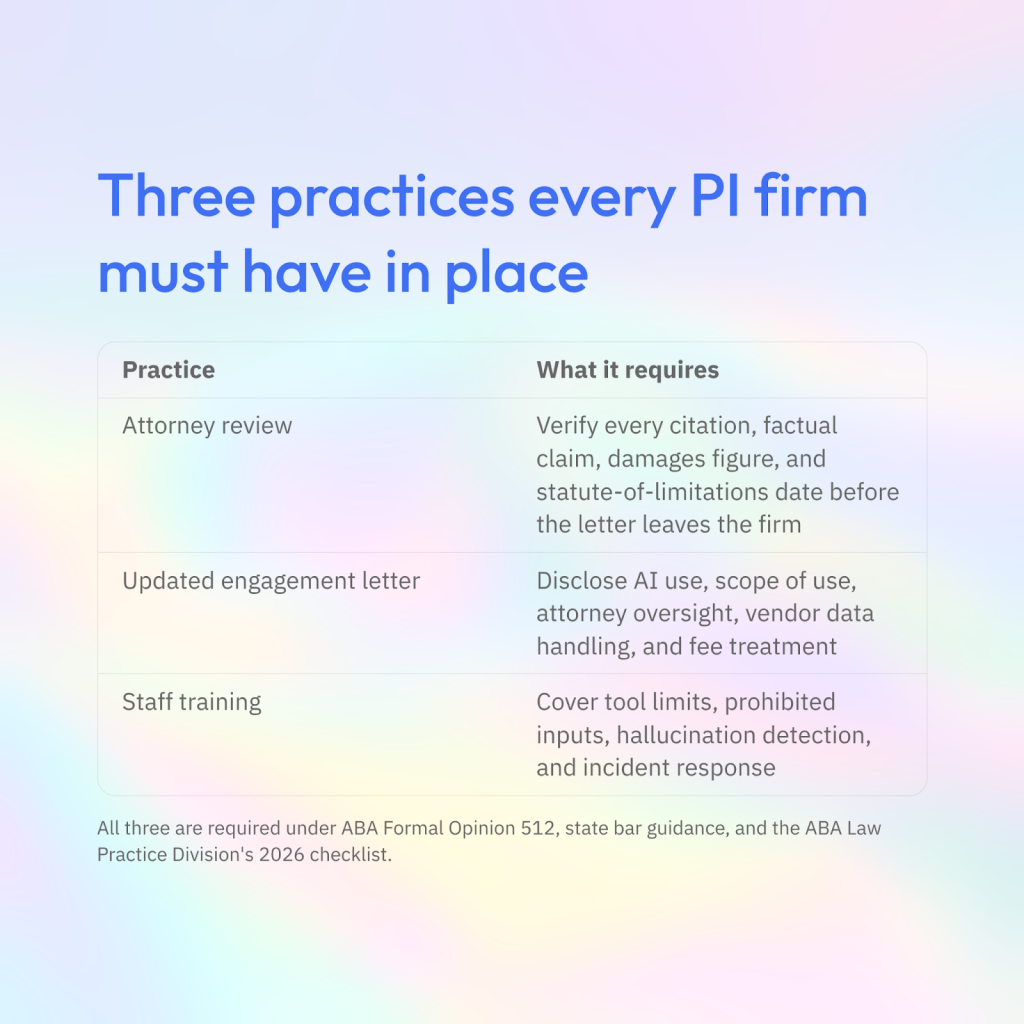
Three practices have converged across Formal Opinion 512, state bar guidance, and the ABA Law Practice Division’s 2026 practical checklist, and all three carry ethics weight.
Attorney review is not optional. Before any AI-drafted demand leaves the firm, a licensed attorney must verify: that every citation exists in a primary source; that case holdings are accurately described; that factual assertions match the record; that damages figures reconcile independently; and that statute-of-limitations dates are correct. Not all AI output carries the same risk. A summarized deposition needs less scrutiny than a demand letter going out under the firm’s letterhead.
Engagement letters need updating. Recommended additions include a plain-language disclosure that AI may be used, the specific categories of use (medical record review, demand drafting, internal research), an attorney-oversight clause, a data-handling clause confirming vendor BAAs and no-training posture, and a fee-treatment clause consistent with Opinion 512. Disclosure is not just a compliance requirement. The Harvard Law has noted that generative AI is already reshaping legal work, which makes transparency about AI use a practical trust signal for clients, not just a legal formality.
Staff training is an ethics obligation. Under Rules 5.1 and 5.3, training must cover what the tool can and cannot do, which inputs are never permitted (Social Security numbers, minor-child information, unconsented mental-health records), how to detect hallucinations, and how to respond to an incident.
Our legal document automation software builds attorney-review checkpoints directly into the drafting workflow.
Frequently Asked Questions
Here are the questions PI attorneys most often ask about AI-drafted demands and what the current ethics guidance actually says.
Can AI Produce a Complete PI Demand Letter on Its Own?
Yes, in the sense that current tools can generate a full draft from structured inputs. No, in the sense that no attorney can ethically send that draft without verifying every factual claim, citation, and damages figure. The output is a starting point, not a finished document.
Is Using AI to Draft Demand Letters Ethical?
Under ABA Formal Opinion 512, using AI in demand letter drafting is permissible, provided attorneys maintain competence, protect client confidentiality, supervise the output, and do not bill clients for time the AI saved. Florida has incorporated these requirements directly into its court rules, and other states are following.
What Is the Biggest Risk of AI-Drafted Demand Letters?
Factual errors that look plausible. A Stanford study found that purpose-built legal AI tools still hallucinate on 17 to 34 percent of queries. In PI, where damages calculations and treatment timelines are central to every demand, a single undetected error can undervalue a case or expose the attorney to sanctions.
Does Feeding Medical Records Into an AI Tool Create a HIPAA Problem?
It can. When a firm inputs PHI into an AI vendor, a HIPAA-compliant Business Associate Agreement is legally required. Attorneys using consumer-grade AI tools without a BAA for medical record processing are operating outside HIPAA compliance, regardless of any other security features the tool may have.
How Much Time Can AI Realistically Save on Demand Letter Drafting?
Thomson Reuters projects four hours of weekly savings per legal professional today, rising to 12 hours by 2029. Per-letter time savings vary by case complexity and record quality, and vendor-specific claims have not been independently validated. The Thomson Reuters projections are survey-based rather than empirical benchmarks, but they represent the most rigorously sourced estimates available.
Start Drafting Demand Letters Faster
DocuLex.ai was built by a practicing civil litigation attorney with 20-plus years in personal injury and complex civil litigation. The existing tools did not handle medical records, demand drafting, and HIPAA compliance as a single workflow, so we built one that does. If you are ready to see what structured AI demand drafting looks like in practice, join the waitlist for early access.