

Medical record retrieval is one of the most consequential workflow decisions a PI firm makes. A slow or incomplete retrieval process does not just delay a case; it can end it. This guide covers the top providers in 2026, the key factors to evaluate, and what to expect in terms of turnaround, pricing, and compliance.
At DocuLex.ai, we build AI tools for PI litigation attorneys. We see firsthand how retrieval bottlenecks back up everything downstream, and firms that pair fast retrieval with strong analysis tools consistently move cases to resolution faster.
Below, we rank the best options available in 2026 and explain what distinguishes them.
Why Your Retrieval Service Choice Matters
Medical records are the backbone of any personal injury case. Without them, there is no chronology, no proof of treatment, and no basis for a demand letter.
Record delays are one of the most common reasons PI cases stall or get dismissed entirely. The Association of Legal Administrators notes that quality retrieval providers should deliver records in 23 days or less, but traditional vendor turnarounds still stretch past that in many cases. AI-powered platforms have compressed timelines further, delivering routine requests in days or even hours. The difference between choosing the right vendor and the wrong one is now measured in weeks of case preparation time.
Completeness is the other half of the problem. Clients regularly overlook providers when recounting their treatment history, leaving manual requests incomplete. AI-assisted platforms cross-reference prescription histories, insurance claims, and referral records to surface providers the client never mentioned. These are often the providers who documented initial injury and causation.
What to Look for in a Medical Record Retrieval Service
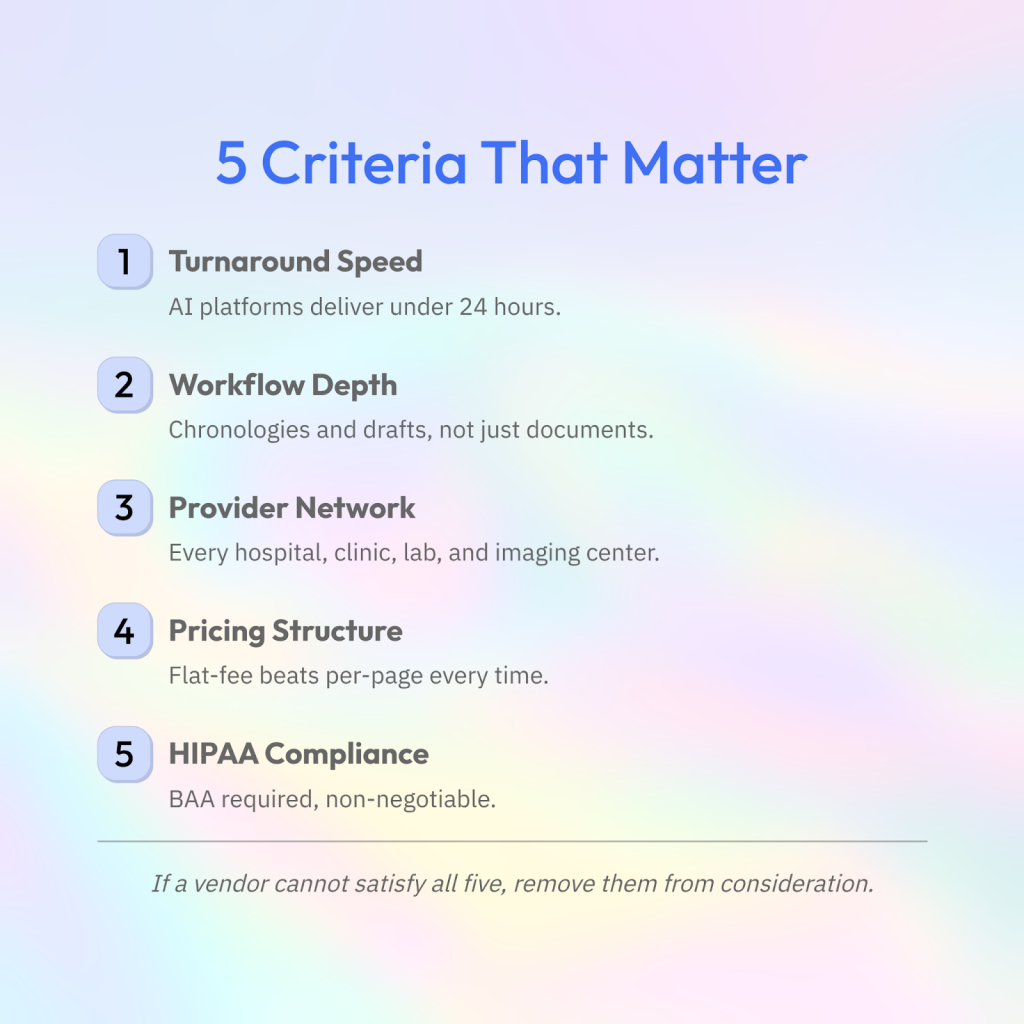
Five criteria should drive your evaluation.
Turnaround Speed
Under federal rules, healthcare providers have up to 30 days to respond to record requests. Traditional vendors average 10 to 15 days by maintaining established provider relationships. AI-driven platforms have pushed that to under 24 hours through direct digital connections and automated follow-up.
Workflow Depth
Some vendors deliver raw documents and stop. Others return pre-indexed, searchable records with auto-generated chronologies and draft demand letters. For high-volume PI practices, the latter approach is the difference between a day of paralegal work and an hour.
Provider Network Coverage
Effective retrieval depends on reaching every relevant source: hospitals, clinics, urgent care centers, labs, and imaging facilities. Healthcare providers are increasingly accepting electronic record requests, which has improved what digital-first vendors can deliver. Vendors with the broadest networks and automated follow-up consistently deliver more complete records.
Pricing Structure
Per-page fees and rush charges compound quickly on complex cases. Flat-fee per-case pricing, now standard among AI platforms, eliminates that variability.
HIPAA Compliance and Security
Every vendor handling PHI on behalf of a law firm must comply with HIPAA. At minimum, that means secure transmission, encrypted storage, full audit trails, and a signed Business Associate Agreement. Any vendor that cannot produce these on request is not a viable option.
Top Medical Record Retrieval Services for Law Firms in 2026
The vendors below cover the full range of service models currently available, from traditional full-service providers to AI-powered end-to-end platforms. Each entry notes what the service does well and which type of firm it suits best.
ChartRequest
ChartRequest is a release-of-information portal with one of the broadest provider networks in the industry. It connects directly with many healthcare systems and provides real-time request tracking. The platform stops at retrieval; your team handles organization and analysis from there. Pricing is custom.
Best suited for: firms that want broad provider coverage and real-time visibility into request status.
Record Retrieval Solutions (RRS)
RRS was founded in 2014 by a professional who had worked in the records industry since 1989. They offer a HIPAA-compliant online portal that includes medical record summarization and indexing alongside retrieval, which reduces some of the downstream manual work. Their flat fee of $45 per request makes pricing straightforward.
Best suited for: firms that want transparent flat-fee pricing with basic summarization support built into the retrieval workflow.
Lexitas
Lexitas is a national litigation support firm that bundles medical record retrieval with court reporting, deposition services, and expert witness coordination. For firms already using Lexitas in other capacities, consolidating retrieval under the same vendor reduces vendor management overhead. Their record retrieval service is court-compliant and available nationwide.
Best suited for: firms already using Lexitas for depositions or court reporting who want to consolidate vendors.
American Retrieval Company
American Retrieval has operated since 1993 and was acquired by U.S. Legal Support in January 2025, expanding its national footprint. They offer real-time tracking, OCR-processed searchable PDFs, and flat-rate per-case pricing, and integrate directly with Datavant, which processes records from approximately 55% of U.S. healthcare providers. Their consistent turnaround of approximately 15 days makes them a reliable option for firms that prioritize predictability over speed.
Best suited for: firms that want flat-rate pricing, broad provider access, and searchable document output without a full AI workflow.
AI-Powered Platforms (LlamaLab, Tavrn, and Similar)
A newer category of retrieval providers uses AI to automate the full sequence: intake, request submission, follow-up, provider discovery, and initial record analysis. Platforms in this space report sub-24-hour turnarounds on standard cases, and they are particularly effective at identifying overlooked providers through automated cross-referencing. These platforms typically use flat-fee pricing and include chronology building and sometimes demand letter drafting.
Best suited for: high-volume PI firms that need maximum speed and want to reduce paralegal workload across the full retrieval-to-analysis pipeline.
Side-by-Side Comparison
| Provider | Typical Turnaround | Pricing Model | Workflow Depth | Best For |
| ChartRequest | 1 to 2 weeks | Custom | Retrieval only | Broad provider network, real-time tracking |
| Record Retrieval Solutions | ~16 days | $45 flat fee per request | Retrieval + summarization | Transparent pricing with analysis support |
| Lexitas | Varies | Custom | Retrieval + litigation support | Multi-service vendor consolidation |
| American Retrieval Company | ~15 days | Flat rate per case | Retrieval + OCR | Broad Datavant network, searchable PDFs |
| AI-Powered Platforms | Under 24 hours | Flat rate per case | End-to-end automation | High-volume PI, fastest turnaround |
| Traditional in-house | 60 to 90+ days | Staff time cost | Manual | Not recommended for most firms |
The Medical Record Retrieval Market in 2026
The global medical record retrieval market was valued at approximately 1.1 billion in 2024 and is projected to reach $2.8 billion by 2034, representing roughly a 10% annual growth rate. That investment is flowing into technology and provider networks. The performance gap between AI-enabled vendors and traditional ones is widening every year, which means the cost of staying with an outdated retrieval process compounds over time.
What Happens After You Receive the Records
Getting records is only the start of the problem. On a high-volume PI docket, reading, organizing, and building a chronology from incoming records can still consume days of paralegal time per case.
That is where AI analysis tools change the equation. At DocuLex.ai, our AI medical records processing is built specifically for litigation attorneys. Once records come in, the platform processes them visit by visit, organizes them by provider and date, and generates detailed medical summaries and billing breakdowns automatically.
Frequently Asked Questions
The questions below cover what law firms most commonly ask when evaluating retrieval vendors.
How Long Does Medical Record Retrieval Take for a Law Firm?
AI-driven platforms now deliver records in under 24 hours for many cases; traditional vendors typically take 10 to 15 days. Federal rules allow providers up to 30 days to respond, but the top services beat that substantially through direct digital connections.
How Much Does a Medical Record Retrieval Service Cost?
Pricing ranges from per-page billing, which compounds quickly on complex cases, to flat-fee per-case models that are now standard among AI platforms. Flat-fee pricing is more predictable for firms with high document volumes.
Do Medical Record Retrieval Services Have to Be HIPAA Compliant?
Yes. Any vendor handling PHI on behalf of a law firm must comply with HIPAA and be able to provide a signed Business Associate Agreement before you share any client records.
What Is the Difference Between Record Retrieval and Record Analysis?
Retrieval is the process of requesting and collecting documents from healthcare providers. Analysis involves organizing those documents into a chronology, summarizing treatment histories, and identifying case-relevant facts. Most retrieval vendors stop at delivery, leaving the analysis work to your firm.
Choosing the Right Retrieval Service
The retrieval decision is also a risk management decision. Of all the ways a PI case stalls, delayed or incomplete records are among the most preventable.
High-volume PI practices will get the most from AI-powered platforms, where speed and automation directly reduce per-case overhead. Firms handling lower volumes or more complex cases, such as mass tort or multi-party litigation, often benefit from the account management and flexibility that established vendors provide.
Once records are in hand, make sure your firm has the tools to process them quickly. Join the DocuLex.ai waitlist to get early access to AI medical records processing and document generation tools built specifically for litigation attorneys.