
How AI Deposition Tools Streamline Prep and Analysis for Litigation Attorneys

AI deposition tools are changing how litigation attorneys prepare for and analyze testimony. Tasks that once took days of manual review, like summarizing a 100-page transcript or building a medical chronology from hundreds of pages of records, now take minutes. Research from Thomson Reuters shows that AI-assisted document analysis can reduce total preparation time from 17 to 28 hours down to roughly 3 to 5.5 hours per matter. At DocuLex.ai, we’ve spent over 20 years in civil litigation and 18 months building tools specifically for litigation document management. This article covers how AI deposition tools function at each stage of the process, where the biggest time savings are, and what to prioritize when evaluating one for your practice. Where Attorneys Lose the Most Time in Deposition Workflows Deposition work breaks into three phases: preparation, the deposition itself, and post-deposition analysis. Each one has historically required significant manual effort. Preparation is typically the biggest time sink. Attorneys need to synthesize thousands of pages of discovery, including medical records, prior testimony, internal communications, and expert reports, to build a line of questioning. In personal injury cases, just organizing the medical records can take a paralegal multiple days. During the deposition, teams often wait days or weeks for a finalized transcript before they can begin any meaningful analysis. After the deposition, associates or paralegals spend hours manually summarizing testimony, cross-referencing exhibits, and organizing the transcript by issue. AI tools target all three phases. The efficiency gains are most dramatic in preparation and post-deposition summarization, where the reduction in manual labor is measurable. How AI Accelerates Pre-Deposition Preparation Automated Medical Chronologies and Record Analysis In personal injury and medical malpractice cases, the volume of medical records is often the single biggest bottleneck. AI tools that specialize in this area can ingest large datasets and structure them into usable formats almost immediately. Processes that once required days of manual paralegal review now happen in minutes. The most valuable output at this stage is the automated medical chronology. Using natural language processing (NLP), AI extracts dates, providers, diagnoses, treatments, and event descriptions from the records and assembles them into a chronological narrative. This lets attorneys visualize causation, spot gaps in treatment, and identify where the defense’s version of events conflicts with the actual record. This is one of the areas where we’ve focused heavily at DocuLex.ai. Our platform processes medical records visit by visit and generates patient visit and billing summaries automatically. What used to require a paralegal working for two or three days is now generated in seconds with page-level accuracy. Identifying Inconsistencies Across Witness Statements One of the most powerful pre-deposition capabilities is automated cross-referencing. AI models can compare a witness’s prior deposition testimony against the documentary evidence and flag contradictions. If a witness’s account of the timeline doesn’t match the medical record, the system identifies it. For expert depositions, AI can also compare an expert’s current reasoning against testimony they’ve given in prior unrelated cases, surfacing vulnerabilities that would be nearly impossible to find manually without hours of research. This kind of rapid inconsistency detection enables attorneys to draft sharper deposition questions and anticipate opposing counsel’s likely lines of attack. Semantic Search: A Better Way to Find What Matters in Case Files Traditional keyword search has been the default since the 1990s. The problem is that it requires attorneys to guess exactly which words a witness or author used. If a relevant document uses a synonym or different phrasing, it gets missed. Semantic search, powered by vector modeling and transformer-based AI, understands the meaning behind a query rather than just matching words. A search for “safety concerns” will surface documents mentioning “hazard protocols,” “injury reports,” or “equipment failure,” even if the word “safety” doesn’t appear. This deeper retrieval across large volumes of case materials eliminates the back-and-forth of running multiple keyword searches and reduces the risk of missing critical evidence. When semantic search is integrated into a litigation file management system, the effect compounds. Attorneys can query across all stored case materials, including archived matters, to instantly retrieve relevant documents. Our AI legal chatbot at DocuLex.ai is built around this concept: ask a natural language question about your case and get context-aware answers drawn directly from your stored files. Real-Time Transcription and In-Deposition Analysis AI transcription tools have reduced the wait for deposition transcripts from days to essentially zero. Real-time transcription services provide high-accuracy text streams during the deposition itself, giving legal teams the ability to adjust their strategy on the fly. Advanced transcription tools use speaker diarization to automatically distinguish between participants, whether attorney, witness, or court reporter. The result is a clean, labeled transcript that clearly shows who said what, with accurate timestamps for quick reference. Some platforms go further and provide real-time summarization, generating bulleted highlights while the deposition is still in progress. Team members monitoring remotely can review these summaries and send feedback to the questioning attorney without waiting for a break. AI-Powered Post-Deposition Summarization Post-deposition analysis is historically the most labor-intensive “grunt work” in litigation support. Paralegals and associates spend hours or days reading through transcripts, pulling key facts, and organizing the testimony by issue. AI tools have compressed this process dramatically. Industry benchmarks show that AI can reduce a 100-page deposition review from several hours to as little as five minutes. What makes modern AI summarization tools especially useful is that they don’t just produce a single type of output. Most offer several formats depending on what the attorney needs. Common AI Summary Formats Summary Type What It Provides Best Used For Page/Line Summary Full transcript coverage with specific page and line citations Trial prep and motion writing Narrative Summary Testimony condensed into a readable story format Client updates, insurance adjuster reports Thematic Summary Testimony organized by legal or factual issue (e.g., “Standard of Care,” “Damages”) Case strategy and issue spotting Key Admissions Extracted concessions and impactful statements grouped by theme Cross-examination prep and settlement negotiations Source: ABA Law Technology Today Automated Exhibit Indexing Another significant
How to Generate Effective Demand Letters with AI: Guide for Personal Injury Attorneys
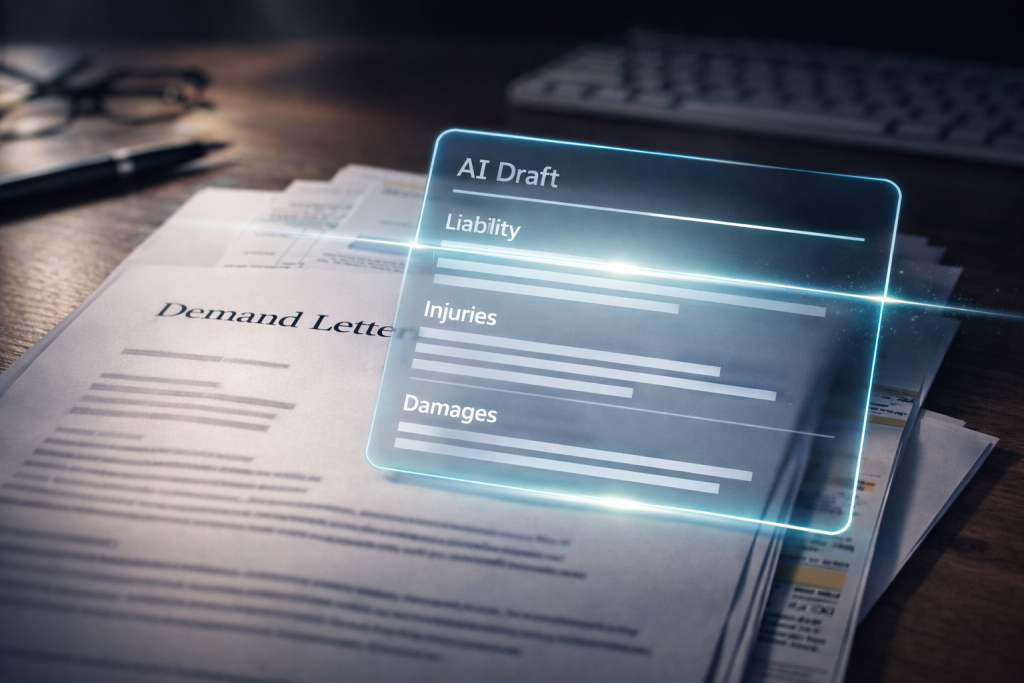
AI-powered demand letter tools can cut drafting time from 5-15 hours down to under 30 minutes while producing more accurate, data-backed settlement demands. For personal injury attorneys managing heavy caseloads, that time savings translates directly into higher case throughput and faster resolutions. At DocuLex.ai, we built our legal document automation software specifically for litigation attorneys dealing with this bottleneck. With over 20 years of civil litigation experience behind our platform, we designed the demand letter workflow around how PI attorneys actually work: upload the case file, let the AI process medical records and billing data, and generate an attorney-ready draft. This guide walks through how AI demand generation works, how to implement it step by step, what to look for in a platform, and where human oversight remains essential. Why Personal Injury Firms Are Moving to AI for Demand Letters The traditional demand letter process is one of the biggest time drains in personal injury practice. A single demand requires attorneys or paralegals to manually review hundreds of pages of medical records, compile billing summaries, cross-reference treatment timelines, and build a persuasive narrative tying liability to damages. For a mid-sized firm handling 50 demands per month, that adds up to hundreds of hours spent on document assembly rather than case strategy or client advocacy. The shift toward AI is already well underway. Industry data shows that 73% of early adopters now complete demand letters and medical chronologies faster with fewer revisions, and 75% of firms report using AI to increase overall productivity without proportionally increasing headcount. The benefit goes beyond speed. Demands that include ICD codes, cited medical projections, and structured damage calculations have a 69% higher likelihood of hitting policy limit settlements. Data-backed demands speak the same language as the insurance adjuster’s valuation software, which makes them harder to lowball. How AI Demand Letter Generation Actually Works Understanding the process helps you use these tools more effectively. Modern AI demand generators are purpose-built systems trained on legal and medical datasets, not general-purpose chatbots. Data Ingestion The process begins when the AI ingests unstructured case materials: physician notes, hospital bills, imaging reports, and police reports. Using optical character recognition (OCR) and natural language processing (NLP), the system converts these documents into structured, searchable data. Top-tier platforms achieve accuracy benchmarks around 97% compared to manual review. Legal Logic Layer Once data is structured, the AI applies legal reasoning to identify the core components of a personal injury claim: liability, causation, and damages. For medical bills, this means recognizing the provider, extracting CPT codes for procedures, and flagging whether billing aligns with the standard of care for the described injury. Narrative Construction The most advanced stage is building a persuasive narrative rather than a list of facts. The AI connects the mechanism of injury from a police report to medical findings, constructing a causal chain. It then quantifies damages using settlement data, factoring in economic damages (medical specials, lost wages) and non-economic damages (pain and suffering) based on jurisdictional benchmarks. Step-by-Step: Generating a Demand Letter with AI 1. Choose the Right Platform Not every AI tool is built for personal injury work. When evaluating options, focus on these criteria: At DocuLex.ai, we designed around these exact requirements. Our AI paralegal handles medical record analysis, billing summaries, and document generation within a single HIPAA-compliant system, with a BAA in place through our AI provider. 2. Prepare a Complete Case File AI output quality depends entirely on input quality. Before generating a demand, make sure your case file includes: Missing documents lead to incomplete demands with gaps that adjusters will exploit. Upload a thorough file upfront to avoid multiple revision cycles. 3. Craft Effective Prompts (When Applicable) Some platforms offer one-click generation from structured case data. Others use open-ended AI assistants that benefit from careful prompt engineering. If your tool requires prompts, structure them with four elements: Start broad, then refine with follow-up instructions like “expand the pain and suffering narrative” or “address the comparative negligence argument.” Iterative prompting consistently produces better results than a single attempt. 4. Run a Multi-Tiered Review This step is non-negotiable. AI is a drafting tool, not a replacement for attorney judgment. Every generated demand needs human review across these dimensions: Review Tier Focus Area Key Checkpoints Factual Integrity Data accuracy Cross-check medical dates, bill totals, and ICD-10 codes Legal Sufficiency Citation verification Confirm all cited case law and statutes are current and relevant Strategic Polish Negotiation tone Ensure the demand reflects your specific case strategy and the client’s story Compliance Check Ethical standards Flag any hallucinated facts or fabricated citations ABA Model Rules 1.1 (Competence) and 5.3 (Supervision) require attorneys to maintain responsibility for any AI-generated output. A mandatory review protocol is an ethical obligation, not a suggestion. Comparing AI Demand Letter Platform Types The market breaks into three general categories. Each fits a different type of practice: Platform Type Best For Typical Turnaround Trade-Off Specialist (demand-focused) Complex, high-value cases Hours to days Higher per-demand cost ($275-$800+) Integrated CMS Firms wanting everything in one system Minutes to instant May lack depth in specialized PI features All-in-one litigation platform PI firms needing file management + document generation Minutes Requires centralizing case materials on the platform Specialist platforms focus narrowly on demand quality and often supplement AI output with human expert review. They charge per demand, which adds up at higher volumes. Integrated CMS tools keep everything in one system but may treat demand generation as an add-on rather than a core feature. All-in-one litigation platforms like DocuLex.ai combine litigation document management with AI-powered generation, so your case data feeds directly into the drafting process without switching between tools. The right choice depends on your firm’s case volume, complexity mix, and existing tech stack. Medical Chronologies: The Foundation of Every Strong Demand A demand letter is only as strong as the medical evidence behind it. AI medical chronology tools have compressed what used to require 20-40 hours of manual review into minutes. Advanced systems go beyond chronological sorting. They