

Yes. AI can produce deposition summaries accurate enough to use in court preparation, provided the attorney verifies the output before relying on it in filings, motions, or trial. The key word is “verified.” AI summarization is a drafting tool, not a finished product. When an attorney treats the AI-generated summary the same way they would treat a summary prepared by a junior associate (review it, check the citations, confirm the facts), the result is reliable enough for motions practice, trial prep, and deposition designations.
At DocuLex, we process depositions page by page rather than feeding entire transcripts into a single AI prompt. This structured approach reduces hallucination risk and produces summaries with specific page and line references that attorneys can verify against the original transcript. Research supports this architecture: a 2025 systematic review found that grounding AI outputs in retrieved source documents substantially improves factual accuracy and reduces fabricated information. Deposition summarization works from a finite, known document rather than generating content from training data, which is why it remains one of the most reliable AI use cases in legal practice.
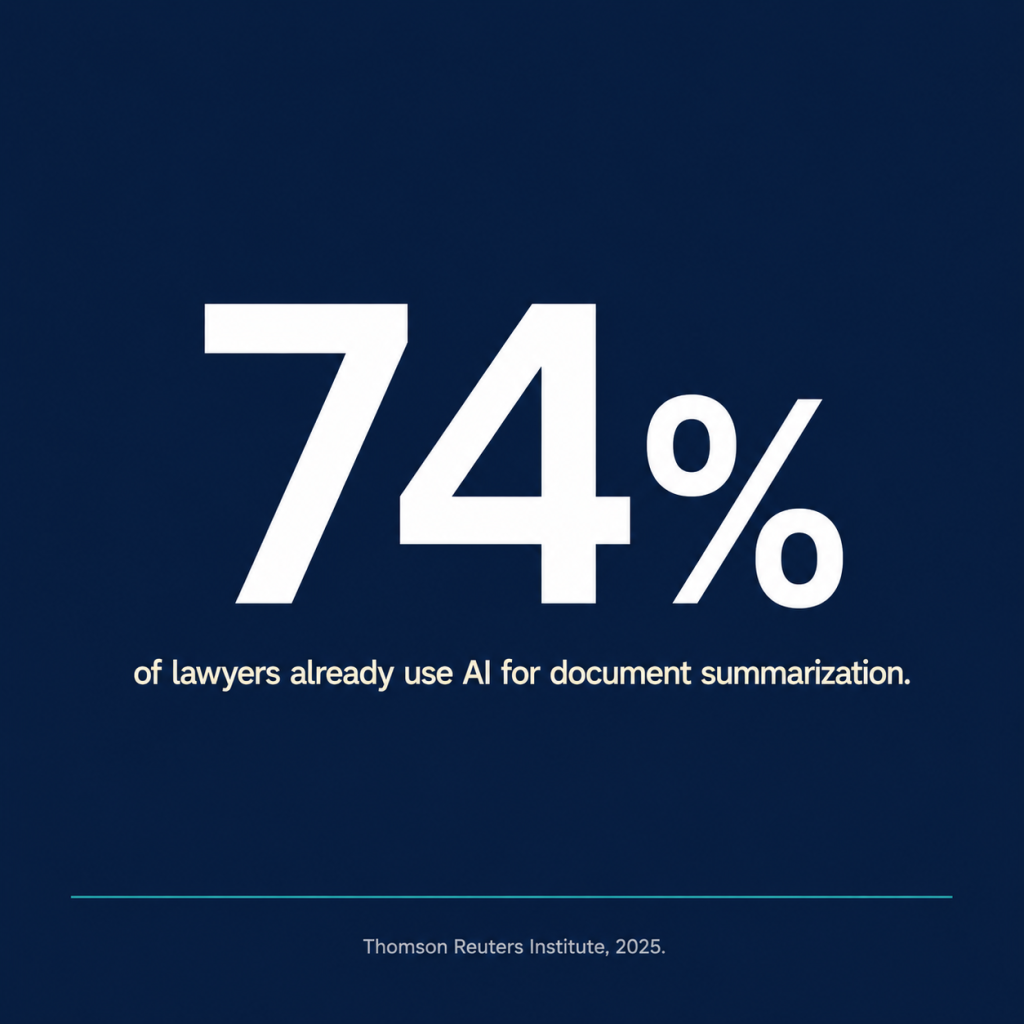
The 2025 Thomson Reuters Institute report found that 74% of surveyed lawyers already use AI for document summarization, and overall GenAI adoption in legal organizations jumped from 14% to 26% between 2024 and 2025. Attorneys are already using AI for deposition work. The remaining question is whether they are using it with the right safeguards.
Three Types of Accuracy in Deposition Summaries
When attorneys ask whether AI deposition summaries are “accurate enough,” they are usually asking about three different things at once. Separating them matters because AI handles each one differently.
Researchers at CHIIR (Farzi & Dietz, 2026) developed a framework for evaluating AI deposition summaries that breaks accuracy into three measurable dimensions: completeness, citation quality, and factual correctness. These map closely to how practicing attorneys evaluate deposition work product.
| Accuracy Type | What It Measures | AI Reliability |
| Factual extraction | Did the summary correctly capture what the witness said? | High. AI is strong at identifying and restating testimony from a provided transcript. |
| Citation accuracy | Are the page and line references correct? | High when the system processes transcripts with page-level indexing. Lower when the AI works from unstructured text. |
| Interpretive accuracy | What does this testimony mean strategically for the case? | Low. AI can flag relevant passages but cannot assess credibility, weigh conflicting testimony, or develop case strategy. This remains attorney work. |
The practical takeaway: AI handles the time-consuming extraction work (what was said, where it appears in the transcript) while attorneys focus on the interpretive layer (what it means for the case). A deposition summary that accurately captures testimony and provides correct page/line citations is useful work product, even before an attorney adds strategic analysis.
Why Deposition Summarization Is Different from Legal Research
Most of the high-profile AI failures in legal practice involved open-ended legal research, where the AI generated citations to cases that did not exist. Deposition summarization is architecturally different, and that distinction matters.
When AI summarizes a deposition transcript, it works from a closed corpus: a finite, known document that the attorney uploaded. The AI is not searching the internet or generating case law from its training data. It is extracting and organizing information from a specific source that the attorney already possesses.
This closed-corpus approach is why retrieval-augmented generation (RAG) systems produce more reliable results. A 2025 systematic review of RAG systems confirmed that grounding AI outputs in retrieved evidence reduces hallucinated information compared to systems that rely solely on the model’s internal knowledge. In deposition work, this means AI that processes the actual transcript (with page references intact) is far less likely to fabricate testimony than a general-purpose chatbot summarizing from memory.
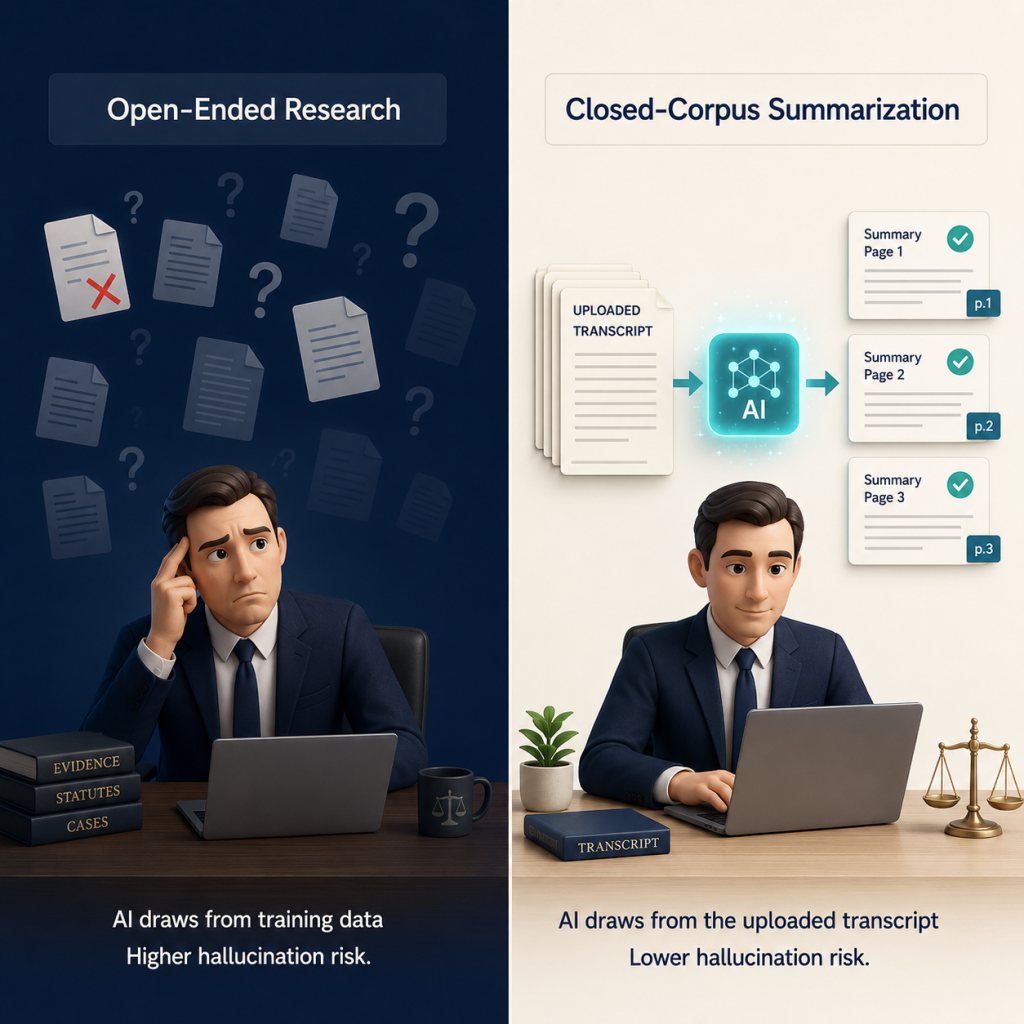
The practical risk profile looks different depending on how the tool works:
| Approach | What the AI Draws From | Hallucination Risk |
| Open-ended AI research | Model’s training data, internet searches | High. The AI may generate plausible-sounding but nonexistent citations. |
| Bulk transcript upload | Entire deposition as a single prompt | Moderate. Long inputs can cause the AI to lose context, skip sections, or conflate testimony from different witnesses. |
| Page-level structured processing | Individual pages with preserved references | Low. The AI processes smaller segments with clear source attribution, reducing errors. |
At DocuLex, we chose page-level processing specifically because it preserves the connection between summary content and transcript source. The platform stores deposition content in a vector database, which means our AI chatbot can retrieve specific testimony by page and line reference rather than reconstructing answers from a bulk text dump.
The Hallucination Risk: What the Data Shows
The word “hallucination” gets thrown around loosely in conversations about AI in legal practice. For deposition work, the numbers provide useful context.
A 2024 study by Magesh et al. examined leading AI legal research tools and found a roughly 17% hallucination rate even among systems using retrieval-augmented generation. That number sounds alarming until you consider two things: first, the study measured open-ended legal research (generating case citations), not closed-corpus summarization. Second, 17% is the rate without structured human review.
The researchers also found that GPT-4 used without any retrieval system produced even higher rates of factual inaccuracy across legal tasks. The difference between “AI used carelessly” and “AI used within a structured workflow” is significant.
For deposition summarization specifically, no independent benchmark study exists yet. This is an honest gap in the research. Most accuracy claims for deposition tools come from vendors, not peer-reviewed studies. What we do know is that the architectural factors that reduce hallucination in other legal AI tasks (closed-corpus input, page-level processing, source attribution) apply directly to deposition work.
What this means in practice: attorneys should not assume any AI-generated summary is error-free. But they also should not assume a 17% error rate applies to a system that only draws from a specific transcript. The error rate depends heavily on how the tool processes the document.
What Courts Have Said About AI-Generated Legal Work
No published court opinion specifically addresses AI-generated deposition summaries. The case law that does exist involves AI-generated legal research, and the distinction is important.
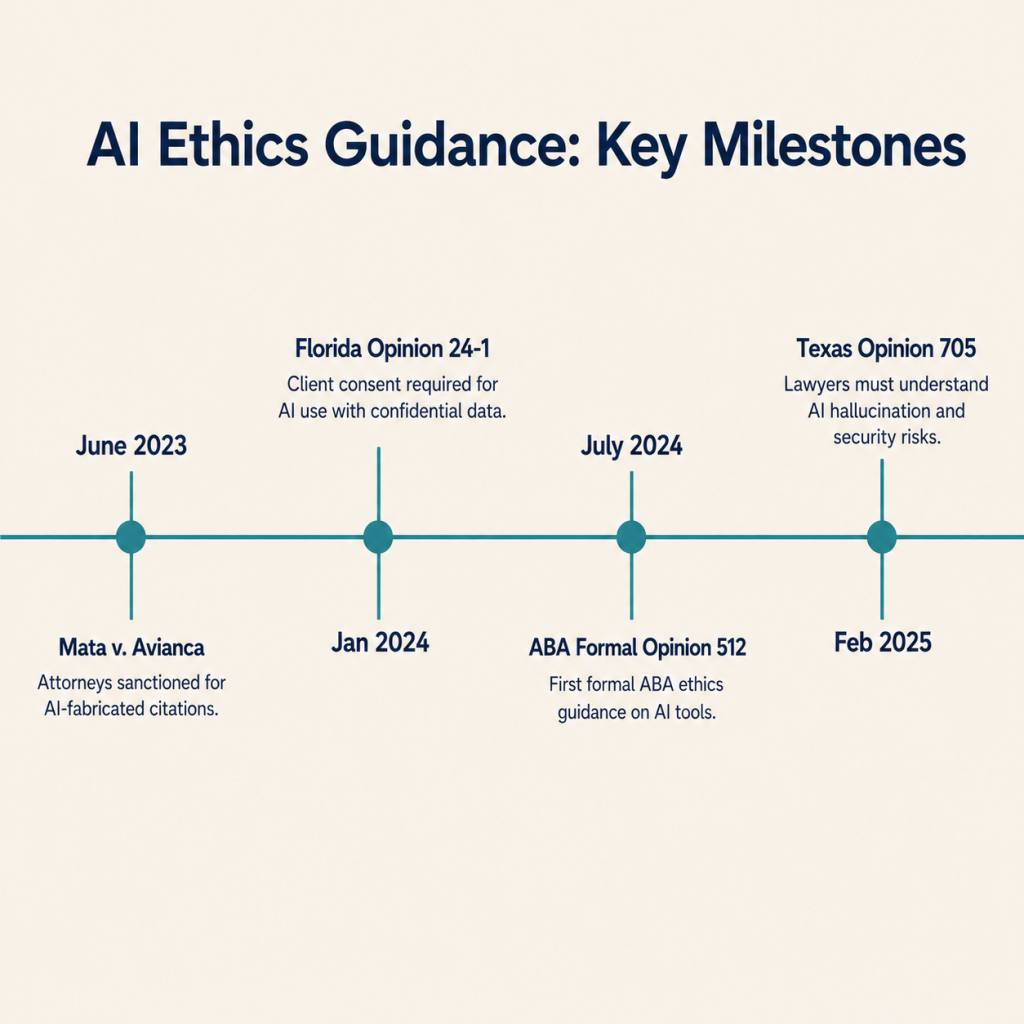
The most cited case is Mata v. Avianca (S.D.N.Y. 2023), where Judge Castel sanctioned attorneys under Federal Rule of Civil Procedure 11 for submitting a brief containing fabricated case citations generated by ChatGPT. The court noted that using AI tools is not inherently improper, but that attorneys have a gatekeeping role to ensure the accuracy of their filings.
Since Mata, multiple federal courts have adopted standing orders requiring attorneys to certify whether AI was used in preparing filings. The District of Colorado’s standing order on AI certification, for example, requires filers to confirm that any AI-drafted language was personally reviewed for accuracy and that all citations are genuine.
These rulings reinforce a simple principle: the attorney is responsible for the accuracy of every filing, regardless of the tools used to prepare it. That applies equally to work prepared by associates, paralegals, contract attorneys, and AI systems.
The important distinction for deposition work is that the Mata problem (fabricated case citations) arises from open-ended generation. Deposition summaries draw from a closed corpus. The AI is not inventing testimony; it is restating what a witness said in a document the attorney already has. The verification step is also simpler: check the summary against the transcript, confirm the page and line references, and ensure nothing critical was omitted.
Rule 11 Obligations and ABA Formal Opinion 512
The ethical framework for using AI in legal work is well established at this point. Multiple authorities have weighed in, and they all reach the same conclusion: AI use is permitted, but the attorney remains fully responsible for the output.
ABA Formal Opinion 512 (July 2024) was the ABA’s first formal ethics guidance on AI. It addresses competence, confidentiality, communication, and fees. The opinion makes clear that lawyers must understand the benefits and risks of the technologies they use, consistent with Model Rule 1.1’s requirement of technological competence.
State bars have followed with their own guidance:
- Florida Advisory Opinion 24-1 (January 2024) requires client consent before using AI with confidential information and underscores that lawyers are responsible for AI-generated work just as they would be for work from any other assistant.
- Texas Ethics Opinion 705 (February 2025) requires lawyers to have a “reasonable and current understanding” of AI technology, including hallucination and data security risks.
For deposition work, these rules mean three things:
- You can use AI. No ethics opinion prohibits AI-assisted deposition summarization.
- You must verify the output. The same standard that applies to reviewing a paralegal’s work applies to reviewing AI output.
- Confidentiality matters. Deposition transcripts, especially in personal injury cases, often contain protected health information. The platform you use must handle that data appropriately. DocuLex maintains full HIPAA compliance with SSE-KMS encryption and a Business Associate Agreement with OpenAI, ensuring that transcript data processed through the platform is not retained after analysis.
These rules formalize the verification step that responsible attorneys were already doing. The effect is to set a clear standard, not to discourage AI use.
What a Reliable AI Deposition Workflow Looks Like
A full step-by-step guide to using AI for deposition summaries is covered in our article on how to use AI for deposition summaries. For the accuracy question, the relevant points are structural:
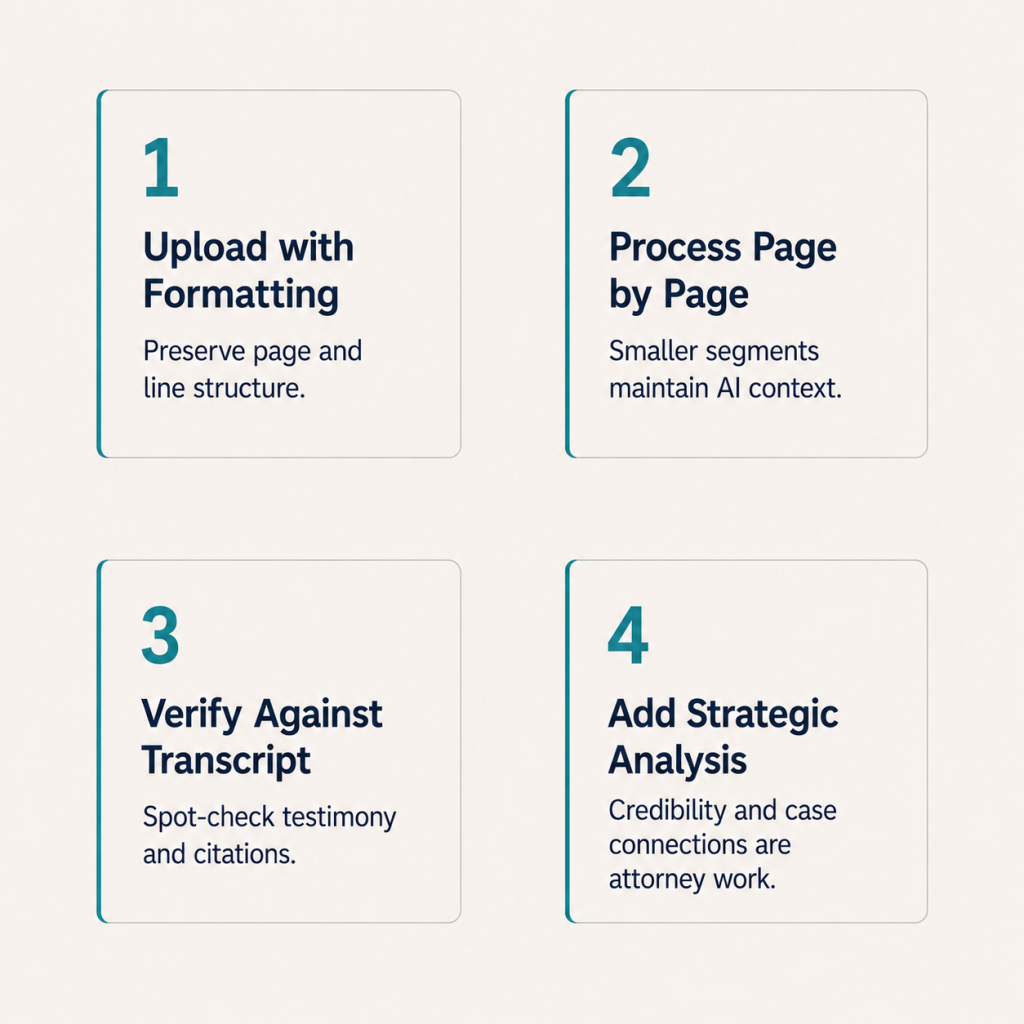
- Upload the transcript with page/line formatting intact. AI accuracy depends on receiving structured input. A clean transcript with preserved formatting produces better results than a scanned PDF or unformatted text dump.
- Use a tool that processes page by page, not in bulk. Smaller processing segments mean the AI maintains better context and produces more accurate citations.
- Verify against the transcript. Spot-check testimony. Confirm page and line references. Look for omissions, especially around critical admissions or contested facts.
- Add the interpretive layer. Strategic analysis, credibility assessments, and connections to other case evidence are attorney work. Use the AI summary as the factual foundation, then build your analysis on top of it.
This workflow treats AI the way a senior attorney treats a junior associate’s first draft: useful work product that saves significant time, but not something you file without reading.
Frequently Asked Questions
Are AI Deposition Summaries Admissible in Court?
Deposition summaries are attorney work product used to prepare for trial, not evidence submitted to the court. The relevant question is whether the testimony referenced in motions and designations is accurately cited. AI-generated summaries that have been verified by the attorney meet the same standard as manually prepared summaries.
Can AI Replace a Paralegal for Deposition Review?
AI handles the initial extraction and organization faster than manual review. A summary that takes a paralegal several hours to compile can be generated in minutes. But the paralegal’s role shifts to verification and quality control rather than disappearing entirely. The time savings come from the first draft, not from eliminating review.
What if the AI Misses Something Important in the Transcript?
Completeness is the accuracy dimension that requires the most attention during review. AI may omit testimony that seems tangential but has strategic significance. The verification step should specifically check whether admissions, inconsistencies, and contested facts appear in the summary. This is also why AI-powered document generation works best when combined with the attorney’s knowledge of the case.
Do I Need to Disclose That I Used AI to Prepare a Deposition Summary?
Disclosure requirements vary by jurisdiction and are evolving. Several federal courts require certification of AI use in filings. A deposition summary used internally for case prep (not filed with the court) may not trigger disclosure obligations, but any content from the summary that appears in a filing should comply with applicable standing orders. Check your jurisdiction’s current requirements.
Is It Safe to Upload Deposition Transcripts to AI Tools?
This depends entirely on the platform. General-purpose AI tools like ChatGPT (without a business agreement) may retain uploaded data for training purposes. Litigation-specific platforms with HIPAA compliance, encryption, and data retention policies are designed for this use case. In personal injury cases, deposition transcripts frequently contain protected health information that requires compliant handling.
Build a Faster Deposition Workflow
Our founder built DocuLex as a practicing civil litigation attorney with over 20 years of trial experience, including complex personal injury cases where deposition testimony drives outcomes. We designed our deposition processing around page-level analysis and vector database storage because we know firsthand how depositions are actually used at trial: specific testimony, specific pages, specific lines.
If you are spending hours manually summarizing transcripts, or if you have tried AI tools and were not confident in the output, schedule a free demo and see how DocuLex handles your actual deposition transcripts.