

AI can compress a task that traditionally takes a paralegal 8 to 10 hours into a summary that’s ready in minutes. At DocuLex, we build litigation document automation software for law firms handling this exact kind of work. According to a Thomson Reuters Institute survey, document summarization is now one of the top three AI use cases in legal practice, cited by 74% of legal professionals. Speed alone doesn’t make a summary usable, though. The best practices below explain how to capture AI’s time savings while controlling for hallucinations, confidentiality risks, and the ethical obligations attorneys owe their clients under ABA Formal Opinion 512.
Why Deposition Summaries Take So Long Without AI
Deposition transcripts run long. A half-day deposition often produces 150 to 250 pages of testimony, and expert or corporate witness depositions can stretch to 500 pages or more. A complex case with ten depositions can put thousands of pages in front of the litigation team.
Manual summarization is slow by design. Industry averages show that an experienced litigation paralegal summarizes 20 to 25 pages of deposition transcript per hour. That means a standard 200-page deposition runs 8 to 10 hours of paralegal time, multiplied across every deposition in the case. The work is also monotonous. Attention slips, formats drift between team members, and the summary written in month one of discovery rarely matches the summary written in month six.
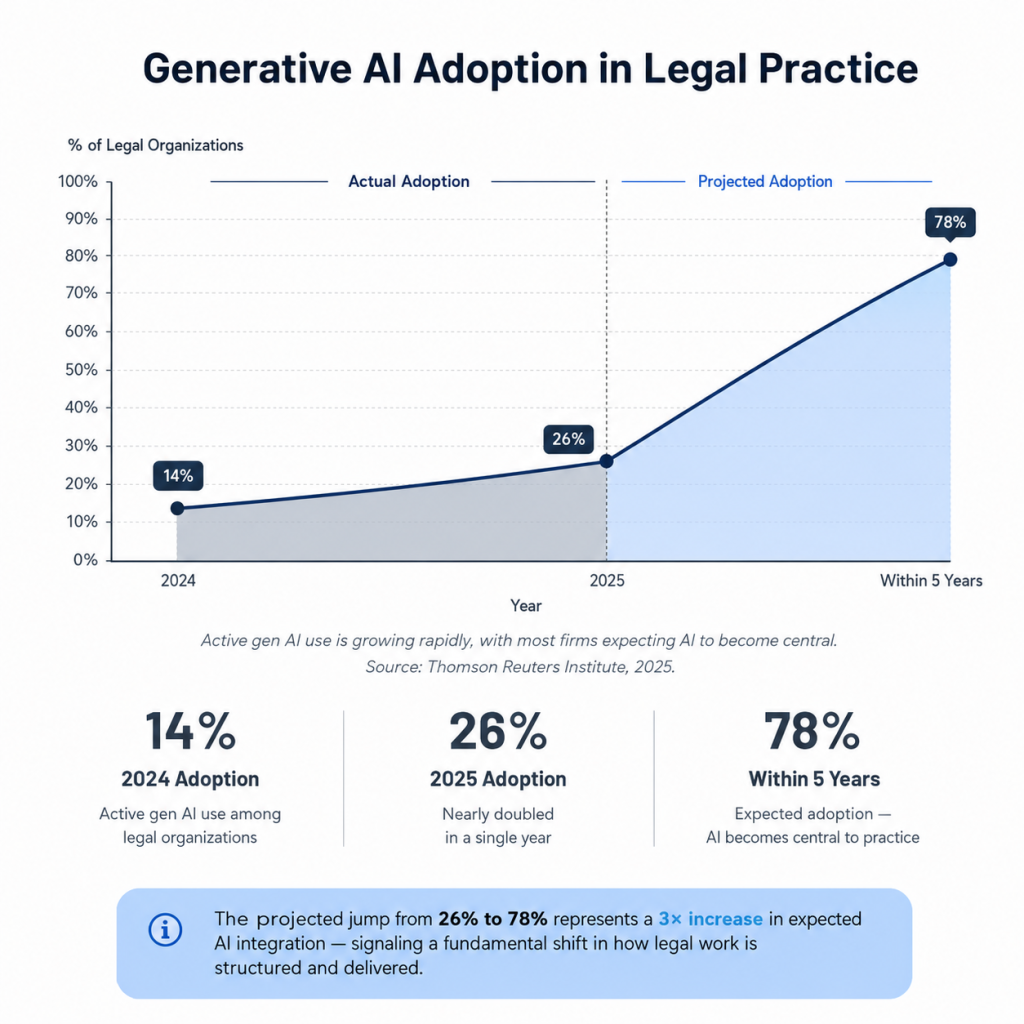
Those inefficiencies are why AI-assisted summarization has moved from novelty to mainstream in less than two years. The Thomson Reuters Institute reported that active gen AI use among legal organizations jumped from 14% in 2024 to 26% in 2025, and 78% of law firms expect AI to become central to their workflow within five years.
How AI Actually Summarizes a Deposition Transcript
A large language model summarizer ingests the full transcript, identifies topical shifts, extracts testimony about each topic, and writes a condensed version that preserves the substance of what was said. Good legal-specific tools also map each summary sentence back to a page and line reference in the source transcript so the attorney can verify it.
The work breaks into three stages:
- Ingestion. The transcript is uploaded in PDF, DOCX, or TXT format. Better tools recognize speaker labels and exhibit references automatically.
- Processing. The AI chunks the transcript, indexes it for retrieval, and produces the summary type requested. Common formats include page-line summaries, topic-based summaries, chronological timelines, and admission-focused digests.
- Output. The attorney receives a structured summary, usually with citations back to the transcript. Some tools add hyperlinks from the summary to the exact transcript page.
Output quality depends heavily on the tool. A general purpose chatbot can hallucinate fake testimony, misattribute statements, or lose the question-and-answer structure. Purpose-built legal tools that use retrieval-augmented generation against the uploaded transcript are more reliable, though not flawless.
The Main Benefits of Using AI for Deposition Summaries
The headline benefit is speed, but that understates what AI actually changes about litigation workflow. We typically see law firms realize five distinct benefits:
- Time compression. A 200-page transcript that would take 8 hours by hand can be summarized in under 15 minutes. That turnaround changes how attorneys use summaries, moving them from post-deposition archival documents to real-time case planning tools.
- Format consistency. When the same prompt and template run across every deposition, summaries are structurally identical. Team members comparing testimony across 12 witnesses see the same section headers, the same citation style, and the same level of detail.
- Searchability at scale. Once transcripts and summaries are indexed, attorneys can ask natural-language questions across the full case record. Our legal AI chatbot is designed for this kind of cross-document querying, where the goal is finding what a specific witness said about a specific topic without scrolling through a binder.
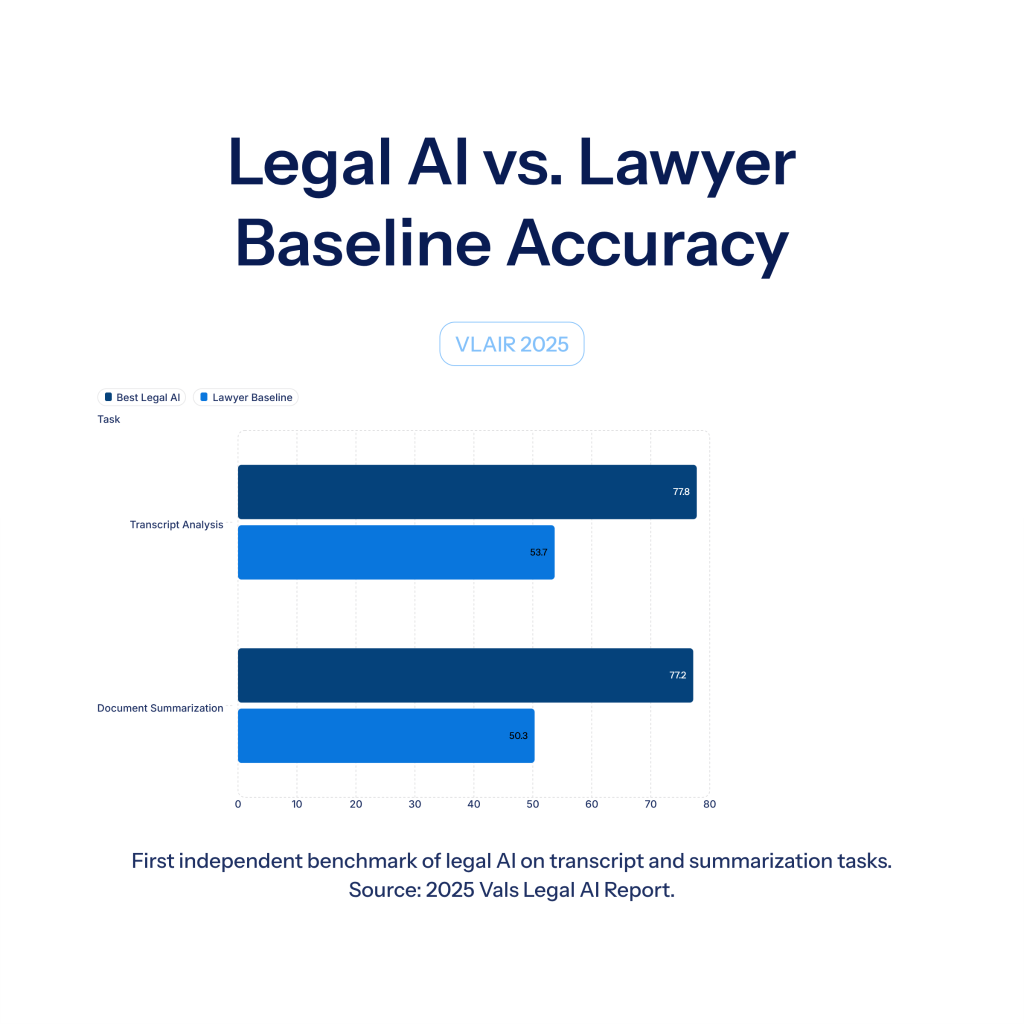
- Admission and contradiction spotting. AI flags statements that support or undercut case theories, including inconsistencies between multiple witnesses. The 2025 Vals Legal AI Report, the first independent benchmark to test legal AI on these tasks directly, found the best-performing legal AI tools scored 77.8% on transcript analysis and 77.2% on document summarization, beating lawyer baselines of 53.7% and 50.3% respectively.
- Cost predictability. Summary cost becomes a function of page count rather than paralegal availability, which makes litigation budgeting simpler. Firms that previously outsourced summaries to external services can often handle the work in-house.
Each of these compounds. A faster summary that’s consistently formatted and instantly searchable is more valuable than a slow handwritten summary, even when the underlying content is comparable.
Where AI Deposition Summaries Fall Short
AI summarization has real limitations. Attorneys who treat AI output as a finished product rather than a draft are the ones who get sanctioned.
Hallucinations and accuracy gaps. Large language models can fabricate plausible-sounding but false information. Even with VLAIR’s strong showing, the best legal AI tools left roughly a 22 to 23 percentage point gap from perfect accuracy on transcript and summarization tasks. That gap is meaningful. Every AI summary needs human verification before it informs strategy. Stanford RegLab’s 2024 study of legal AI research tools found hallucination rates between 17% and 34% on case law queries, which is a different task but reinforces the need for attorney review of any AI-assisted output.
Context loss. AI summaries often flatten tone, sarcasm, hedged answers, and strategic pauses. A witness who says “I suppose that’s possible” in response to a leading question is not giving the same testimony as one who says “yes.” A summary that reads both as “yes” is factually wrong in a way that matters at trial.
Confidentiality exposure. Pasting transcripts into a consumer chatbot can violate client confidentiality under ABA Model Rule 1.6. Public tools often retain inputs for training, which means attorney-client privileged material could surface in another user’s conversation.
HIPAA concerns for personal injury cases. When a deposition discusses protected health information, the tool processing the transcript needs to meet HIPAA standards. Tools without a Business Associate Agreement can’t handle PHI at all. DocuLex is fully HIPAA compliant for this reason, since personal injury depositions routinely reference medical records.
Deterioration on complex or niche legal questions. Stanford researchers found that models hallucinate more often on district court metadata, jurisdiction-specific questions, and less common areas of law. A summary that correctly captures the facts may still get the legal significance wrong.
Best Practices for Using AI to Summarize Depositions
These are the practices we recommend to every firm we work with. They hold up whether you’re using DocuLex, another legal AI platform, or experimenting with a general tool.
Use a Legal-Specific AI Tool, Not a General Chatbot
The gap between a purpose-built legal AI and a consumer chatbot is enormous for this use case. Legal tools process transcripts through secure infrastructure, offer retrieval against the uploaded document rather than open-web search, and include features like page-line citation tracking. Consumer tools do none of this reliably.
If a tool can’t tell you exactly where each summary statement came from in the transcript, it isn’t a serious option for deposition work.
Write Clear, Structured Prompts
Vague prompts produce vague summaries. The more context you give the AI about what you want, the more useful the output. Effective prompts specify:
- Role. “You are a litigation paralegal summarizing deposition testimony for trial preparation.”
- Format. Page-line summary, topic-based digest, chronological timeline, admissions-focused summary, or some combination.
- Focus areas. Liability, damages, causation, specific factual issues the attorney cares about.
- Citation requirement. Every statement should include a page and line reference.
- Length target. A 20-page summary is different from a 3-page executive digest.
Save your effective prompts as templates. Run them across every deposition in the case so outputs stay consistent.
Require Page and Line Citations for Every Summary Point
This is the single most important best practice. Every sentence in the summary should be traceable to a specific range in the transcript. Without citations, verification takes as long as writing the summary from scratch, which eliminates the efficiency gain. With citations, the attorney can spot-check any questionable line in seconds.
Tools that link citations directly to the transcript passage are ideal. Hyperlinked summaries let the reviewer click from claim to source and back in one motion.
Verify the Summary Against the Full Transcript
AI output is a first draft, not a filing. Every summary should pass through a human reviewer, usually a paralegal or associate attorney, who spot-checks citations against the source transcript. The review should focus on:
- Key admissions and contradictions identified by the AI
- Testimony about core legal elements (liability, damages, causation, scienter)
- Any summary statement that sounds surprising or unexpected given what the reviewer knows about the witness
- Quotations, names, dates, and numbers
For routine factual testimony, a lighter review is often sufficient. For testimony that will drive motion practice or trial strategy, the review should be rigorous.
Standardize Your Summary Templates Across Cases
Consistency multiplies AI’s value. If every summary across your cases follows the same structure, with the same section headers and citation format, attorneys and staff move fluidly between matters. Training a new team member takes hours instead of weeks because they only need to learn one summary format.
We recommend building two or three master templates (page-line, topic-based, and admissions-focused) and using them firm-wide.
Keep a Licensed Attorney in the Review Loop
AI drafts, lawyers approve. An attorney should review any summary that will inform deposition strategy, motion practice, settlement valuation, or trial preparation. This is both a professional responsibility under Model Rule 5.3 and a practical safeguard against the hallucination rates documented by Stanford.
Associate attorneys are often the right reviewers because they have the legal knowledge to spot substantive errors and the bandwidth to work through summaries quickly.
Protect Client Confidentiality and HIPAA-Protected Data
Only use tools with clear data handling policies. The questions to ask any vendor:
- Does the platform retain inputs for training? (The answer should be no.)
- Is there a Business Associate Agreement for HIPAA-covered matters?
- Is data encrypted in transit and at rest?
- Where is data physically stored, and who has access?
- Is there an audit log showing who accessed what?
Platforms that can’t answer these questions clearly aren’t suitable for protected information.
Train Your Team on the Tool
AI adoption fails when users don’t understand the tool’s capabilities and limits. A one-hour training session covering prompt writing, citation verification, and common failure modes pays for itself immediately. Annual refreshers keep the team aligned as the tool evolves.
AI vs. Manual Deposition Summaries: Side-by-Side Comparison
| Factor | AI-Generated Summary | Manually Drafted Summary |
| Time for a 200-page deposition | 5 to 15 minutes | 8 to 10 hours |
| Consistency across cases | High when using templates | Varies by writer |
| Cost per summary | Low and predictable | High and labor-dependent |
| Accuracy on obvious facts | Strong with verification | Strong |
| Accuracy on tone and nuance | Weak without human review | Strong |
| Page and line citations | Automatic in legal-specific tools | Manually added |
| Scalability across many transcripts | Excellent | Limited by staffing |
| Benchmark accuracy (VLAIR 2025) | 77.8% transcript / 77.2% summarization (best AI) | 53.7% / 50.3% (lawyer baseline) |
| Best use | First draft and indexing | Final review and strategic interpretation |
The right answer for most firms is a hybrid workflow. AI produces the draft and handles the indexing. A paralegal or associate verifies and refines it. The attorney uses the reviewed summary for strategic decisions.
A Step-by-Step Workflow for AI Deposition Summaries
Here is the workflow we recommend to litigation teams starting with AI-assisted summarization:
- Prepare the transcript. Confirm the transcript is clean, correctly OCR’d if scanned, and free of formatting artifacts that can confuse the AI.
- Upload to a secure, legal-specific platform. Avoid consumer chatbots. Ensure the platform has appropriate security and, for personal injury matters, HIPAA compliance.
- Run the summary with a structured prompt. Use your firm’s standard template for the summary type you need (page-line, topic-based, admissions-focused, or chronological).
- Require citations in the output. Every summary point should map to a specific page and line range in the transcript.
- Have a paralegal or associate verify the summary. Spot-check citations, confirm key admissions and contradictions, and flag anything that reads as surprising.
- Route the final summary to the handling attorney. The attorney applies legal judgment, connects the testimony to case theories, and decides how the summary informs strategy.
- Store the summary centrally. A central litigation document management system keeps summaries searchable alongside transcripts, exhibits, and related case materials, so the work product compounds across the case lifecycle.
- Iterate on prompts across matters. When a prompt produces a better summary, add it to the firm template library. When a prompt underperforms, revise it.
Ethical Obligations Under ABA Formal Opinion 512
The American Bar Association issued Formal Opinion 512 on July 29, 2024, addressing lawyers’ ethical duties when using generative AI. The opinion covers six Model Rules:
- Rule 1.1 (Competence). Lawyers must have a reasonable understanding of the capabilities and limits of any AI tool they use, including reliability, accuracy, completeness, and bias.
- Rule 1.6 (Confidentiality). Lawyers must evaluate whether inputs could be disclosed or accessed by third parties. Self-learning tools raise particular concerns because client information entered into them may surface in outputs to other users.
- Rule 1.4 (Communication). In some cases, lawyers must disclose AI use to clients, particularly when the AI’s output will significantly influence the representation.
- Rule 1.5 (Fees). Lawyers generally cannot bill clients for time spent learning a tool used across the firm’s practice. They can bill for time spent inputting information and reviewing AI output.
- Rules 5.1 and 5.3 (Supervision). Managing attorneys must establish clear policies for AI use and ensure subordinate lawyers and nonlawyer staff comply with them.
- Rule 3.3 (Candor). Lawyers remain responsible for every statement submitted to a tribunal, including any statement drafted with AI assistance. The AI does not shield the lawyer from sanctions for fabricated citations or false factual claims.
The practical takeaway is that attorneys remain fully responsible for AI-assisted work. AI shifts the task from drafting to supervising, and supervising AI output well requires understanding how the tool works and where it fails.
Frequently Asked Questions About AI Deposition Summaries
Can AI replace a paralegal for deposition summaries?
No. AI handles the mechanical drafting, but a paralegal or associate still needs to verify citations, catch subtle errors, and confirm the summary accurately reflects the testimony. The role shifts from drafting to reviewing, and good reviewers can process AI summaries faster than they could write them from scratch.
How accurate are AI-generated deposition summaries?
Accuracy depends on the tool. The 2025 Vals Legal AI Report, the first independent benchmark on these tasks, found the best legal AI tools scored 77.8% on transcript analysis and 77.2% on document summarization, both well above lawyer baselines of 53.7% and 50.3%. Legal-specific platforms outperform general chatbots by a wide margin. The remaining gap to perfect accuracy means every AI summary still needs human verification before it informs strategic decisions.
Is it ethical to use AI for deposition summaries?
Yes, when used properly. ABA Formal Opinion 512 confirms that lawyers may ethically use generative AI, provided they meet their duties of competence, confidentiality, supervision, and candor. The key is using secure, legal-specific tools and verifying output before relying on it.
How long does AI take to summarize a deposition?
Most legal-specific AI tools summarize a 100- to 200-page deposition in 5 to 15 minutes. Longer or more complex transcripts can take longer. By comparison, a paralegal working manually typically needs 8 to 10 hours for a 200-page transcript.
Can AI summarize video depositions?
Some AI tools accept video or audio recordings directly, transcribing and then summarizing in one workflow. Others require a transcript as input. Accuracy on video often depends on audio quality and speaker diarization.
Closing Thoughts on AI and Deposition Summaries
AI has moved deposition summaries from a week-long bottleneck to a task that fits inside a morning. The firms getting the most value from it are the ones pairing the speed with disciplined review, secure infrastructure, and standardized workflows. The firms running into trouble are the ones treating AI output as finished work.
If you want to see how AI-assisted deposition summaries work inside a purpose-built litigation platform designed for civil litigation and personal injury firms, request a DocuLex demo.